
题目
7.
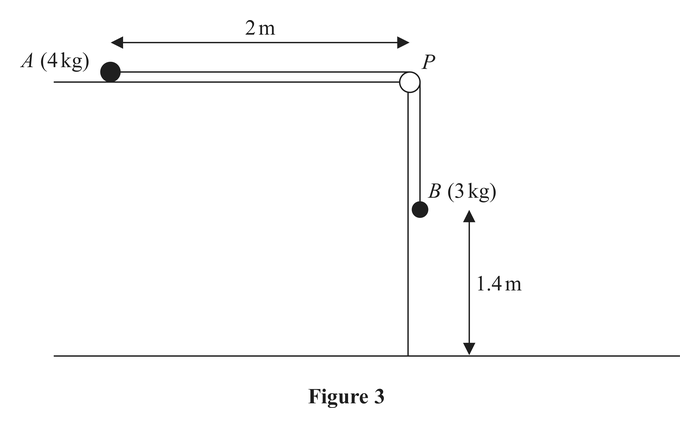
A particle of mass is held at rest on a rough horizontal table. Particle is attached to one end of a string that passes over a pulley . The pulley is fixed at the edge of the table. The other end of the string is attached to a particle , of mass , which hangs freely below .
The part of the string from to is perpendicular to the edge of the table and , and all lie in the same vertical plane.
The string is modelled as being light and inextensible and the pulley is modelled as being small, smooth and light.
The system is released from rest with the string taut. At the instant of release, is from the edge of the table and is above a horizontal floor, as shown in Figure 3.
After descending with constant acceleration for seconds, hits the floor and does not rebound.
(a) Show that the acceleration of before hits the floor is .
(b) State which of the modelling assumptions you have used in order to answer part (a).
(c) Find the magnitude of the resultant force exerted on the pulley by the string.
The coefficient of friction between and the table is .
(d) Find the value of .
(e) Determine, by calculation, whether or not reaches the pulley.
题目中文翻译
一个质量为 的质点 被保持静止在粗糙水平桌面上。质点 连接在一根绕过滑轮 的绳的一端,滑轮固定在桌子边缘。绳的另一端连接一个质量为 的质点 , 自由悬挂在 下方。
从 到 的绳段垂直于桌子边缘,且 、、 均位于同一竖直平面内。
将绳视为轻且不可伸长的绳,将滑轮视为光滑轻质小滑轮。
系统从静止释放,绳保持绷紧。释放瞬间, 距桌子边缘 , 距水平地板 ,如图 3 所示。
做匀加速下降运动 秒后撞击地板,且不反弹。
(a) 证明: 撞击地板之前, 的加速度大小为 。
(b) 指出在回答 (a) 时使用了哪一项建模假设。
(c) 求绳对滑轮施加的合力的大小。
与桌面之间的摩擦系数为 。
(d) 求 的值。
(e) 通过计算判断 是否会到达滑轮。
解答
(a)
解法一
思路
展开
先由 的下落位移与时间求加速度。绳绷紧且不可伸长,使 的加速度大小与 相同。
答题过程
展开
For , starting from rest and moving downwards in ,
The taut inextensible string gives the same acceleration magnitude, so towards the pulley.
(b)
解法一
思路
展开
这里要指出用来把 的运动联系到 的假设,不要混入张力相等所需的其他假设。
答题过程
展开
The string is inextensible.
(c)
解法一
思路
展开
先用 的运动方程求张力。绳在滑轮处的两段互相垂直,因此绳对滑轮的两个张力应按勾股定理合成。
答题过程
展开
Before hits the floor, taking downwards as positive for ,
Thus
The two forces exerted on the pulley by the string are perpendicular and each has magnitude . Hence
(d)
解法一
思路
展开
对桌面上的 ,竖直方向无加速度,所以支持力等于重力。水平方向是张力减摩擦力等于质量乘加速度。
答题过程
展开
For , the normal reaction is . Since it is sliding, the friction is
Taking motion towards the pulley as positive,
Using from (c),
(e)
解法一
思路
展开
落地后绳变松, 不再受原来的张力,只受摩擦力而减速。先求落地瞬间的速率,再求后续停止距离,和剩余的 米比较。
答题过程
展开
When hits the floor, has speed
and has moved towards the pulley. Its remaining distance to the pulley is .
After impact the string becomes slack. The only horizontal force on is friction, so its new acceleration towards the pulley is
Let the further stopping distance be . Then
The total distance travelled is
Therefore .
解法二
思路
展开
也可以反证:假设 能走完剩余距离,用新的减速度求到滑轮处的速度平方。若得到负值,说明它早已停下。
答题过程
展开
At the instant hits the floor, has speed and is from the pulley. As in method 1, after this instant its acceleration is .
If could reach the pulley without first stopping, its speed there would satisfy
Since the square of a real speed cannot be negative, stops before travelling the remaining . Thus .