题目
2.
A small ball is thrown vertically upwards with speed from a point that is above horizontal ground. The ball is modelled as a particle moving freely under gravity.
Find
(a) the total time from when the ball is thrown to when it first hits the ground,
(b) the speed of the ball immediately before it first hits the ground,
(c) the total distance travelled by the ball from when it is thrown to when it first hits the ground.
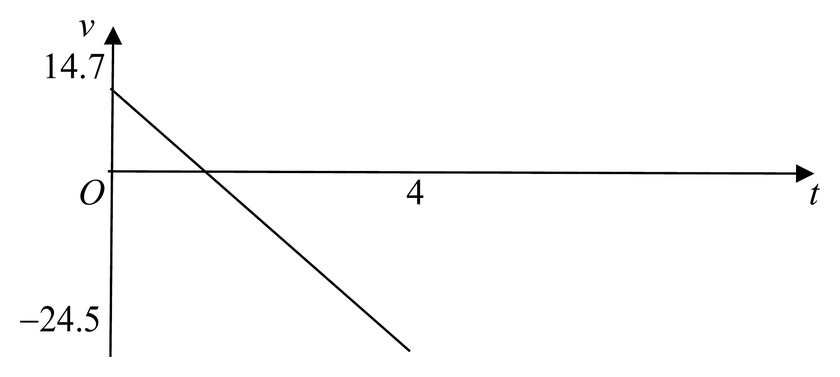
(d) Sketch a velocity-time graph for the motion of the ball from when it is thrown to when it first hits the ground.
State the coordinates of the start point and the coordinates of the end point of your graph.
题目中文翻译
一个小球从水平地面上方 处,以速率 竖直向上抛出。将小球视为仅在重力作用下运动的质点。
求
(a) 从小球被抛出到首次撞击地面的总时间,
(b) 小球首次撞击地面前一瞬间的速率,
(c) 从小球被抛出到首次撞击地面的总路程。
(d) 画出小球从被抛出到首次撞击地面的运动过程的速度—时间图像草图。
写出图像起点和终点的坐标。
解答
(a)
解法一
思路
展开
向上为正,落地时相对抛出点的位移为 米。用位移公式建立二次方程,并舍去负时间。
答题过程
展开
Take upwards as positive. With , and ,
Dividing by and rearranging,
The roots are and . Only the positive time applies after projection, so the total time is .
解法二
思路
展开
也可以把运动分成上升到最高点及从最高点下落两段。下落距离必须包含原来离地面的高度。
答题过程
展开
The time to the highest point is found from :
The height gained is
The highest point is above the ground. Falling from rest through this height,
Thus the total time is .
(b)
解法一
思路
展开
速度有方向,速率只有大小。代入 (a) 的总时间得到落地速度,再取绝对值。
答题过程
展开
Using the upward positive direction and the time from (a),
Hence the speed immediately before impact is .
解法二
思路
展开
不使用飞行时间也能求速率:用末速度平方、初速度平方与位移的关系。
答题过程
展开
Using ,
Therefore the speed is , with the velocity directed downwards.
(c)
解法一
思路
展开
路程不等于位移大小。小球先上升一段,再下落相同的一段并继续落到地面,所以增加的高度要计两次。
答题过程
展开
At the highest point the velocity is zero. If the upward distance is ,
The downward distance is . Hence the total distance is
Thus the required distance is (3 s.f.).
(d)
解法一
思路
展开
重力加速度恒定,所以速度图像是一条斜率为负的直线。它会越过时间轴进入负速度,不能把下降阶段画成正速率。
答题过程
展开
Take upwards as positive. Label the horizontal axis (seconds) and the vertical axis (). Draw the straight line
Its start point is and its end point is . It crosses the time axis at . Do not add a solid vertical line at .