
题目
8.
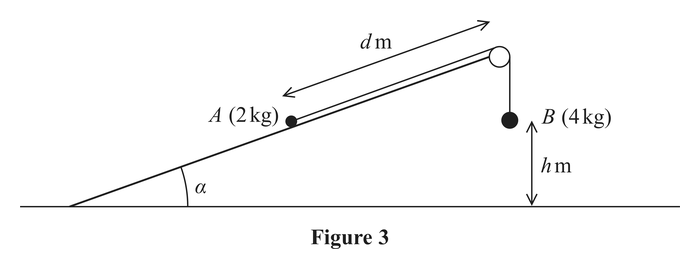
Two particles, and , have masses and respectively. The particles are connected by a light inextensible string. The string passes over a small smooth pulley which is fixed at the top of a rough plane. The plane is inclined to the horizontal ground at an angle where . The particle is held at rest on the plane at a distance metres from the pulley. The particle hangs freely at rest, vertically below the pulley, at a distance metres above the ground, as shown in Figure 3. The part of the string between and the pulley is parallel to a line of greatest slope of the plane. The coefficient of friction between and the plane is .
The system is released from rest with the string taut and descends.
(a) Find the tension in the string as descends.
On hitting the ground, immediately comes to rest.
Given that comes to rest before reaching the pulley,
(b) find, in terms of , the range of possible values of .
(c) State one physical factor, other than air resistance, that could be taken into account to make the model described above more realistic.
题目中文翻译
两个质点 和 的质量分别为 和 ,由一根轻且不可伸长的细绳连接。细绳绕过固定在粗糙斜面顶端的光滑小滑轮。斜面与水平地面成 角,其中 。质点 被保持静止在斜面上,距滑轮 米。如图 3 所示,质点 自由悬挂并静止在滑轮正下方,距地面 米。 与滑轮之间的绳段平行于斜面的一条最大坡度线。 与斜面之间的摩擦系数为 。
系统从静止释放,细绳绷紧, 向下运动。
(a) 求 下落过程中细绳中的张力。
撞击地面后立即静止。
已知 在到达滑轮之前静止,
(b) 用 表示 的可能取值范围。
(c) 指出除空气阻力外,可纳入考虑以使上述模型更符合实际的一个物理因素。
解答
(a)
解法一
思路
展开
先求斜面上 的支持力与摩擦力,再分别沿两粒子的运动方向列牛顿第二定律。轻绳和光滑滑轮使张力相等,不可伸长使加速度大小相等。
答题过程
展开
Since ,
For , resolving perpendicular to the plane,
As moves up the plane, friction acts down the plane with magnitude
Let the common acceleration magnitude be and the tension be . The equations of motion are
Adding and substituting the components,
Hence
(b)
解法一
思路
展开
先承接 (a) 的加速度求 落地时的速率。之后绳变松, 继续上滑但被重力分量和摩擦力共同减速;总上滑距离必须严格小于初始距离 。
答题过程
展开
Before reaches the ground, its acceleration is from (a), so after descending through its speed satisfies
During this time has moved a distance up the plane. After stops, the string becomes slack. Taking up the plane as positive for , its new acceleration satisfies
Thus
If moves a further distance before first coming to rest, then
Hence . The total upward distance is . To stop before reaching the pulley, we require
(c)
解法一
思路
展开
只给一个实际因素,并说明应纳入模型;不要把题目原有理想化假设原样重述。
答题过程
展开
Friction between the string and the pulley could be included.