
题目
5.
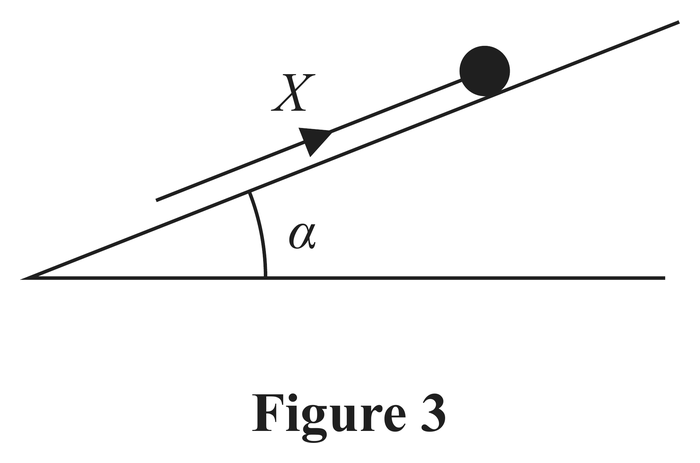
A particle of mass rests in equilibrium on a fixed rough plane under the action of a force of magnitude . The force acts up a line of greatest slope of the plane, as shown in Figure 3.
The plane is inclined at an angle to the horizontal, where .
The coefficient of friction between the particle and the plane is .
- When , the particle is on the point of sliding up the plane.
- When , the particle is on the point of sliding down the plane.
Find the value of .
题目中文翻译
一个质量为 的质点在大小为 的力作用下,静止平衡于固定粗糙斜面上。如图 3 所示,该力沿斜面的一条最大坡度线向上作用。
斜面与水平面成 角,其中 。
质点与斜面之间的摩擦系数为 。
- 当 时,质点恰好要沿斜面向上滑动。
- 当 时,质点恰好要沿斜面向下滑动。
求 的值。
解答
解法一
思路
展开
两个临界状态的支持力相同,极限摩擦力大小也相同,但方向相反。分别沿斜面列平衡方程,先消去 求摩擦力,再除以支持力。
答题过程
展开
From , and .
Resolving perpendicular to the plane,
Let be the magnitude of limiting friction. When , impending motion is up the plane, so friction acts down the plane:
When , impending motion is down the plane, so friction acts up the plane:
Subtracting twice (2) from (1),
Therefore
解法二
思路
展开
也可在两个临界状态中都沿水平方向分解,利用同一支持力和相反的摩擦力方向。两式相加、相减后相除,可同时消去外力大小和支持力。
答题过程
展开
Let be the magnitude of limiting friction. For impending upward motion with , horizontal equilibrium gives
For impending downward motion with , horizontal equilibrium gives
Adding and subtracting the equations,
Dividing the second equation by the first gives
Consequently .