题目
5.
A small ball is projected vertically upwards with speed from a point which is above horizontal ground.
The ball is modelled as a particle moving freely under gravity until it hits the ground. It is assumed that the ball does not rebound.
(a) Find the distance travelled by the ball while its speed is less than .
(b) Find the time for which the ball is moving with a speed of more than .
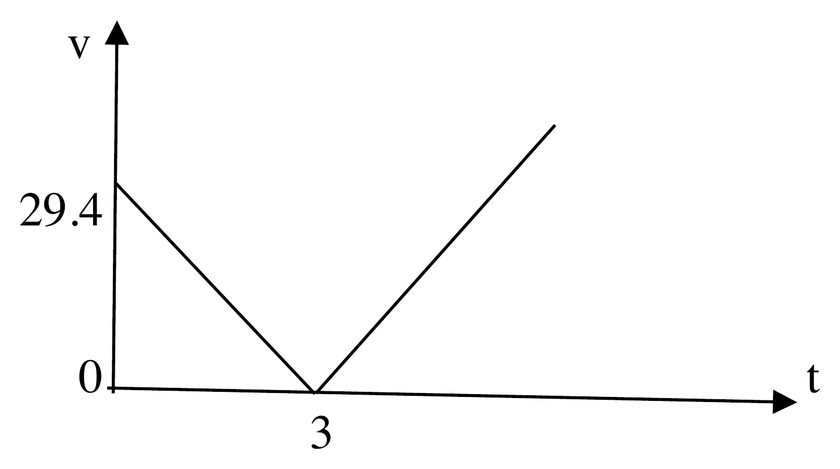
(c) Sketch a speed-time graph for the motion of the ball from the instant when it is projected from to the instant when it hits the ground. Show clearly where your graph meets the axes.
题目中文翻译
一个小球从水平地面上方 的 点,以速率 竖直向上抛出。
在撞击地面之前,将小球视为仅在重力作用下运动的质点。假设小球不反弹。
(a) 求小球速率小于 的过程中所经过的路程。
(b) 求小球速率大于 的持续时间。
(c) 画出小球从在 点被抛出的瞬间到撞击地面的瞬间的速率—时间图像草图,清楚标出图像与坐标轴的交点。
解答
(a)
解法一
思路
展开
速率小于给定值的过程横跨最高点,包括上升和下降两段。先算从上升速率 到最高点的距离,再利用运动对称性把这段路程加倍。
答题过程
展开
Let be the distance travelled from the point where the upward speed is to the highest point. Using ,
After the highest point, the ball falls the same distance before its downward speed reaches .
Thus the total distance travelled while its speed is below is
(b)
解法一
思路
展开
小球返回 时向下速率恰好为初速 。只有从此之后到落地的这一段速率更大,所以以返回 为新的计时起点。
答题过程
展开
When the ball returns to the level of , its downward speed is . Its speed exceeds this value during the subsequent fall of 19.6 m to the ground.
Let this interval last seconds. Taking downwards as positive,
Rejecting the negative root, the required duration is
解法二
思路
展开
也可先求落地速率,再求速度从向下 增大到落地速率所需的时间。全程使用向下为正,避免把初始上抛方向混入最后一段。
答题过程
展开
On returning to , the ball has downward speed . Let its downward speed at the ground be . Then
During the interval when the speed exceeds , the acceleration is downwards. Hence
(c)
解法一
思路
展开
速率图是 V 形,最低点对应最高位置。先求到最高点的时间,标出初始速率与时间轴交点,下降段末端速率高于初速。
答题过程
展开
The time to reach the highest point is
Draw a speed-time graph starting at and decreasing linearly to . It then increases linearly until the ball hits the ground, ending at a speed greater than 29.4.
The two segments have gradients and , so they make equal acute angles with the time axis. Label both axis intercepts clearly. Do not include a vertical drop at the final instant.