
题目
5.
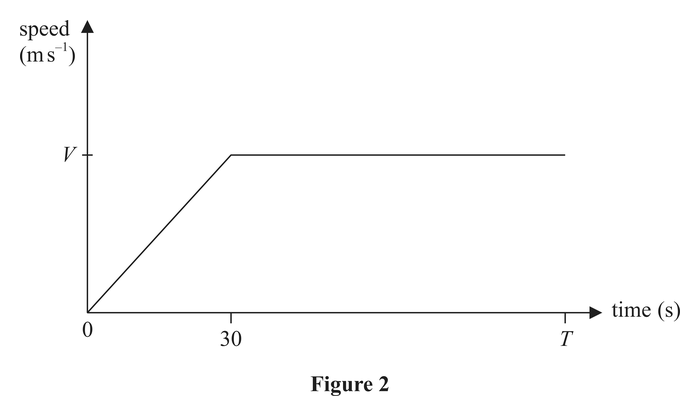
The speed-time graph in Figure 2 illustrates the motion of a car travelling along a straight horizontal road.
At time , the car starts from rest and accelerates uniformly for until it reaches a speed of .
The car then travels at a constant speed of until time seconds.
(a) Show that the distance travelled by the car between and seconds is metres.
A motorbike also travels along the same road.
- The motorbike starts from rest at time and accelerates uniformly for .
- The acceleration of the motorbike is the same as the acceleration of the car.
- The motorbike then travels at a constant speed for a further before decelerating uniformly until it reaches a speed of at time seconds.
(b) On Figure 2, sketch a speed-time graph for the motion of the motorbike.
[If you need to redraw your sketch, there is a copy of Figure 2 on page 15.]
(c) Show that the constant speed of the motorbike is .
At time seconds, the distance travelled by each vehicle is the same.
(d) Find the value of .
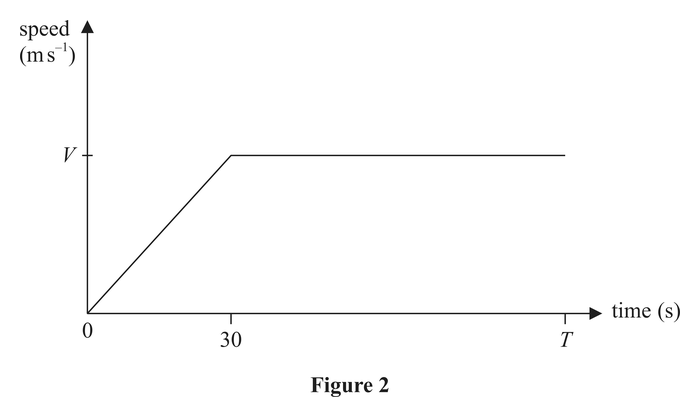
Only use this copy of Figure 2 if you need to redraw your sketch.
题目中文翻译
图 2 中的速率—时间图像表示一辆汽车沿水平直路行驶的运动过程。
在 时,汽车从静止出发,匀加速运动 ,直至速率达到 。
随后汽车以恒定速率 行驶至 秒。
(a) 证明汽车在 至 秒之间行驶的路程为 米。
一辆摩托车也沿同一条公路行驶。
- 摩托车在** 时**从静止出发,并匀加速运动 。
- 摩托车的加速度与汽车的加速度相同。
- 随后摩托车以恒定速率再行驶 ,然后匀减速运动,直至在 秒时速率达到 。
(b) 在图 2 上画出摩托车运动的速率—时间图像草图。
[如果需要重画草图,第 15 页提供了图 2 的副本。]
(c) 证明摩托车匀速运动时的速率为 。
在 秒时,两辆车各自行驶的路程相同。
(d) 求 的值。
仅在需要重画草图时使用此图 2 副本。
解答
(a)
解法一
思路
展开
总路程等于速率图下的面积,分成最初三角形与后面的长方形。
答题过程
展开
The distance is the area under the car’s speed-time graph:
as required.
(b)
解法一
思路
展开
必须在原汽车图的同一坐标轴上加画摩托车图。两车加速度相同,所以两条上升线平行;摩托车从 开始,到 结束加速, 开始减速。
答题过程
展开
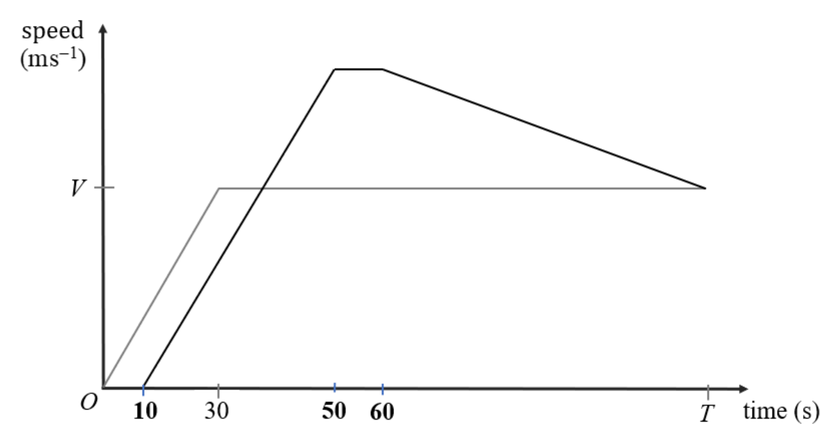
On the given car graph, add the motorbike graph as follows:
- It starts at and rises along a straight line parallel to the car’s rising line.
- Its acceleration ends at . Draw a horizontal segment from to , above speed .
- From , draw a straight falling line ending at , where it meets the car’s horizontal graph.
Label times 10, 50 and 60 clearly. Keep both vehicles on the same axes; do not draw a vertical drop at .
(c)
解法一
思路
展开
汽车加速度是 ,摩托车以同样加速度从静止加速 秒,因此直接用速度变化等于加速度乘时间。
答题过程
展开
The car’s acceleration is . The motorbike has the same acceleration for 40 s, starting from rest.
Its constant speed is therefore
as required.
(d)
解法一
思路
展开
先把摩托车的总面积写完整:加速三角形、匀速长方形、减速梯形。令两车总路程相等,再约去正数 求 。
答题过程
展开
The motorbike’s distance is
The distances are equal at , so
Here was cancelled. The result satisfies , consistent with the motorbike’s deceleration interval.
解法二
思路
展开
也可比较两条速率图之间的面积。摩托车在前 秒落后的路程,等于它之后多行驶的路程,这样不用计算两车全部面积。
答题过程
展开
The motorbike reaches speed at
Up to , the car travels metres, while the motorbike travels metres. The motorbike’s distance deficit is therefore metres.
From onwards, the area between the motorbike’s graph and the car’s horizontal graph is a trapezium. Its height is , and its parallel time lengths are and . Thus the extra distance is
Equality of the total distances requires
Hence .