
题目
7.
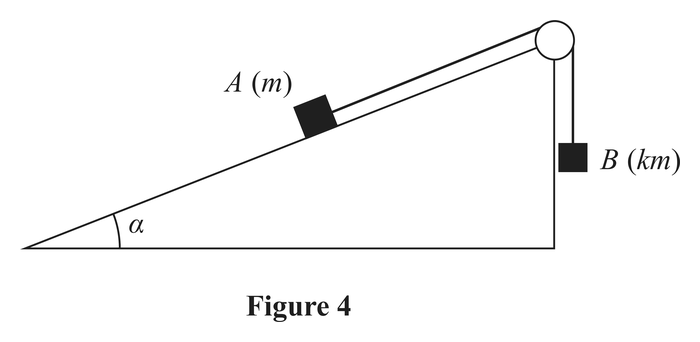
Figure 4 shows a block of mass held at rest on a rough plane. The plane is inclined at an angle to the horizontal and the coefficient of friction between the block and the plane is .
One end of a light inextensible string is now attached to . The string passes over a small smooth pulley which is fixed at the top of the plane. The other end of the string is attached to a block of mass . Block hangs vertically below the pulley, with the string taut.
The string from to the pulley lies along a line of greatest slope of the plane.
Both and are modelled as particles.
When the system is released from rest, moves up the plane and the tension in the string is
Given that and ,
(a) (i) find the magnitude of the acceleration of , giving your answer in terms of ,
(ii) find the value of .
(b) Find the magnitude of the resultant force exerted on the pulley by the string, giving your answer in terms of and .
题目中文翻译
图 4 所示的质量为 的物块 被保持静止在粗糙斜面上。 斜面与水平面成 角,物块与斜面之间的摩擦系数为 。
现将一根不可伸长的轻绳的一端连接于 。绳跨过一个固定在斜面顶端的小光滑滑轮。 绳的另一端连接于质量为 的物块 。 物块 竖直悬挂在滑轮下方,绳绷紧。
从 到滑轮的一段绳沿斜面的最大坡度线放置。
将 和 均视为质点。
系统由静止释放后, 沿斜面向上运动,绳中的张力为 。
已知 ,,
(a) (i) 求 的加速度大小,用 表示,
(ii) 求 的值。
(b) 求绳对滑轮施加的合力大小,用 和 表示。
解答
(a)(i)
解法一
思路
展开
向上运动,摩擦沿斜面向下。先用垂直斜面的平衡求支持力,再沿斜面列运动方程。
答题过程
展开
From ,
For , resolving perpendicular to the plane,
The friction acts down the plane and has magnitude
Taking up the plane as positive,
(a)(ii)
解法一
思路
展开
绳绷紧且不可伸长,两物块的加速度大小相同。对向下运动的 列方程,注意质量为 。
答题过程
展开
The taut inextensible string gives the same acceleration magnitude, , downwards. For , taking downwards as positive,
(b)
解法一
思路
展开
滑轮受到两段绳各自大小为 的拉力;两力向下的竖直分量相加,水平分量只来自斜绳。用勾股定理求合力。
答题过程
展开
The light string and smooth pulley give equal tensions
on both sides. Both forces pull away from the pulley along the strings. The resultant has horizontal magnitude and downward vertical magnitude . Hence its magnitude is
解法二
思路
展开
两个等大力的合力沿夹角平分线。两绳对滑轮拉力的夹角为 ,由半角公式求合力大小。
答题过程
展开
The angle between the two equal tension forces is . Resolving along their angle bisector gives
Using the half-angle identity,
The half-angle is acute, so its cosine is . Therefore