题目
Problem
4.
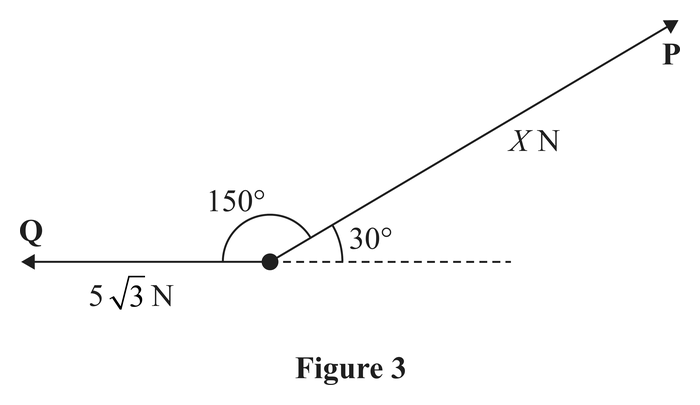
Figure 3 shows two horizontal forces P \mathbf{P} P Q \mathbf{Q} Q
The angle between the direction of P \mathbf{P} P Q \mathbf{Q} Q 150 ∘ 150^\circ 15 0 ∘
Force P \mathbf{P} P X X X
Force Q \mathbf{Q} Q 5 3 N 5\sqrt{3}\text{ N} 5 3 N
The resultant of P \mathbf{P} P Q \mathbf{Q} Q 129 N \sqrt{129}\text{ N} 129 N
Find
(i) the value of X X X
(ii) the angle between Q \mathbf{Q} Q
(8)
题目中文翻译
图 3 显示了作用在一个粒子上的两个水平力 P \mathbf{P} P Q \mathbf{Q} Q
P \mathbf{P} P Q \mathbf{Q} Q 150 ∘ 150^\circ 15 0 ∘
力 P \mathbf{P} P X X X
力 Q \mathbf{Q} Q 5 3 N 5\sqrt{3}\text{ N} 5 3 N
P \mathbf{P} P Q \mathbf{Q} Q 129 N \sqrt{129}\text{ N} 129 N
求:
(i) X X X
(ii) Q \mathbf{Q} Q
(8)
解答
(i)
解法一
思路
展开
选向右为水平正方向,向上为另一正方向。把两力分解后,用合力模的平方建立关于 X X X
答题过程
展开
Take i \mathbf i i j \mathbf j j
P = X cos 30 ∘ i + X sin 30 ∘ j , Q = − 5 3 i . \mathbf P=X\cos30^\circ\mathbf i+X\sin30^\circ\mathbf j,\qquad
\mathbf Q=-5\sqrt3\mathbf i. P = X cos 3 0 ∘ i + X sin 3 0 ∘ j , Q = − 5 3 i . The resultant is
R = ( 3 X 2 − 5 3 ) i + X 2 j . \mathbf R=\left(\frac{\sqrt3X}{2}-5\sqrt3\right)\mathbf i+\frac X2\mathbf j. R = ( 2 3 X − 5 3 ) i + 2 X j . Since ∣ R ∣ = 129 |\mathbf R|=\sqrt{129} ∣ R ∣ = 129
129 = ( 3 X 2 − 5 3 ) 2 + ( X 2 ) 2 , = X 2 − 15 X + 75 , X 2 − 15 X − 54 = 0 , ( X − 18 ) ( X + 3 ) = 0. \begin{align*}
129=&\,\left(\frac{\sqrt3X}{2}-5\sqrt3\right)^2+\left(\frac X2\right)^2,\\
=&\,X^2-15X+75,\\
X^2-15X-54=&\,0,\\
(X-18)(X+3)=&\,0.
\end{align*} 129 = = X 2 − 15 X − 54 = ( X − 18 ) ( X + 3 ) = ( 2 3 X − 5 3 ) 2 + ( 2 X ) 2 , X 2 − 15 X + 75 , 0 , 0. As X X X − 3 -3 − 3 X = 18 \boxed{X=18} X = 18
解法二
思路
展开
把两个力首尾相接构成力三角形,三角形内角是 30 ∘ 30^\circ 3 0 ∘ 150 ∘ 150^\circ 15 0 ∘
答题过程
展开
In the head-to-tail force triangle, the sides of lengths X X X 5 3 5\sqrt3 5 3 180 ∘ − 150 ∘ = 30 ∘ 180^\circ-150^\circ=30^\circ 18 0 ∘ − 15 0 ∘ = 3 0 ∘ 129 \sqrt{129} 129
129 = X 2 + ( 5 3 ) 2 − 2 X ( 5 3 ) cos 30 ∘ , = X 2 + 75 − 15 X . \begin{align*}
129=&\,X^2+(5\sqrt3)^2-2X(5\sqrt3)\cos30^\circ,\\
=&\,X^2+75-15X.
\end{align*} 129 = = X 2 + ( 5 3 ) 2 − 2 X ( 5 3 ) cos 3 0 ∘ , X 2 + 75 − 15 X . Therefore
( X − 18 ) ( X + 3 ) = 0. (X-18)(X+3)=0. ( X − 18 ) ( X + 3 ) = 0. Rejecting the negative magnitude gives X = 18 \boxed{X=18} X = 18
解法三
思路
展开
已知一边及其对角,可先用正弦定理求另一个角。较大的补角会使三角形内角和超过 180 ∘ 180^\circ 18 0 ∘
答题过程
展开
In the force triangle, let α \alpha α 5 3 5\sqrt3 5 3 129 \sqrt{129} 129 30 ∘ 30^\circ 3 0 ∘
sin α 5 3 = sin 30 ∘ 129 . \frac{\sin\alpha}{5\sqrt3}=\frac{\sin30^\circ}{\sqrt{129}}. 5 3 sin α = 129 sin 3 0 ∘ . Hence
α = sin − 1 ( 5 3 sin 30 ∘ 129 ) = 22.4109 … ∘ . \alpha=\sin^{-1}\left(\frac{5\sqrt3\sin30^\circ}{\sqrt{129}}\right)
=22.4109\ldots^\circ. α = sin − 1 ( 129 5 3 sin 3 0 ∘ ) = 22.4109 … ∘ . The supplementary value 157.589 … ∘ 157.589\ldots^\circ 157.589 … ∘ 30 ∘ 30^\circ 3 0 ∘ 180 ∘ 180^\circ 18 0 ∘
β = 180 ∘ − 30 ∘ − α = 127.5890 … ∘ . \beta=180^\circ-30^\circ-\alpha=127.5890\ldots^\circ. β = 18 0 ∘ − 3 0 ∘ − α = 127.5890 … ∘ . Applying the sine rule once more,
X = 129 sin β sin 30 ∘ = 18 . X=\frac{\sqrt{129}\sin\beta}{\sin30^\circ}=\boxed{18}. X = sin 3 0 ∘ 129 sin β = 18 .
(ii)
解法一
思路
展开
代入 X = 18 X=18 X = 18 Q \mathbf Q Q
答题过程
展开
With X = 18 X=18 X = 18
R = ( 18 cos 30 ∘ − 5 3 ) i + ( 18 sin 30 ∘ ) j = 4 3 i + 9 j . \mathbf R=(18\cos30^\circ-5\sqrt3)\mathbf i
+(18\sin30^\circ)\mathbf j
=4\sqrt3\mathbf i+9\mathbf j. R = ( 18 cos 3 0 ∘ − 5 3 ) i + ( 18 sin 3 0 ∘ ) j = 4 3 i + 9 j . Let ϕ \phi ϕ R \mathbf R R
tan ϕ = 9 4 3 , ϕ = 52.4109 … ∘ . \tan\phi=\frac9{4\sqrt3},\qquad \phi=52.4109\ldots^\circ. tan ϕ = 4 3 9 , ϕ = 52.4109 … ∘ . As Q \mathbf Q Q
180 ∘ − ϕ = 127.5890 … ∘ = 128 ∘ 180^\circ-\phi=127.5890\ldots^\circ=\boxed{128^\circ} 18 0 ∘ − ϕ = 127.5890 … ∘ = 12 8 ∘ to the nearest degree.
解法二
思路
展开
在力三角形中,X X X Q \mathbf Q Q
答题过程
展开
Let β \beta β Q \mathbf Q Q R \mathbf R R P = R − Q \mathbf P=\mathbf R-\mathbf Q P = R − Q
18 2 = ( 5 3 ) 2 + 129 − 2 ( 5 3 ) 129 cos β . 18^2=(5\sqrt3)^2+129-2(5\sqrt3)\sqrt{129}\cos\beta. 1 8 2 = ( 5 3 ) 2 + 129 − 2 ( 5 3 ) 129 cos β . Consequently,
cos β = 75 + 129 − 324 2 ( 5 3 ) 129 , \cos\beta=\frac{75+129-324}{2(5\sqrt3)\sqrt{129}}, cos β = 2 ( 5 3 ) 129 75 + 129 − 324 , giving
β = 127.5890 … ∘ = 128 ∘ \beta=127.5890\ldots^\circ=\boxed{128^\circ} β = 127.5890 … ∘ = 12 8 ∘ to the nearest degree.