题目
6.
A particle is projected vertically upwards from a point with speed
The point is vertically above the point .
Point lies on horizontal ground.
The particle moves freely under gravity until it hits the ground at with speed
After hitting the ground the particle does not rebound.
(a) Find the value of .
(b) Find the time taken for the particle to reach .
The point is vertically above .
(c) Find the length of time for which the particle is above .
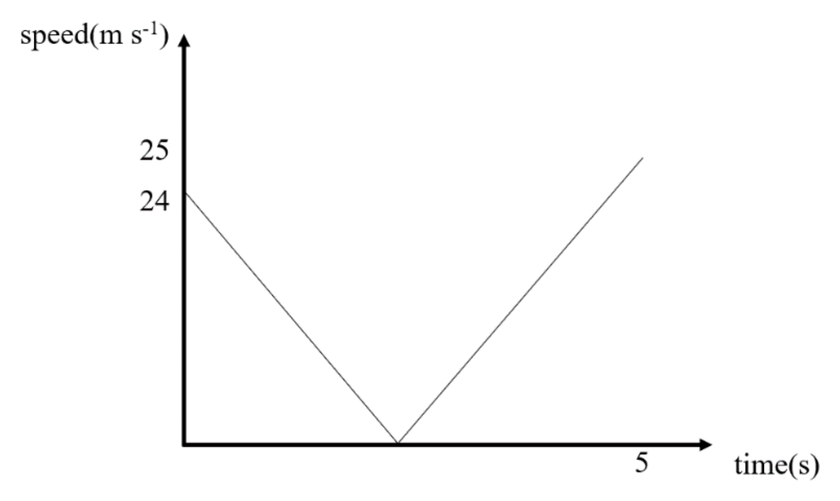
(d) Sketch a speed-time graph for the motion of the particle from projection to the instant that it reaches . (No further calculations are required.)
题目中文翻译
一个粒子从点 以 的速率被竖直向上投射。
点 在点 竖直上方 处。
点 位于水平地面上。
粒子在重力作用下自由运动,直到以 的速率撞击地面上的点 。
撞击地面后粒子不再反弹。
(a) 求 的值。
(b) 求粒子到达 所用的时间。
点 在 竖直上方 处。
(c) 求粒子处于 上方的时间长度。
(d) 绘制粒子自投射至到达 瞬时的速率-时间(speed-time)图像。(无需进一步计算。)
解答
(a)
解法一
思路
展开
以向上为正,从 到地面的位移为负。用速度平方公式求落地速率,取正平方根。
答题过程
展开
Take upwards as positive. From to , , and . Thus
As is a speed, .
(b)
解法一
思路
展开
落地前速度向下,所以在向上为正的坐标中,末速度应是 ,不是 。
答题过程
展开
Using with upwards positive,
Hence
(c)
解法一
思路
展开
上升和下降时各经过 一次。解相对 高度为 10 m 的方程,两个正根之差就是在 上方停留的时间。
答题过程
展开
At , the displacement above is 10 m, so
Equivalently,
with roots
The particle is above between these two crossings. The length of time is
解法二
思路
展开
也可先求上升经过 时的速率,再利用在 上方运动的时间对称性:到最高点的时间乘以二。
答题过程
展开
Let be the upward speed when the particle first reaches . Then
The time from to the highest point is . By symmetry the return from the highest point to takes the same time. Therefore the total time above is
解法三
思路
展开
把第一次经过 的时刻当作新的时间零点,再次回到 时相对位移为零。方程中的非零时间根就是所求时长。
答题过程
展开
At the first upward crossing of the speed is
Let be the time from this crossing to the return to . The net displacement is zero, so
The root is the initial crossing. The later crossing has
(d)
解法一
思路
展开
速率是速度的大小,转向处降到零后又上升,形成 V 形;两边斜率绝对值相等。图像终点是刚到达地面时,不需要画碰后的静止段。
答题过程
展开
Draw a speed-time graph with two straight segments forming a V:
- Start at speed when .
- Decrease linearly to a vertex on the time axis at the highest point.
- Increase linearly to speed at s.
The two segments have equal gradient magnitudes. The endpoint is slightly higher than the starting point. Label speeds 24 and 25 and the final time 5. Stop the graph at arrival at .