题目
Problem
6.
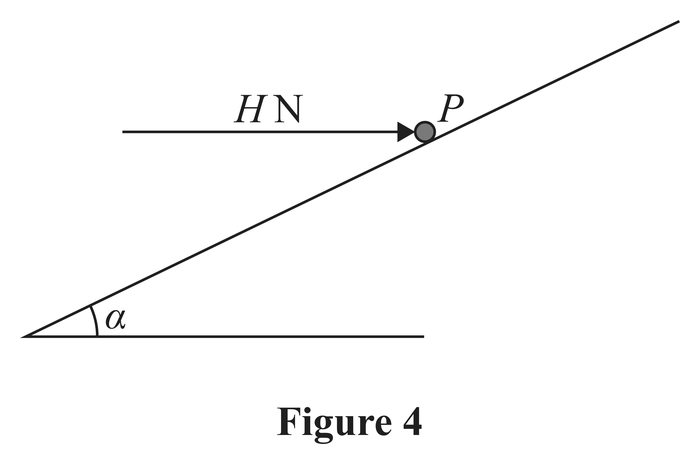
A particle P of mass 5kg lies on the surface of a rough plane.
The plane is inclined at an angle α to the horizontal, where tanα=43
The particle is held in equilibrium by a horizontal force of magnitude H newtons, as shown in Figure 4.
The horizontal force acts in a vertical plane containing a line of greatest slope of the inclined plane.
The coefficient of friction between the particle and the plane is 41
(a) Find the smallest possible value of H.
(6)
The horizontal force is now removed, and P starts to slide down the slope.
In the first T seconds after P is released from rest, P slides 1.5m down the slope.
(b) Find the value of T.
(6)
题目中文翻译
质量为 5kg 的质点 P 位于粗糙斜面表面。
斜面与水平面成 α 角,其中 tanα=43。
如图 4 所示,一个大小为 H 牛顿的水平力使质点保持平衡。
该水平力作用于包含斜面一条最大坡度线的竖直平面内。
质点与斜面之间的摩擦系数为 41。
(a) 求 H 的最小可能值。
(6)
现移去水平力,P 开始沿斜面向下滑动。
P 由静止释放后的前 T 秒内,沿斜面向下滑动 1.5m。
(b) 求 T 的值。
(6)
解答
(a)
解法一
思路
展开
最小水平推力对应即将沿斜面下滑,摩擦向上且达到最大值。水平推力还把物体压向斜面,所以支持力包含 Hsinα。
答题过程
展开
From tanα=3/4,
sinα=53,cosα=54.
For the smallest possible H, the particle is on the point of sliding down the plane, so limiting friction acts up the plane.
Resolving perpendicular to the plane,
R=5gcosα+Hsinα=4g+53H.
Resolving up the plane, with F=R/4,
Hcosα+F=5gsinα.
Hence
54H+41(4g+53H)=2019H=H=3g,2g,1940g=20.6315… N.
Thus the smallest value is H=20.6 (3 s.f.).
解法二
思路
展开
也可按水平、竖直方向分解支持力与摩擦。临界摩擦向上,大小为支持力的四分之一,然后先解支持力再求水平推力。
答题过程
展开
At the minimum H, friction is up the plane and F=R/4. Resolving vertically,
5g=Rcosα+Fsinα=R(54+4153)=2019R.
Thus R=100g/19. Resolving horizontally,
H+Fcosα=Rsinα.
Therefore
H==R(53−4154),52R=1940g.
Hence H=20.6 (3 s.f.).
(b)
解法一
思路
展开
移去水平力后,支持力要重新求为 5gcosα,不能沿用上一问。摩擦仍向上,重力沿斜面分量减摩擦给出向下加速度。
答题过程
展开
After H is removed, the normal reaction is
S=5gcosα=4g.
The particle slides down, so friction acts up the plane with magnitude S/4=g. Taking down the plane as positive,
5gsinα−g=5a,3g−g=5a,
giving
a=52g=3.92 ms−2.
Starting from rest and sliding 1.5 m,
1.5=21(3.92)T2.
Taking the positive root,
T=3.923=0.875(3 s.f.).
