题目
Problem
7.
Two trains, A and B, start together from rest, at time t=0, at a station and move along parallel straight horizontal tracks.
Both trains come to rest at the next station after 180s.
Train A moves with constant acceleration 32ms−2 for 30s, then moves at constant speed for 120s and then moves with constant deceleration for the final 30s.
Train B moves with constant acceleration for 90s and then moves with constant deceleration for the final 90s.
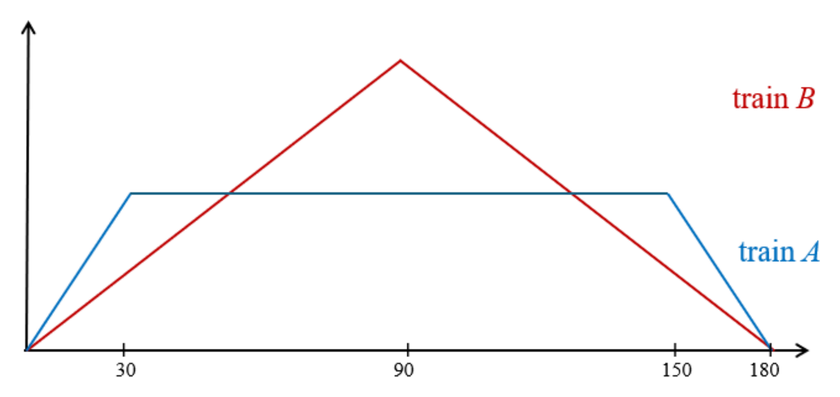
(a) Sketch, on the same axes, the speed-time graphs for the motion of the two trains between the two stations.
(3)
(b) Find the acceleration of train B for the first half of its journey.
(5)
(c) Find the times when the two trains are moving at the same speed.
(4)
(d) Find the distance between the trains 96s after they start.
(5)
题目中文翻译
两列火车 A 和 B 在 t=0 时从同一车站同时由静止出发,沿平行的水平直轨道行驶。
两列火车均在 180s 后到达下一站并静止。
火车 A 先以恒定加速度 32ms−2 行驶 30s,再以恒定速率行驶 120s,最后以恒定减速度行驶 30s。
火车 B 先以恒定加速度行驶 90s,再在最后 90s 内以恒定减速度行驶。
(a) 在同一坐标系中画出两列火车在两站之间运动的速率—时间图像草图。
(3)
(b) 求火车 B 在行程前半段的加速度。
(5)
(c) 求两列火车速率相同的时刻。
(4)
(d) 求出发 96s 后两列火车之间的距离。
(5)
解答
(a)
解法一
思路
展开
A 的速率图为等腰梯形,B 的图为等腰三角形。两车同起点同终点且同向,图下面积相等,因此 B 的最高速率大于 A,两图在行驶中相交两次。
答题过程
展开
Draw both graphs on the same axes, with time t (s) horizontally and speed v (m s−1) vertically.
For A, the maximum speed is
vA=32(30)=20 m s−1.
Join (0,0), (30,20), (150,20) and (180,0) by straight lines.
For B, draw an isosceles triangle from (0,0) to a peak at t=90, then to (180,0). Its peak must be above 20 m s−1, so the graphs cross twice between the stations. Label the two trains and the times 30,90,150,180.
(b)
解法一
思路
展开
两车经过的总路程相同,用图下面积先求站间距离。B 在前 90 秒达到最高速率,再由速度增量除以时间求加速度。
答题过程
展开
The distance between the stations is the area under A‘s graph:
s=21(180+120)(20)=3000 m.
Let the maximum speed of B be V. Equating the area under its graph to this distance,
21(180)V=3000⟹V=3100 m s−1.
Therefore the acceleration of B is
aB=90V=2710 m s−2.
(c)
解法一
思路
展开
行驶中速率相等的两个交点都在 A 匀速阶段。先分别写出 B 加速段和减速段的速率,解后检查时间所在区间。
答题过程
展开
During 30≤t≤150, train A has speed 20 m s−1.
On B‘s accelerating section,
2710t=20⟹t=54.
This lies in 30<t<90, as required.
On B‘s decelerating section,
2710(180−t)=20⟹t=126.
This lies in 90<t<150. Thus, while the trains are moving, the required times are
54 s and 126 s.
(d)
解法一
思路
展开
在 t=90 时,两车均恰好走过一半路程,因此位置相同。只比较接下来 6 秒的位移,可减少计算。
答题过程
展开
By symmetry of each speed–time graph, both trains have travelled 1500 m at t=90.
From t=90 to t=96, train A travels
sA=20(6)=120 m.
Train B has initial speed 100/3 m s−1 and acceleration −10/27 m s−2. Its displacement in these 6 seconds is
sB==3100(6)−212710(62)3580 m.
Therefore B is ahead of A by
sB−sA=3580−120=3220 m.
解法二
思路
展开
也可从终点往回计算剩余路程。两车终点相同,剩余路程之差就是此时的间距。
答题过程
展开
At t=96, train B has 180−96=84 seconds remaining. Its remaining distance is the area of its final triangular section:
sB,rem=212710(84)2=33920 m.
Train A has 54 seconds at speed 20 followed by its final 30-second deceleration. Its remaining distance is
sA,rem=54(20)+21(30)(20)=1380 m.
Thus B is ahead, and the separation is
1380−33920=3220 m.
