
题目
7.
A rough plane is inclined at an angle to the horizontal, where
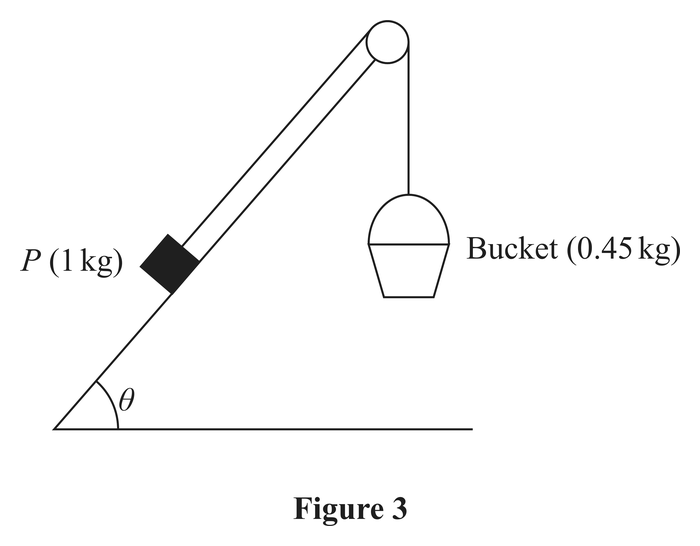
One end of a light inextensible string is attached to a package . The string passes over a smooth pulley that is fixed at the top of the plane. The string from to the pulley lies along a line of greatest slope of the plane. The other end of the string is attached to a bucket. The package has mass and is held at rest on the plane. The bucket has mass and hangs vertically below the pulley with the string taut, as shown in Figure 3.
The coefficient of friction between and the plane is
When a small block of mass is placed in the bucket, the system is released and remains at rest in limiting equilibrium, with on the point of slipping down the plane.
(a) Show that
Additional identical blocks of mass are added one at a time into the bucket until starts to move up the plane. At the instant when starts to move up the plane, there are a total of blocks in the bucket.
(b) Find
(i) the value of
(ii) the magnitude of the initial acceleration of
题目中文翻译
一个粗糙斜面与水平面成 角,其中 。
一根不可伸长的轻绳的一端连接于包裹 。 绳跨过一个固定在斜面顶端的光滑滑轮。 从 到滑轮的一段绳沿斜面的最大坡度线放置。 绳的另一端连接于一个桶。 包裹 的质量为 ,被保持静止在斜面上。 如图 3 所示,桶的质量为 ,竖直悬挂在滑轮下方,绳绷紧。
与斜面之间的摩擦系数为 。
将一个质量为 的小物块放入桶中后,释放系统,系统仍静止并处于极限平衡状态, 恰好要沿斜面向下滑动。
(a) 证明 。
向桶内逐个加入更多相同的、质量为 的物块,直到 开始沿斜面向上运动。 开始沿斜面向上运动的瞬间,桶内共有 个物块。
(b) 求
(i) 的值,
(ii) 的初始加速度大小。
解答
(a)
解法一
思路
展开
恰要向下滑,摩擦力应沿斜面向上。先求桶和一个物块静止时的张力,再求平衡所需摩擦力,与极限摩擦力相等。
答题过程
展开
Since ,
The bucket and one block are at rest, so
For , the normal reaction is
As is on the point of slipping down the plane, friction acts up the plane and has magnitude . Resolving along the plane,
Therefore
as required.
(b)
解法一
思路
展开
向上运动时摩擦力改为沿斜面向下。先比较使系统向上启动的临界总重,再取最小整数物块数;求加速度时把所有物块质量都计入惯性质量。
答题过程
展开
(i) For impending upward motion of , friction acts down the plane, with limiting magnitude
The bucket must outweigh the total opposing force on :
The smallest integer is therefore .
(ii) Let accelerate up the plane with magnitude . The bucket and three blocks accelerate downwards with the same magnitude. Their equations of motion are
Adding to eliminate ,
Hence the initial acceleration magnitude is