
题目
6.
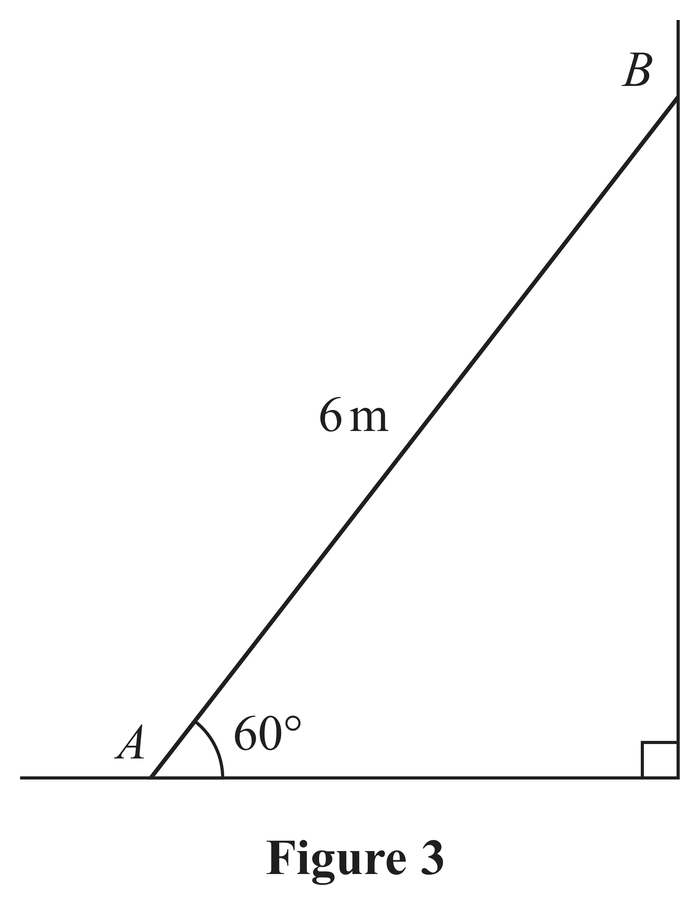
A ladder has length and mass . The ladder rests in equilibrium at to the horizontal with the end on rough horizontal ground and the end against a smooth vertical wall, as shown in Figure 3.
A man of mass stands on the ladder at the point , where , and the ladder remains in equilibrium. The ladder is modelled as a uniform rod in a vertical plane perpendicular to the wall. The man is modelled as a particle.
(a) Find the magnitude of the force exerted on the ladder by the ground.
The man climbs further up the ladder. When he is at the point on the ladder, the ladder is about to slip.
Given that the coefficient of friction between the ladder and the ground is
(b) find the distance .
(c) State how you have used the modelling assumption that the ladder is a rod.
题目中文翻译
梯子 长 ,质量为 。如图 3 所示,梯子与水平面成 角并处于平衡状态, 端放在粗糙水平地面上, 端靠在光滑竖直墙上。
一个质量为 的人站在梯子的 点,其中 ,梯子仍保持平衡。将梯子视为位于垂直于墙面的竖直平面内的均匀杆,将人视为质点。
(a) 求地面对梯子施加的力的大小。
此人继续沿梯子向上爬。当他位于梯子的 点时,梯子恰好要滑动。
已知梯子与地面之间的摩擦系数为 ,
(b) 求距离 。
(c) 说明你如何运用了将梯子视为杆这一建模假设。
解答
(a)
解法一
思路
展开
墙光滑,因此墙端只有水平支持力。地面对梯子的力包含竖直支持力和水平摩擦力,最后必须求两者的合力。
答题过程
展开
Let the ground’s normal reaction be , the friction at be towards the wall, and the wall’s horizontal reaction be .
Vertical and horizontal equilibrium give
Taking moments about ,
Thus
The magnitude of the resultant force exerted by the ground is
(b)
解法一
思路
展开
人向上爬后,摩擦力和墙支持力改变。临界时 ,重新列力矩方程,不能沿用上一问的 。
答题过程
展开
At limiting equilibrium,
Let . Taking moments about ,
Cancelling and simplifying,
Therefore
(c)
解法一
思路
展开
题目问“杆”模型的作用,要说明刚性,而非把“均匀”模型所确定的重心位置当作答案。
答题过程
展开
The ladder is treated as rigid, so it does not bend under the man’s weight.