
题目
5.
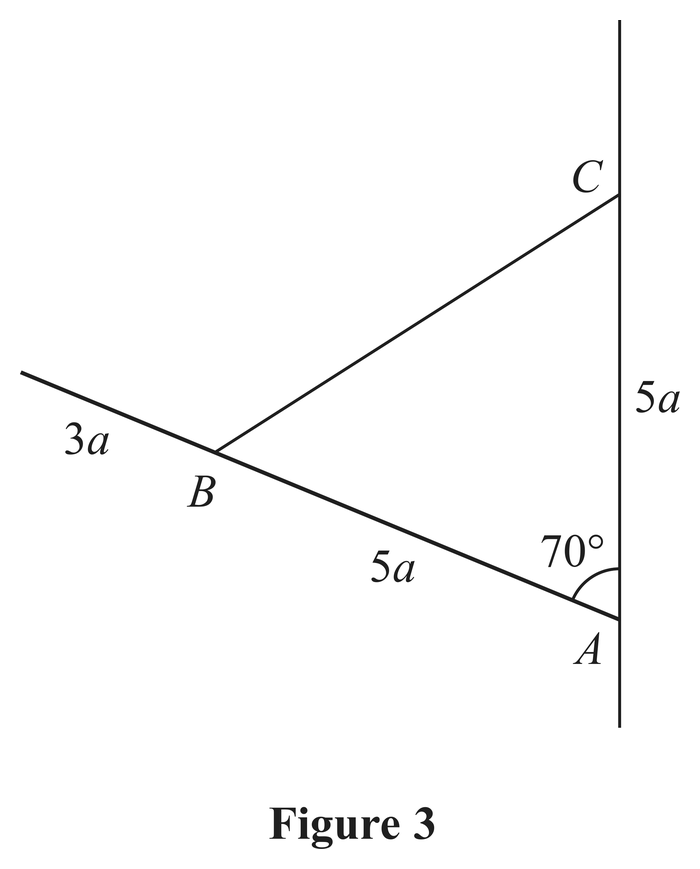
A uniform rod, of length and mass , has one end freely hinged to a fixed point on a vertical wall. One end of a light inextensible string is attached to the rod at the point , where . The other end of the string is attached to the wall at the point , where and is vertically above . The rod rests in equilibrium in a vertical plane perpendicular to the wall with angle , as shown in Figure 3.
(a) Find, in terms of and , the tension in the string.
The magnitude of the force acting on the rod at is , where is a constant.
(b) Find, to 2 significant figures, the value of .
题目中文翻译
一根长为 、质量为 的均匀杆,其一端通过自由铰链连接于竖直墙上的固定点 。一根不可伸长的轻绳的一端连接于杆上的 点,其中 。绳的另一端连接于墙上的 点,其中 , 位于 的正上方。如图 3 所示,杆在垂直于墙面的竖直平面内静止平衡,且 。
(a) 用 和 表示绳中的张力。
点处作用在杆上的力的大小为 ,其中 为常数。
(b) 求 的值,保留 2 位有效数字。
解答
(a)
解法一
思路
展开
,所以先由等腰三角形确定绳与杆的夹角。均匀杆的重心在中点;对铰链取矩消去铰链反力。
答题过程
展开
Since , triangle is isosceles. Therefore
The rod is inclined at to the horizontal. Its weight acts at its midpoint, a distance from .
Let the tension be . Taking moments about ,
Hence
(b)
解法一
思路
展开
铰链反力通常既不沿杆也不水平。分别求其水平、竖直分量,再用勾股定理求合力。绳与竖直方向的夹角为 。
答题过程
展开
Let the force at have horizontal component to the left and vertical component upwards. Resolving horizontally and vertically,
Using the unrounded expression for ,
Since the magnitude of this force is ,
Substitution gives, to 2 significant figures,
解法二
思路
展开
也可以不使用张力:对 取矩消去张力和竖直铰链分量,对 取矩再求竖直分量。注意杆重心在 与 之间,距 为 。
答题过程
展开
Let the hinge-force components be to the left and upwards. Taking moments about , both the tension and have zero moment, so
Thus
Taking moments about ,
Consequently
Therefore