
题目
7.
[In this question, the unit vectors and are in a vertical plane, being horizontal and being vertically upwards.]
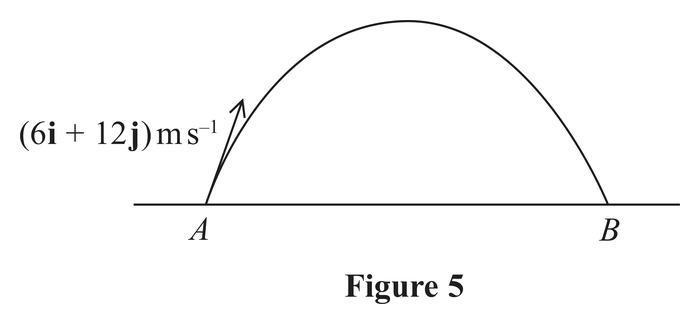
A small ball is projected with velocity from a fixed point on horizontal ground. The ball hits the ground at the point , as shown in Figure 5. The motion of the ball is modelled as a particle moving freely under gravity.
(a) Find the distance .
When the height of the ball above the ground is more than metres, the speed of the ball is less than
(b) Find the smallest possible value of .
When the ball is at the point on its path, the direction of motion of the ball is perpendicular to the direction of motion of the ball at the instant before it hits the ground at .
(c) Find, in terms of and , the velocity of the ball when it is at .
题目中文翻译
[本题中,单位向量 和 位于一个竖直平面内, 为水平方向, 竖直向上。]
一个小球从水平地面上的固定点 以速度 抛出。如图 5 所示,球在 点撞击地面。将球的运动视为质点仅在重力作用下的运动。
(a) 求距离 。
当球离地面的高度大于 米时,球的速率小于 。
(b) 求 的最小可能值。
球位于轨迹上的 点时,其运动方向与在 点撞击地面前一瞬间的运动方向垂直。
(c) 用 和 表示球位于 时的速度。
解答
(a)
解法一
思路
展开
落地点与起点等高。先用竖直位移为零求非零飞行时间,再乘恒定水平速度。
答题过程
展开
Let the flight time be s. Vertically,
Since ,
The horizontal speed remains 6 m s, so
Therefore
(b)
解法一
思路
展开
速率小于 并不等于竖直速度小于 。水平分量始终为 ,所以临界竖直速度的大小是 。在上升和下降途中,同一高度的速率相同。
答题过程
展开
At height metres, let the vertical velocity be . Then
The square of the speed is
Hence
Thus the smallest height threshold is
A smaller threshold would include some heights at which the speed is at least 10 m s.
解法二
思路
展开
用机械能也可直接把总速率与高度联系起来,不必先求竖直速度。质量在方程中约去。
答题过程
展开
Let the mass of the ball be and its speed at height be . Conservation of mechanical energy gives
Thus
At the boundary speed ,
so
Above this height the speed is less than 10 m s; taking any smaller would fail the stated condition.
(c)
解法一
思路
展开
落地前水平分量仍为 ,竖直分量变成 。两方向垂直意味着速度向量的数量积为零,无须先求两个方向角。
答题过程
展开
Immediately before reaching ,
Let the velocity at be
Since the directions are perpendicular,
Therefore
Hence