
题目
5.
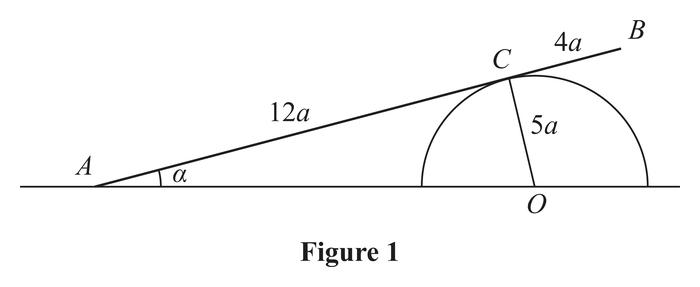
A smooth solid hemisphere is fixed with its flat surface in contact with rough horizontal ground. The hemisphere has centre and radius . A uniform rod , of length and weight , rests in equilibrium on the hemisphere with end on the ground. The rod rests on the hemisphere at the point , where and angle , as shown in Figure 1.
Points , , and all lie in the same vertical plane.
(a) Explain why
The normal reaction on the rod at has magnitude
(b) Show that
The resultant force acting on the rod at has magnitude and acts upwards at to the horizontal.
(c) Find
(i) an expression for in terms of
(ii) the value of
题目中文翻译
一个光滑实心半球被固定,其平面与粗糙水平地面接触。半球的球心为 ,半径为 。 长为 、重为 的均匀杆 支承在半球上并处于平衡状态, 端位于地面上。如图 1 所示,杆与半球在 点接触,其中 ,。
、、、 各点均位于同一竖直平面内。
(a) 解释为什么 。
杆在 点所受的法向反作用力大小为 。
(b) 证明 。
杆在 点所受合力的大小为 ,方向与水平面成 角斜向上。
(c) 求:
(i) 用 表示的 的表达式;
(ii) 的值。
解答
(a)
解法一
思路
展开
杆与半球截面相切,接触点的半径垂直切线,所以能使用勾股定理;仅列出 、、 而不解释直角还不充分。
答题过程
展开
The rod is tangent to the circular cross-section at , so . Thus triangle is right-angled at and
(b)
解法一
思路
展开
光滑接触力沿半径,垂直于杆。对 取矩,重力作用点为杆中点,距 为 。
答题过程
展开
From the right-angled triangle,
The reaction at is perpendicular to the rod. Taking moments about ,
Hence
(c)
解法一
思路
展开
处合力由水平摩擦力与竖直支持力组成。先求两个分量,再求模和方向;不能把合力直接当成竖直支持力。
答题过程
展开
Let the components of the force at be horizontally towards and vertically upwards. The force at has magnitude and acts upwards and to the left, perpendicular to the rod.
Resolving horizontally,
Resolving vertically,
so
Therefore, for (i),
Since ,
For (ii), since both components are positive,
Hence
解法二
思路
展开
选沿杆和垂直杆的方向分解,可以直接把接触点反力放在一个坐标方向。最后的方向角要加上杆相对于水平的角度。
答题过程
展开
Resolve the force at into a component along the rod from towards , and a component perpendicular to the rod, upwards and to the left.
Resolving parallel to the rod,
Resolving perpendicular to the rod,
so
Thus, for (i),
The force makes angle above the rod. Therefore, for (ii),
Hence