题目
Problem
7.
A particle P P P O O O u u u α \alpha α P P P O O O x x x P P P y y y P P P
(a) Show that y = x tan α − g x 2 2 u 2 ( 1 + tan 2 α ) y=x\tan\alpha-\frac{gx^2}{2u^2}(1+\tan^2\alpha) y = x tan α − 2 u 2 g x 2 ( 1 + tan 2 α )
(6)
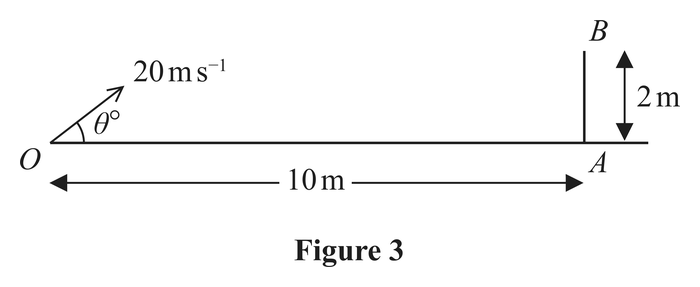
A small ball is projected from the fixed point O O O 20 m s − 1 20\,\mathrm{m\,s^{-1}} 20 m s − 1 θ ∘ \theta^\circ θ ∘ A B AB A B 2 m 2\,\mathrm{m} 2 m O A = 10 m OA=10\,\mathrm{m} O A = 10 m
The ball is modelled as a particle moving freely under gravity and the pole is modelled as a rod.
The path of the ball lies in the vertical plane containing O O O A A A B B B
Using the model,
(b) find the range of values of θ \theta θ
(3)
Given that θ = 40 \theta=40 θ = 40 C C C
(c) find the speed of the ball at the instant it passes over the pole,
(5)
(d) find the distance O C OC O C
(2)
题目中文翻译
从水平地面上的固定点 O O O u u u α \alpha α P P P P P P O O O x x x P P P y y y P P P
(a) 证明 y = x tan α − g x 2 2 u 2 ( 1 + tan 2 α ) y=x\tan\alpha-\frac{gx^2}{2u^2}(1+\tan^2\alpha) y = x tan α − 2 u 2 g x 2 ( 1 + tan 2 α )
(6)
从水平地面上的固定点 O O O 20 m s − 1 20\,\mathrm{m\,s^{-1}} 20 m s − 1 θ ∘ \theta^\circ θ ∘ 2 m 2\,\mathrm{m} 2 m A B AB A B O A = 10 m OA=10\,\mathrm{m} O A = 10 m
将小球视为仅受重力作用而自由运动的质点,将杆视为细杆。
小球的轨迹位于包含 O O O A A A B B B
利用此模型,
(b) 求小球能越过杆顶时 θ \theta θ
(3)
已知 θ = 40 \theta=40 θ = 40 C C C
(c) 求小球经过杆上方瞬间的速率;
(5)
(d) 求距离 O C OC O C
(2)
解答
(a)
解法一
思路
展开
先分别写水平、竖直运动方程,再利用水平运动消去时间。最后明确使用 sec 2 α = 1 + tan 2 α \sec^2\alpha=1+\tan^2\alpha sec 2 α = 1 + tan 2 α
答题过程
展开
After time t t t
x = u cos α t , y = u sin α t − 1 2 g t 2 . x=u\cos\alpha\,t,\qquad y=u\sin\alpha\,t-\frac12gt^2. x = u cos α t , y = u sin α t − 2 1 g t 2 . From the horizontal equation,
t = x u cos α . t=\frac{x}{u\cos\alpha}. t = u cos α x . Substituting into the vertical equation,
y = u sin α ( x u cos α ) − g 2 ( x u cos α ) 2 . y=u\sin\alpha\left(\frac{x}{u\cos\alpha}\right)-\frac g2\left(\frac{x}{u\cos\alpha}\right)^2. y = u sin α ( u cos α x ) − 2 g ( u cos α x ) 2 . Hence
y = x tan α − g x 2 2 u 2 sec 2 α . y=x\tan\alpha-\frac{gx^2}{2u^2}\sec^2\alpha. y = x tan α − 2 u 2 g x 2 sec 2 α . Using sec 2 α = 1 + tan 2 α \sec^2\alpha=1+\tan^2\alpha sec 2 α = 1 + tan 2 α
y = x tan α − g x 2 2 u 2 ( 1 + tan 2 α ) . \boxed{y=x\tan\alpha-\frac{gx^2}{2u^2}(1+\tan^2\alpha)}. y = x tan α − 2 u 2 g x 2 ( 1 + tan 2 α ) .
(b)
解法一
思路
展开
越过杆顶要求在水平距离 10 10 10 2 2 2 z = tan θ z=\tan\theta z = tan θ
答题过程
展开
At x = 10 x=10 x = 10 u = 20 u=20 u = 20
10 tan θ − 9.8 ( 10 ) 2 2 ( 20 ) 2 ( 1 + tan 2 θ ) > 2. 10\tan\theta-\frac{9.8(10)^2}{2(20)^2}(1+\tan^2\theta)>2. 10 tan θ − 2 ( 20 ) 2 9.8 ( 10 ) 2 ( 1 + tan 2 θ ) > 2. Put z = tan θ z=\tan\theta z = tan θ
1.225 z 2 − 10 z + 3.225 < 0. 1.225z^2-10z+3.225<0. 1.225 z 2 − 10 z + 3.225 < 0. The boundary roots are
z = 10 ± 100 − 4 ( 1.225 ) ( 3.225 ) 2 ( 1.225 ) . z=\frac{10\pm\sqrt{100-4(1.225)(3.225)}}{2(1.225)}. z = 2 ( 1.225 ) 10 ± 100 − 4 ( 1.225 ) ( 3.225 ) . Since the quadratic opens upwards, z z z 0 ∘ < θ < 90 ∘ 0^\circ<\theta<90^\circ 0 ∘ < θ < 9 0 ∘
18.6 ∘ < θ < 82.7 ∘ . \boxed{18.6^\circ<\theta<82.7^\circ}. 18. 6 ∘ < θ < 82. 7 ∘ . The endpoints correspond to hitting the top of the pole and are excluded. The displayed boundary angles are rounded to 3 significant figures.
(c)
解法一
思路
展开
小球越过杆时不一定刚好位于杆顶。先用实际仰角 40 ∘ 40^\circ 4 0 ∘
答题过程
展开
When the ball is vertically above the pole, x = 10 x=10 x = 10 θ = 40 ∘ \theta=40^\circ θ = 4 0 ∘
y = 10 tan 40 ∘ − 9.8 ( 10 ) 2 2 ( 20 ) 2 ( 1 + tan 2 40 ∘ ) . y=10\tan40^\circ-\frac{9.8(10)^2}{2(20)^2}(1+\tan^240^\circ). y = 10 tan 4 0 ∘ − 2 ( 20 ) 2 9.8 ( 10 ) 2 ( 1 + tan 2 4 0 ∘ ) . Using this unrounded value, conservation of energy gives
1 2 m v 2 + m g y = 1 2 m ( 20 ) 2 . \frac12mv^2+mgy=\frac12m(20)^2. 2 1 m v 2 + m g y = 2 1 m ( 20 ) 2 . Therefore
v = 400 − 2 g y . v=\sqrt{400-2gy}. v = 400 − 2 g y . Hence the required speed is
16.6 m s − 1 . \boxed{16.6\text{ m s}^{-1}}. 16.6 m s − 1 .
解法二
思路
展开
另一条路线是先用水平运动求经过杆上方的时间,再求当时竖直速度,与恒定水平速度合成。
答题过程
展开
The time to reach the vertical line through the pole is
t = 10 20 cos 40 ∘ . t=\frac{10}{20\cos40^\circ}. t = 20 cos 4 0 ∘ 10 . The horizontal and vertical velocity components at this time are
v x = 20 cos 40 ∘ , v_x=20\cos40^\circ, v x = 20 cos 4 0 ∘ , v y = 20 sin 40 ∘ − 9.8 ( 10 20 cos 40 ∘ ) . v_y=20\sin40^\circ-9.8\left(\frac{10}{20\cos40^\circ}\right). v y = 20 sin 4 0 ∘ − 9.8 ( 20 cos 4 0 ∘ 10 ) . Therefore
v = v x 2 + v y 2 . v=\sqrt{v_x^2+v_y^2}. v = v x 2 + v y 2 . This gives
v = 16.6 m s − 1 . \boxed{v=16.6\text{ m s}^{-1}}. v = 16.6 m s − 1 .
(d)
解法一
思路
展开
落地点高度为零,在轨迹方程中舍去起点对应的 x = 0 x=0 x = 0
答题过程
展开
At C C C y = 0 y=0 y = 0
0 = x tan 40 ∘ − g x 2 800 ( 1 + tan 2 40 ∘ ) . 0=x\tan40^\circ-\frac{gx^2}{800}(1+\tan^240^\circ). 0 = x tan 4 0 ∘ − 800 g x 2 ( 1 + tan 2 4 0 ∘ ) . Since C ≠ O C\ne O C = O x > 0 x>0 x > 0
x = 800 tan 40 ∘ g ( 1 + tan 2 40 ∘ ) . x=\frac{800\tan40^\circ}{g(1+\tan^240^\circ)}. x = g ( 1 + tan 2 4 0 ∘ ) 800 tan 4 0 ∘ . Hence
O C = 40.2 m . \boxed{OC=40.2\text{ m}}. O C = 40.2 m .
解法二
思路
展开
也可先求返回地面的非零飞行时间,再乘水平速度。这里起点、终点等高。
答题过程
展开
At the first return to ground level after projection,
0 = 20 sin 40 ∘ t − 1 2 g t 2 . 0=20\sin40^\circ\,t-\frac12gt^2. 0 = 20 sin 4 0 ∘ t − 2 1 g t 2 . Taking the non-zero root,
t = 40 sin 40 ∘ g . t=\frac{40\sin40^\circ}{g}. t = g 40 sin 4 0 ∘ . Thus
O C = ( 20 cos 40 ∘ ) 40 sin 40 ∘ g = 400 sin 80 ∘ g . OC=(20\cos40^\circ)\frac{40\sin40^\circ}{g}=\frac{400\sin80^\circ}{g}. O C = ( 20 cos 4 0 ∘ ) g 40 sin 4 0 ∘ = g 400 sin 8 0 ∘ . Therefore
O C = 40.2 m . \boxed{OC=40.2\text{ m}}. O C = 40.2 m .