
题目
7.
[In this question, the perpendicular unit vectors and are in a vertical plane with being horizontal and being vertically upwards.]
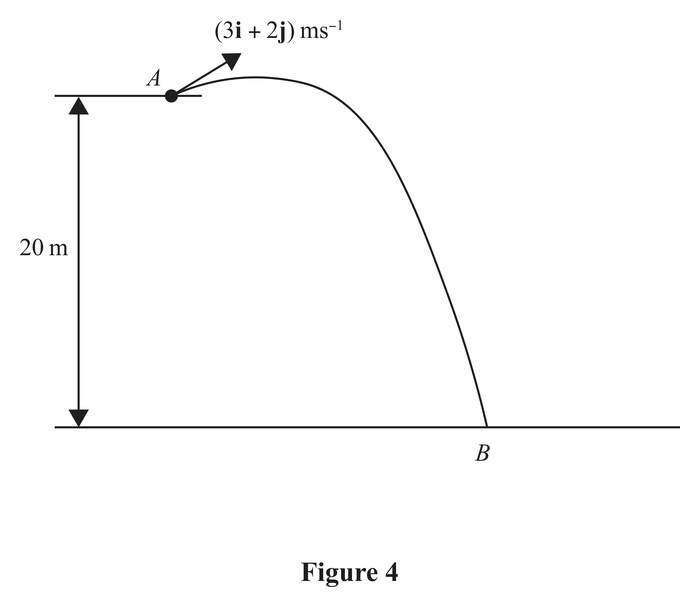
A small ball is projected with velocity from the fixed point .
The point is above horizontal ground.
The ball hits the ground at the point , as shown in Figure 4.
The ball is modelled as a particle moving freely under gravity.
(a) By considering energy, find the speed of the ball at the instant immediately before it hits the ground.
(b) Find the direction of motion of the ball at the instant immediately before it hits the ground.
(c) Find the time taken for the ball to travel from to .
At the instant when the direction of motion of the ball is perpendicular to the ball is metres above the ground.
(d) Find the value of .
题目中文翻译
[ 本题中,相互垂直的单位向量 、 位于同一竖直平面内,其中 沿水平方向, 竖直向上。 ]
从固定点 以速度 抛出一个小球。
点位于水平地面上方 处。
如图 4 所示,小球在 点落地。
将小球视为仅受重力作用而自由运动的质点。
(a) 利用能量关系,求小球落地前瞬间的速率。
(b) 求小球落地前瞬间的运动方向。
(c) 求小球从 运动至 所用的时间。
当小球的运动方向垂直于 时,小球离地面 米。
(d) 求 的值。
解答
(a)
解法一
思路
展开
先由初速度两个分量求初速率平方,再用机械能守恒计算下落 米后的速率。题目指定能量方法。
答题过程
展开
Let the mass of the ball be , and let its speed immediately before impact be . The initial speed squared is
Conservation of mechanical energy gives
Thus
and therefore
(b)
解法一
思路
展开
水平速度始终为 ,落地时向下。用水平分量除以总速率求与水平面的夹角,必须说明是向下的角。
答题过程
展开
The horizontal velocity remains 3 m s. Let the angle below the horizontal immediately before impact be .
Using the unrounded speed from (a),
Therefore the direction is
Equivalently, the velocity has the direction of
where the negative vertical component specifies downward motion.
(c)
解法一
思路
展开
以起点为竖直位移零点,落地位移为 。初竖直速度为 ,解二次方程时只取正时间。
答题过程
展开
Let the flight time be . Vertically, taking upwards as positive,
With ,
Hence
Taking the positive root gives
(d)
解法一
思路
展开
垂直方向用数量积判定。水平速度不变,因此先求当时竖直速度,再用竖直运动求相对起点的位移,最后转换成离地高度。不能把竖直速度简单改成 。
答题过程
展开
Let the vertical velocity when the directions are perpendicular be . The velocity is then
Perpendicularity to gives
so
Let the vertical displacement from be , positive upwards. Using ,
Therefore
Since is 20 m above the ground,
Hence
解法二
思路
展开
求出垂直方向对应的速度后,也可用机械能把初末速率和高度直接联系,避免混淆位移正负。
答题过程
展开
At the required point, perpendicularity gives
Its speed squared is
Taking the ground as zero potential energy, conservation of energy between and this point gives
Thus
Therefore