题目
Problem
3.
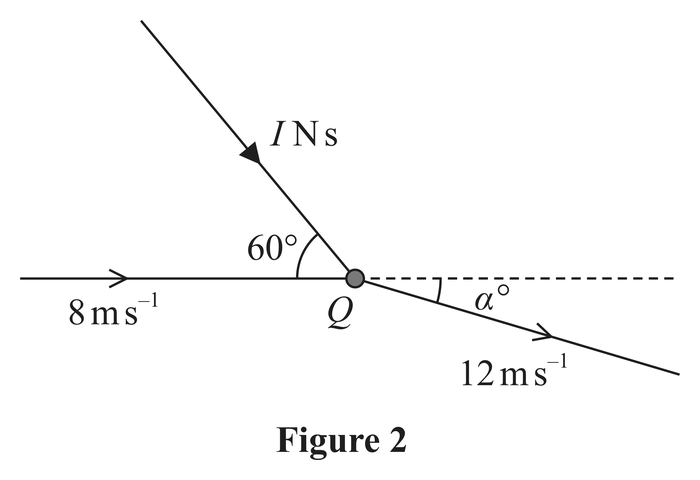
A particle Q Q Q 0.25 k g 0.25\,\mathrm{kg} 0.25 kg 8 m s − 1 8\,\mathrm{m\,s^{-1}} 8 m s − 1 I N s I\,\mathrm{N\,s} I N s
The impulse acts parallel to the horizontal surface and at 60 ∘ 60^\circ 6 0 ∘ Q Q Q
Immediately after receiving the impulse, the speed of Q Q Q 12 m s − 1 12\,\mathrm{m\,s^{-1}} 12 m s − 1
As a result of receiving the impulse, the direction of motion of Q Q Q α ∘ \alpha^\circ α ∘
Find the value of I I I
(6)
题目中文翻译
质量为 0.25 k g 0.25\,\mathrm{kg} 0.25 kg Q Q Q 8 m s − 1 8\,\mathrm{m\,s^{-1}} 8 m s − 1 I N s I\,\mathrm{N\,s} I N s
冲量方向平行于水平面,与 Q Q Q 60 ∘ 60^\circ 6 0 ∘
受到冲量后瞬间,Q Q Q 12 m s − 1 12\,\mathrm{m\,s^{-1}} 12 m s − 1
如图 2 所示,受到冲量使 Q Q Q α ∘ \alpha^\circ α ∘
求 I I I
(6)
解答
解法一
思路
展开
冲量加在初动量上得到末动量。沿初始运动方向及图中偏转方向分解,用末速率为 12 12 12 I I I
答题过程
展开
Take one axis along the original direction of motion and the perpendicular axis towards the side of the deflection in Figure 2.
The initial momentum has components ( 0.25 × 8 , 0 ) = ( 2 , 0 ) (0.25\times8,0)=(2,0) ( 0.25 × 8 , 0 ) = ( 2 , 0 )
( I cos 60 ∘ , I sin 60 ∘ ) = ( I 2 , 3 I 2 ) . \left(I\cos60^\circ,I\sin60^\circ\right)=\left(\frac I2,\frac{\sqrt3 I}{2}\right). ( I cos 6 0 ∘ , I sin 6 0 ∘ ) = ( 2 I , 2 3 I ) . By impulse-momentum, the final momentum has components
( 2 + I 2 , 3 I 2 ) . \left(2+\frac I2,\frac{\sqrt3 I}{2}\right). ( 2 + 2 I , 2 3 I ) . Its magnitude is 0.25 × 12 = 3 0.25\times12=3 0.25 × 12 = 3
( 2 + I 2 ) 2 + ( 3 I 2 ) 2 = 9. \left(2+\frac I2\right)^2+\left(\frac{\sqrt3 I}{2}\right)^2=9. ( 2 + 2 I ) 2 + ( 2 3 I ) 2 = 9. Expanding and collecting terms,
4 + 2 I + I 2 = 9 , 4+2I+I^2=9, 4 + 2 I + I 2 = 9 , I 2 + 2 I − 5 = 0. I^2+2I-5=0. I 2 + 2 I − 5 = 0. Therefore
I = − 1 ± 6 . I=-1\pm\sqrt6. I = − 1 ± 6 . Since I > 0 I>0 I > 0
I = 6 − 1 N s . \boxed{I=\sqrt6-1\text{ N s}}. I = 6 − 1 N s .
解法二
思路
展开
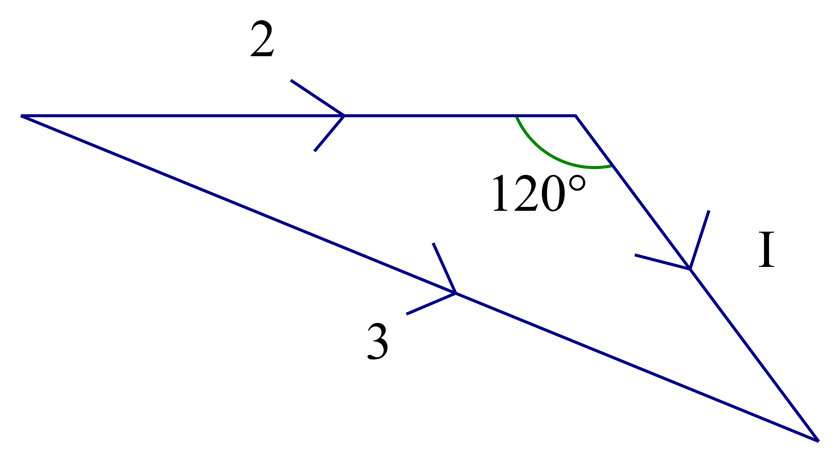
也可把初动量、冲量、末动量首尾相接。题图中的方向夹角为 60 ∘ 60^\circ 6 0 ∘ 120 ∘ 120^\circ 12 0 ∘
答题过程
展开
The vector relation is
initial momentum + impulse = final momentum . \text{initial momentum}+\text{impulse}=\text{final momentum}. initial momentum + impulse = final momentum . The initial and final momentum magnitudes are 2 N s and 3 N s. In the head-to-tail momentum triangle, the angle between the side of length 2 and the side of length I I I
180 ∘ − 60 ∘ = 120 ∘ . 180^\circ-60^\circ=120^\circ. 18 0 ∘ − 6 0 ∘ = 12 0 ∘ .
Applying the cosine rule,
3 2 = 2 2 + I 2 − 2 ( 2 ) I cos 120 ∘ . 3^2=2^2+I^2-2(2)I\cos120^\circ. 3 2 = 2 2 + I 2 − 2 ( 2 ) I cos 12 0 ∘ . Thus
9 = 4 + I 2 + 2 I , 9=4+I^2+2I, 9 = 4 + I 2 + 2 I , so
( I + 1 ) 2 = 6. (I+1)^2=6. ( I + 1 ) 2 = 6. Taking the positive value of the impulse magnitude,
I = 6 − 1 N s . \boxed{I=\sqrt6-1\text{ N s}}. I = 6 − 1 N s .