
题目
6.
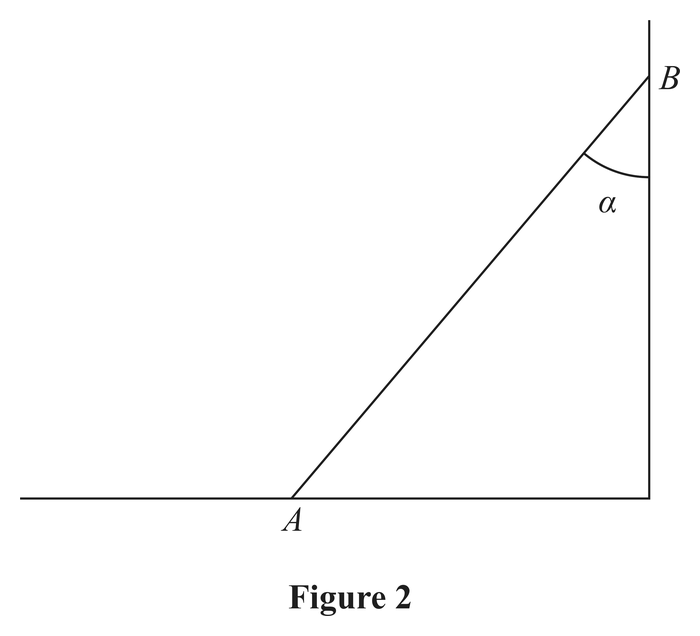
A uniform rod, , of mass and length , rests in limiting equilibrium with its end on rough horizontal ground and its end against a smooth vertical wall. The vertical plane containing the rod is at right angles to the wall. The rod is inclined to the wall at an angle , as shown in Figure 2.
The coefficient of friction between the rod and the ground is
(a) Show that
With the rod in the same position, a horizontal force of magnitude is applied to the rod at , towards the wall. The line of action of this force is at right angles to the wall.
The rod remains in equilibrium.
(b) Find the largest possible value of .
题目中文翻译
质量为 、长为 的均匀杆 ,其 端位于粗糙水平地面上, 端靠在光滑竖直墙上,处于极限平衡状态。 包含杆的竖直平面垂直于墙面。 如图 2 所示,杆与墙成 角。
杆与地面之间的摩擦系数为 。
(a) 证明 。
杆保持在同一位置,在 点对杆施加大小为 、指向墙面的水平力。该力的作用线垂直于墙面。
杆仍保持平衡。
(b) 求 的最大可能值。
解答
(a)
解法一
思路
展开
注意 是杆与墙的夹角。墙光滑,反力水平;地面摩擦指向墙。竖直平衡、极限摩擦与绕 的力矩共同给出角度关系。
答题过程
展开
Let be the vertical ground reaction, the friction towards the wall at , and the horizontal wall reaction away from the wall at .
Resolving vertically,
Since the rod is in limiting equilibrium,
Resolving horizontally,
The angle to the vertical is . Taking moments about ,
Substituting and cancelling ,
Hence
(b)
解法一
思路
展开
新增水平力作用于 ,不影响绕 的力矩或竖直平衡,所以墙反力和地面支持力均不变。力较大时地面摩擦反向;最大 对应摩擦背离墙且达到极限。
答题过程
展开
The rod remains in the same position. The new force at has zero moment about , so taking moments about again gives the same wall reaction:
Vertical equilibrium still gives .
Let be the signed ground friction, positive towards the wall. Horizontal equilibrium gives
so
Static friction must satisfy
Therefore
This gives . At the maximum, friction acts away from the wall at its limiting value , and
Hence