题目
Problem
7.
[In this question, the unit vectors i \mathbf{i} i j \mathbf{j} j i \mathbf{i} i j \mathbf{j} j ]
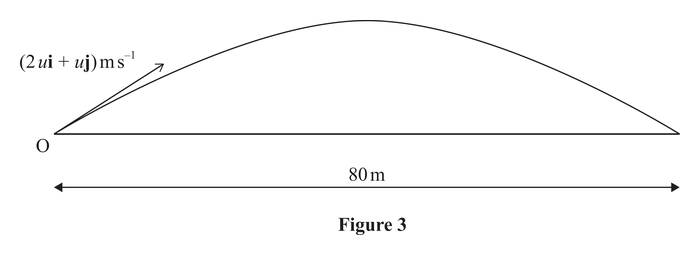
A golf ball is hit from a point O O O ( 2 u i + u j ) m s − 1 (2u\mathbf{i}+u\mathbf{j})\,\mathrm{m\,s^{-1}} ( 2 u i + u j ) m s − 1 80 m 80\,\mathrm{m} 80 m O O O
Use the model to
(a) show that u = 14 u=14 u = 14
(6)
(b) find the total time, while the ball is in the air, for which the speed of the ball is greater than 7 17 m s − 1 7\sqrt{17}\,\mathrm{m\,s^{-1}} 7 17 m s − 1
(5)
题目中文翻译
[ 本题中,单位向量 i \mathbf{i} i j \mathbf{j} j i \mathbf{i} i j \mathbf{j} j ]
一个高尔夫球从水平地面上的 O O O ( 2 u i + u j ) m s − 1 (2u\mathbf{i}+u\mathbf{j})\,\mathrm{m\,s^{-1}} ( 2 u i + u j ) m s − 1 O O O 80 m 80\,\mathrm{m} 80 m
利用此模型,
(a) 证明 u = 14 u=14 u = 14
(6)
(b) 求球在空中运动时速率大于 7 17 m s − 1 7\sqrt{17}\,\mathrm{m\,s^{-1}} 7 17 m s − 1
(5)
解答
(a)
解法一
思路
展开
水平初速度是 2 u 2u 2 u u u u 14 14 14
答题过程
展开
Let the total flight time be t f > 0 t_f>0 t f > 0
2 u t f = 80. 2ut_f=80. 2 u t f = 80. Vertically, the displacement on landing is zero:
0 = u t f − 1 2 g t f 2 . 0=ut_f-\frac12gt_f^2. 0 = u t f − 2 1 g t f 2 . Since t f > 0 t_f>0 t f > 0
t f = 2 u g . t_f=\frac{2u}{g}. t f = g 2 u . Substituting into the horizontal equation,
2 u ( 2 u g ) = 80 , 2u\left(\frac{2u}{g}\right)=80, 2 u ( g 2 u ) = 80 , u 2 = 20 g . u^2=20g. u 2 = 20 g . With g = 9.8 g=9.8 g = 9.8 u 2 = 196 u^2=196 u 2 = 196
u = 14 . \boxed{u=14}. u = 14 .
(b)
解法一
思路
展开
水平速度恒为 28 28 28 7 7 7
答题过程
展开
Using (a),
v = 28 i + ( 14 − g t ) j . \mathbf v=28\mathbf i+(14-gt)\mathbf j. v = 28 i + ( 14 − g t ) j . The speed exceeds 7 17 7\sqrt{17} 7 17
28 2 + ( 14 − g t ) 2 > ( 7 17 ) 2 . 28^2+(14-gt)^2>(7\sqrt{17})^2. 2 8 2 + ( 14 − g t ) 2 > ( 7 17 ) 2 . Thus
( 14 − g t ) 2 > 833 − 784 = 49 , (14-gt)^2>833-784=49, ( 14 − g t ) 2 > 833 − 784 = 49 , so
14 − g t > 7 or 14 − g t < − 7. 14-gt>7\quad\text{or}\quad14-gt<-7. 14 − g t > 7 or 14 − g t < − 7. The corresponding intervals, within the flight, are
0 ≤ t < 7 g and 21 g < t ≤ 28 g . 0\le t<\frac7g\quad\text{and}\quad\frac{21}{g}<t\le\frac{28}{g}. 0 ≤ t < g 7 and g 21 < t ≤ g 28 . (The endpoint conventions at take-off and landing do not change their durations.)
The total required time is
T = 7 g + ( 28 g − 21 g ) = 14 g . T=\frac7g+\left(\frac{28}{g}-\frac{21}{g}\right)=\frac{14}{g}. T = g 7 + ( g 28 − g 21 ) = g 14 . Therefore
T = 1.43 s . \boxed{T=1.43\text{ s}}. T = 1.43 s .
解法二
思路
展开
用机械能先把速率阈值转换成高度阈值,再找穿越该高度的两个时刻。速率大于阈值对应较低处,仍需取两段外侧时间。
答题过程
展开
The initial speed squared is 28 2 + 14 2 = 980 28^2+14^2=980 2 8 2 + 1 4 2 = 980 h h h
1 2 m ( 980 ) = 1 2 m v 2 + m g h . \frac12m(980)=\frac12mv^2+mgh. 2 1 m ( 980 ) = 2 1 m v 2 + m g h . At the threshold v = 7 17 v=7\sqrt{17} v = 7 17
g h = 1 2 ( 980 − 833 ) = 147 2 . gh=\frac12(980-833)=\frac{147}{2}. g h = 2 1 ( 980 − 833 ) = 2 147 . Thus the threshold height is h = 7.5 h=7.5 h = 7.5 v 2 = 980 − 2 g h v^2=980-2gh v 2 = 980 − 2 g h h < 7.5 h<7.5 h < 7.5
The times at height 7.5 m satisfy
7.5 = 14 t − 4.9 t 2 , 7.5=14t-4.9t^2, 7.5 = 14 t − 4.9 t 2 , 49 t 2 − 140 t + 75 = 0 , 49t^2-140t+75=0, 49 t 2 − 140 t + 75 = 0 , ( 7 t − 5 ) ( 7 t − 15 ) = 0. (7t-5)(7t-15)=0. ( 7 t − 5 ) ( 7 t − 15 ) = 0. Hence t 1 = 5 / 7 t_1=5/7 t 1 = 5/7 t 2 = 15 / 7 t_2=15/7 t 2 = 15/7 28 / g = 20 / 7 28/g=20/7 28/ g = 20/7
The required total duration is
T = t 1 + ( 20 7 − t 2 ) = 5 7 + ( 20 7 − 15 7 ) . T=t_1+\left(\frac{20}{7}-t_2\right)=\frac57+\left(\frac{20}{7}-\frac{15}{7}\right). T = t 1 + ( 7 20 − t 2 ) = 7 5 + ( 7 20 − 7 15 ) . Therefore
T = 1.43 s . \boxed{T=1.43\text{ s}}. T = 1.43 s .