题目
Problem
4.
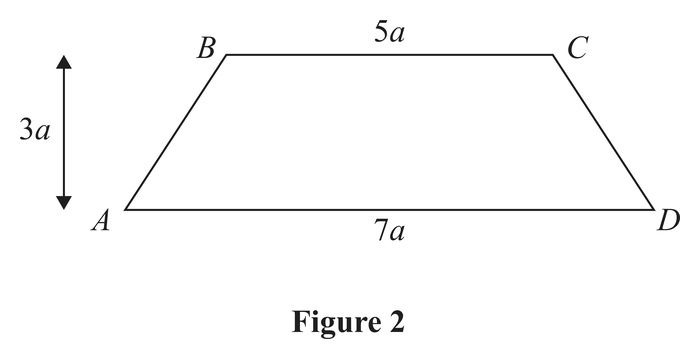
The uniform lamina ABCD shown in Figure 2 is in the shape of an isosceles trapezium.
- BC is parallel to AD and angle BAD is equal to angle ADC
- BC=5a and AD=7a
- the perpendicular distance between BC and AD is 3a
- the distance of the centre of mass of ABCD from AD is d
(a) Show that d=1217a
(5)
The uniform lamina PQRS is a rectangle with PQ=5a and QR=9a.
The lamina ABCD in Figure 2 is used to cut a hole in PQRS to form the template shown shaded in Figure 3.
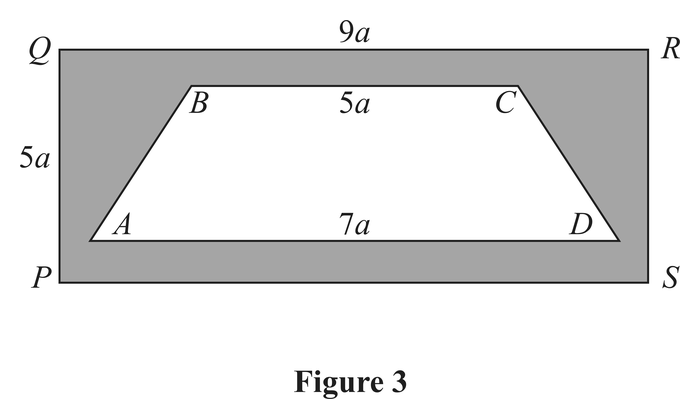
- PS is parallel to AD
- the perpendicular distance between PS and AD is a
- the perpendicular distance of A from PQ is a
The template is freely suspended from P and hangs in equilibrium with PS at an angle of θ∘ to the downward vertical.
(b) Find the value of θ
(7)
题目中文翻译
图 2 所示的均匀薄片 ABCD 为等腰梯形。
- BC 平行于 AD,且 ∠BAD=∠ADC;
- BC=5a,AD=7a;
- BC 与 AD 之间的垂直距离为 3a;
- ABCD 的质心到 AD 的距离为 d。
(a) 证明 d=1217a。
(5)
均匀薄片 PQRS 为长方形,PQ=5a,QR=9a。
从 PQRS 中挖去图 2 的薄片 ABCD,形成图 3 阴影所示的模板。
- PS 平行于 AD;
- PS 与 AD 之间的垂直距离为 a;
- A 到 PQ 的垂直距离为 a。
模板从 P 点自由悬挂并处于平衡状态,PS 与竖直向下方向成 θ∘ 角。
(b) 求 θ 的值。
(7)
解答
(a)
解法一
思路
展开
把等腰梯形分成中间长方形和两侧全等直角三角形。三角形底边各为 a,质心距 AD 为高度的三分之一。列面积矩并化简证明给定结果。
答题过程
展开
Split the trapezium into a central rectangle of width 5a and height 3a, and two congruent side triangles.
Each triangle has base
27a−5a=a,
so their combined area is
2(21a(3a))=3a2.
Their centroids are each 3a/3=a from AD. The rectangle has area 15a2 and centroid distance 3a/2 from AD.
The total area is 18a2. Taking moments of areas about AD,
18a2d=15a2(23a)+3a2(a).
Hence
18a2d=(245+3)a3=251a3.
Thus
d=1217a.
(b)
解法一
思路
展开
先用对称性确定质心到 PQ 的距离,再以负面积矩求其到 PS 的距离。悬挂时 PG 竖直,角度正切必须按相对于 PS 的两分量来取。
答题过程
展开
Let G be the template’s centre of mass. In the orientation of Figure 3, measure horizontal distances from PQ and vertical distances above PS.
Since A is a from PQ and AD=7a, the trapezium’s symmetry axis is
a+27a=29a
from PQ. This is also the symmetry axis of the rectangle, so G has horizontal coordinate
xˉ=29a.
The original rectangle has area 45a2 and centroid height 5a/2. The removed trapezium has area 18a2 and centroid height
a+d=a+1217a=1229a.
The remaining area is 45a2−18a2=27a2. Taking moments about PS,
27a2yˉ=45a2(25a)−18a2(1229a).
Thus
27a2yˉ=(2225−287)a3=69a3,
so
yˉ=923a.
When freely suspended from P, PG is vertically downwards. Therefore the angle between PS and PG satisfies
tanθ=xˉyˉ=9a/223a/9=8146.
Hence
θ=29.6∘.
