题目
Problem
7.
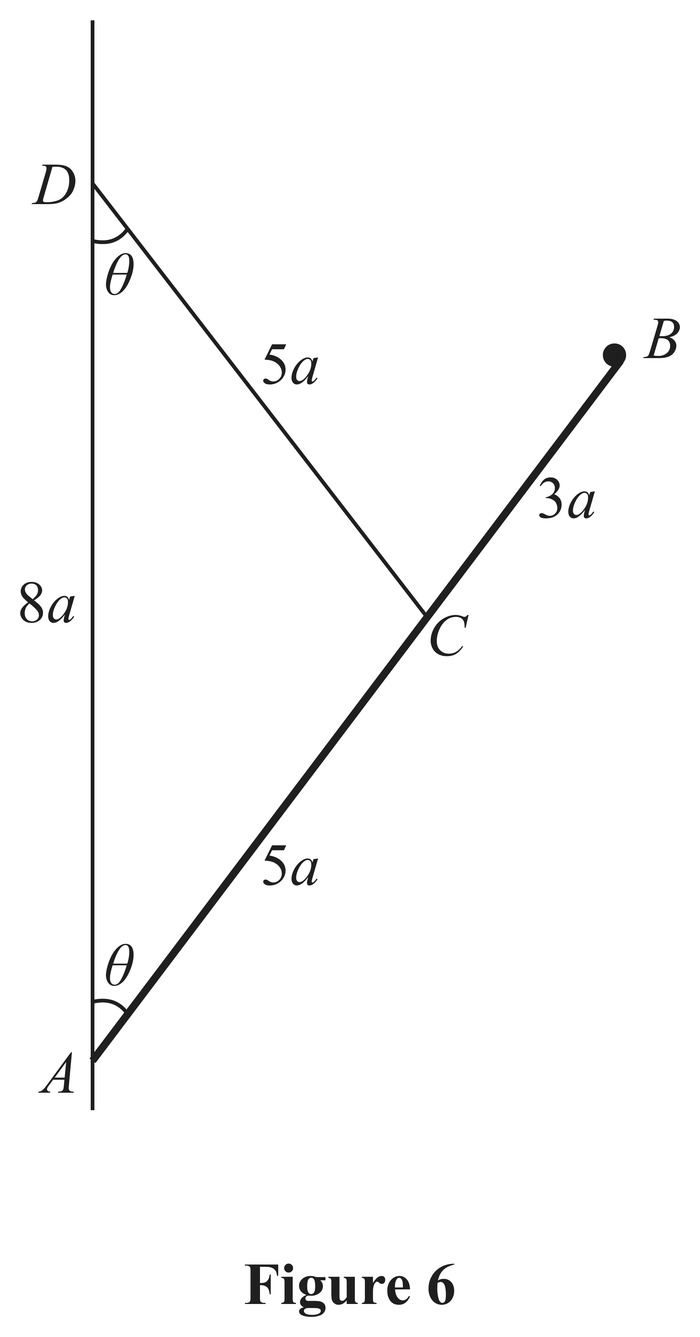
A uniform rod A B AB A B 8 a 8a 8 a 12 W 12W 12 W A A A W W W B B B 5 a 5a 5 a C C C A C = 5 a AC=5a A C = 5 a D D D D D D A A A A D = 8 a AD=8a A D = 8 a D A C = DAC= D A C = A D C = θ ADC=\theta A D C = θ
The rod and the particle rest in equilibrium.
The tension in the string is T T T
(a) Show that T = 7 W T=7W T = 7 W
(4)
The force exerted on the rod by the hinge at A A A α ∘ \alpha^\circ α ∘ 0 < α < 90 0<\alpha<90 0 < α < 90
(b) Find the value of α \alpha α
(6)
题目中文翻译
均匀杆 A B AB A B 8 a 8a 8 a 12 W 12W 12 W A A A W W W B B B 5 a 5a 5 a C C C A C = 5 a AC=5a A C = 5 a D D D D D D A A A A D = 8 a AD=8a A D = 8 a ∠ D A C = ∠ A D C = θ \angle DAC=\angle ADC=\theta ∠ D A C = ∠ A D C = θ
杆与质点处于静止平衡状态。
绳中的张力为 T T T
(a) 证明 T = 7 W T=7W T = 7 W
(4)
A A A α ∘ \alpha^\circ α ∘ 0 < α < 90 0<\alpha<90 0 < α < 90
(b) 求 α \alpha α
(6)
解答
(a)
解法一
思路
展开
证明题先从等腰三角形推导三角比,不能直接猜力臂。A C = C D = 5 a AC=CD=5a A C = C D = 5 a A D = 8 a AD=8a A D = 8 a 3 : 4 : 5 3:4:5 3 : 4 : 5
答题过程
展开
Triangle A C D ACD A C D A C = C D = 5 a AC=CD=5a A C = C D = 5 a A D = 8 a AD=8a A D = 8 a M M M A D AD A D
A M = D M = 4 a , C M = ( 5 a ) 2 − ( 4 a ) 2 = 3 a . AM=DM=4a,\qquad CM=\sqrt{(5a)^2-(4a)^2}=3a. A M = D M = 4 a , C M = ( 5 a ) 2 − ( 4 a ) 2 = 3 a . Thus
sin θ = 3 5 , cos θ = 4 5 . \sin\theta=\frac35,\qquad \cos\theta=\frac45. sin θ = 5 3 , cos θ = 5 4 . The rod’s weight 12 W 12W 12 W 4 a 4a 4 a A A A W W W 8 a 8a 8 a A A A
The angle between the rod direction A C AC A C C D CD C D 2 θ 2\theta 2 θ A A A
12 W ( 4 a sin θ ) + W ( 8 a sin θ ) = T ( 5 a sin 2 θ ) . 12W(4a\sin\theta)+W(8a\sin\theta)=T(5a\sin2\theta). 12 W ( 4 a sin θ ) + W ( 8 a sin θ ) = T ( 5 a sin 2 θ ) . Using sin 2 θ = 2 sin θ cos θ \sin2\theta=2\sin\theta\cos\theta sin 2 θ = 2 sin θ cos θ a sin θ a\sin\theta a sin θ
48 W + 8 W = 10 T cos θ . 48W+8W=10T\cos\theta. 48 W + 8 W = 10 T cos θ . Hence
56 W = 10 T ( 4 5 ) = 8 T , 56W=10T\left(\frac45\right)=8T, 56 W = 10 T ( 5 4 ) = 8 T , so
T = 7 W . \boxed{T=7W}. T = 7 W .
(b)
解法一
思路
展开
先求铰链力的水平、竖直分量。题目角度是铰链力相对于杆,而非相对于竖直;两者的竖直方向角相减才是所求。
答题过程
展开
Let the hinge force have components H H H V V V
The tension acts towards D D D
H = T sin θ = 7 W 3 5 = 21 5 W . H=T\sin\theta=7W\frac35=\frac{21}{5}W. H = T sin θ = 7 W 5 3 = 5 21 W . Resolving vertically,
V + T cos θ = 12 W + W , V+T\cos\theta=12W+W, V + T cos θ = 12 W + W , so
V = 13 W − 7 W 4 5 = 37 5 W . V=13W-7W\frac45=\frac{37}{5}W. V = 13 W − 7 W 5 4 = 5 37 W . Let the hinge force make angle β \beta β
tan β = H V = 21 37 . \tan\beta=\frac HV=\frac{21}{37}. tan β = V H = 37 21 . The rod makes angle θ \theta θ tan θ = 3 / 4 \tan\theta=3/4 tan θ = 3/4 21 / 37 < 3 / 4 21/37<3/4 21/37 < 3/4
α = θ − β = tan − 1 ( 3 4 ) − tan − 1 ( 21 37 ) . \alpha=\theta-\beta=\tan^{-1}\left(\frac34\right)-\tan^{-1}\left(\frac{21}{37}\right). α = θ − β = tan − 1 ( 4 3 ) − tan − 1 ( 37 21 ) . Therefore
α = 7.3 ∘ . \boxed{\alpha=7.3^\circ}. α = 7. 3 ∘ .
解法二
思路
展开
也可直接沿杆和垂直杆分解铰链力,得到相对于杆的角度。这样不需要求两个绝对方向角,且可独立检查角度定义。
答题过程
展开
Let the hinge force have components R ∥ R_{\parallel} R ∥ A B AB A B R ⊥ R_{\perp} R ⊥
Along the rod, equilibrium gives
R ∥ + T cos 2 θ = 13 W cos θ . R_{\parallel}+T\cos2\theta=13W\cos\theta. R ∥ + T cos 2 θ = 13 W cos θ . Since
cos 2 θ = 16 − 9 25 = 7 25 , \cos2\theta=\frac{16-9}{25}=\frac7{25}, cos 2 θ = 25 16 − 9 = 25 7 , we obtain
R ∥ = 13 W 4 5 − 7 W 7 25 = 211 25 W . R_{\parallel}=13W\frac45-7W\frac7{25}=\frac{211}{25}W. R ∥ = 13 W 5 4 − 7 W 25 7 = 25 211 W . Perpendicular to the rod,
R ⊥ + T sin 2 θ = 13 W sin θ . R_{\perp}+T\sin2\theta=13W\sin\theta. R ⊥ + T sin 2 θ = 13 W sin θ . Using sin 2 θ = 24 / 25 \sin2\theta=24/25 sin 2 θ = 24/25
R ⊥ = 13 W 3 5 − 7 W 24 25 = 27 25 W . R_{\perp}=13W\frac35-7W\frac{24}{25}=\frac{27}{25}W. R ⊥ = 13 W 5 3 − 7 W 25 24 = 25 27 W . Thus
tan α = R ⊥ R ∥ = 27 211 , \tan\alpha=\frac{R_{\perp}}{R_{\parallel}}=\frac{27}{211}, tan α = R ∥ R ⊥ = 211 27 , and therefore
α = 7.3 ∘ . \boxed{\alpha=7.3^\circ}. α = 7. 3 ∘ .