题目
Problem
3.
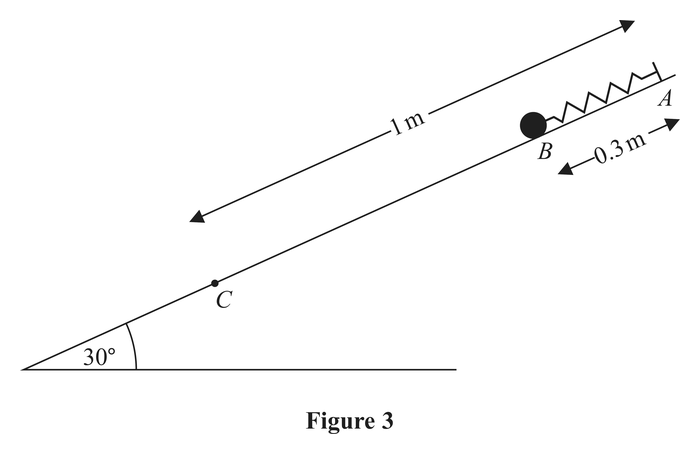
A particle P of mass 2kg is attached to one end of a light elastic spring, of natural length 0.8m and modulus of elasticity 12N. The other end of the spring is attached to a fixed point A on a rough plane. The plane is inclined at 30∘ to the horizontal. Initially P is held at rest on the plane at the point B, where B is below A, with AB=0.3m and AB lies along a line of greatest slope of the plane. The point C lies on the plane with AC=1m, as shown in Figure 3.
The coefficient of friction between P and the plane is 0.3
After being released P passes through the point C.
Find the speed of P at the instant it passes through C.
(7)
题目中文翻译
一个质量为 2kg 的质点 P 连接于一根原长为 0.8m、弹性模量为 12N 的弹性轻弹簧的一端。弹簧另一端固定于粗糙斜面上的 A 点。斜面与水平面成 30∘ 角。最初将 P 静止保持在斜面上的 B 点,B 位于 A 下方,AB=0.3m,且 AB 沿斜面的最大坡度线。如图 3 所示,C 点位于斜面上,AC=1m。
P 与斜面之间的摩擦系数为 0.3。
释放后,P 经过 C 点。
求 P 经过 C 的瞬间的速率。
(7)
解答
解法一
思路
展开
初始弹簧受压 0.5 米,末位置弹簧伸长 0.2 米,两者都有弹性势能。下滑的重力势能减少,同时摩擦耗能;弹力随位置变化,不能按匀加速处理。
答题过程
展开
The distance travelled down the plane is
BC=AC−AB=1−0.3=0.7 m.
Initially the spring is compressed by 0.8−0.3=0.5 m. At C it is extended by 1−0.8=0.2 m. Therefore the initial and final elastic energies are
EB=2(0.8)12(0.5)2,EC=2(0.8)12(0.2)2.
The spring acts along the plane, so the normal reaction is 2gcos30∘. The work done against friction is
Ef=0.3(2gcos30∘)(0.7).
The gravitational potential energy lost is 2g(0.7sin30∘).
Using the work–energy principle, with initial speed zero and speed v at C,
2(0.8)12(0.5)2+2g(0.7sin30∘)=2(0.8)12(0.2)2+0.3(2gcos30∘)(0.7)+21(2)v2.
Hence
v2=1.875+6.86−0.3−0.42(9.8)cos30∘=4.8704….
Thus
v=2.21 m s−1(3 s.f.).
