
题目
7.
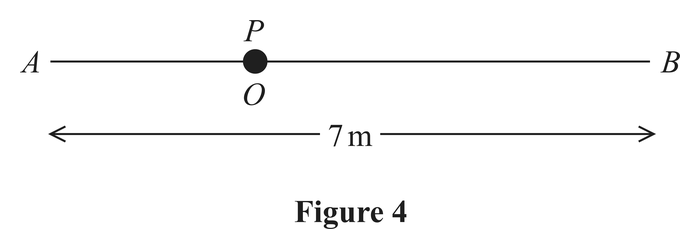
The fixed points and are apart on a smooth horizontal surface.
A light elastic string has natural length and modulus of elasticity . One end of the string is attached to a particle of mass and the other end is attached to
Another light elastic string has natural length and modulus of elasticity . One end of this string is attached to and the other end is attached to
The particle rests in equilibrium at the point , where is a straight line, as shown in Figure 4.
(a) Show that .
The particle now receives an impulse of magnitude in the direction
(b) (i) Show that initially moves with simple harmonic motion with centre
(ii) Determine the amplitude of this simple harmonic motion.
The point lies on . As passes through the string attached to becomes slack.
(c) Find the speed of as it passes through
(d) Find the time taken for to travel directly from to
题目中文翻译
光滑水平面上的两个固定点 、 相距 。
一根弹性轻绳的原长为 ,弹性模量为 。绳的一端连接于质量为 的质点 ,另一端连接于 。
另一根弹性轻绳的原长为 ,弹性模量为 。绳的一端连接于 ,另一端连接于 。
如图 4 所示,质点 静止平衡于 点,、、 共线。
(a) 证明 。
现在质点 受到沿 方向、大小为 的冲量。
(b) (i) 证明 最初做以 为中心的简谐运动。
(ii) 确定此简谐运动的振幅。
点位于 上。 经过 时,连接于 的绳变松。
(c) 求 经过 时的速率。
(d) 求 从 直接运动到 所需的时间。
解答
(a)
解法一
思路
展开
平衡时两绳张力相等。两绳实际长度之和为 7 米,伸长之和为 2 米;统一用 AO 表示长度。
答题过程
展开
Let m. Then m, and the extensions of the strings attached to and are and , respectively. By Hooke’s law and horizontal equilibrium,
Thus
(b)(i)
解法一
思路
展开
从平衡位置 O 向 B 量位移,两绳伸长分别增加和减少。列出两项张力后化简,只有两绳都绷紧的初段满足这个方程。
答题过程
展开
Let be the displacement from towards . Initially both strings are taut, with extensions m and m. At displacement , their tensions are
Resolving towards ,
Hence
The acceleration is proportional to the displacement and directed towards . Therefore the initial motion is SHM with centre and
(b)(ii)
解法一
思路
展开
冲量决定初速度。O 是初段简谐运动的中心,该处速率为相应简谐解的最大速率,用 vmax=Aω 求振幅参数。
答题过程
展开
The particle is initially at rest. The impulse gives
At , , so the corresponding SHM has maximum speed . If its amplitude is ,
Thus
This is the amplitude parameter of the initial SHM solution; that equation ceases to apply once either string becomes slack.
(c)
解法一
思路
展开
B 端绳长减到原长 3 米时松弛,因此 OC=1.5 米。此刻仍可用前一阶段的简谐运动速率公式。
答题过程
展开
At , m. Since m,
Using at the end of the initial SHM phase,
Therefore
解法二
思路
展开
也可比较 O 与 C 的两绳弹性势能。光滑桌面上没有摩擦,动能减少等于总弹性势能增加。
答题过程
展开
At the string extensions are m and m, so the total elastic energy is
At , the string has zero extension while the string has extension m. Thus
Conservation of energy gives
(d)
解法一
思路
展开
从 O 向 B 出发,所以以正弦写位移。取第一次到达 C 的锐相位,不用整个四分之一周期。
答题过程
展开
Take immediately after the impulse. Since and the initial velocity is towards ,
At the first arrival at , , giving
Since the particle is still moving towards , the phase lies between and . Therefore