
题目
5.
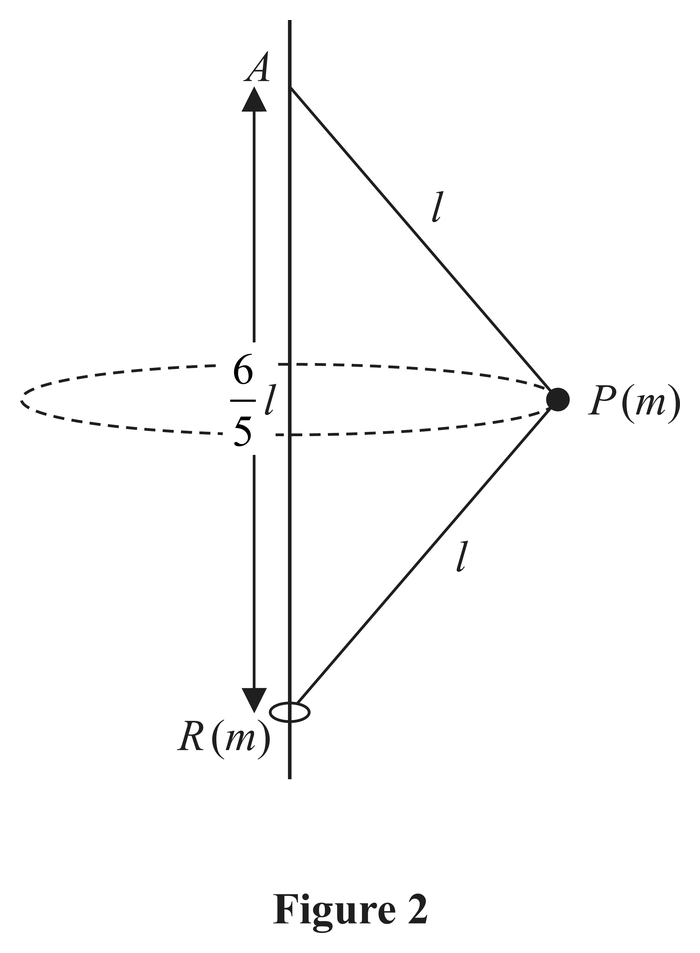
A small smooth ring of mass is threaded on to a thin smooth fixed vertical pole. One end of a light inextensible string of length is attached to a point on the pole. The other end of the string is attached to . A particle of mass is attached to the midpoint of the string. The particle moves with constant angular speed in a horizontal circle, with both halves of the string taut, and , as shown in Figure 2.
It may be assumed that in this motion the string does not wrap itself around the pole and that at any instant, the triangle lies in a vertical plane.
(a) Show that the tension in the lower half of the string is
(b) Find, in terms of and , the time for to complete one revolution.
题目中文翻译
一个质量为 的光滑小环 套在一根细、光滑且固定的竖直杆上。一根长为 的不可伸长轻绳的一端连接于杆上的 点,另一端连接于 。质量为 的质点 连接于绳的中点。如图 2 所示,质点 以恒定角速度做水平圆周运动,绳的两半均绷紧,且 。
可假设在此运动中,绳不会缠绕在杆上,且在任何瞬间,三角形 均位于竖直平面内。
(a) 证明绳的下半段中的张力为 。
(b) 用 和 表示 完成一整圈所需的时间。
解答
(a)
解法一
思路
展开
两段绳等长使 P 位于 AR 的中垂线上,先由几何求下段与竖直杆的夹角。小环没有竖直运动,光滑杆也没有竖直摩擦力。
答题过程
展开
Let , the angle between the lower string and the upward vertical. Since and , the vertical height from to the level of is . Thus
Let the lower tension be . For the ring , the pole exerts only a horizontal reaction. Vertical equilibrium gives
Therefore
(b)
解法一
思路
展开
P 固定于绳的中点,上下两段张力不必相等。先对 P 作竖直平衡求上段张力,再把两张力的水平分量相加作为向心力。
答题过程
展开
Let be the upper tension. For , the upper tension has an upward component, while the lower tension has a downward component. Vertical equilibrium gives
Using and ,
The radius of the circular path is
Both horizontal tension components act towards the pole, so
Hence
The time for one revolution is therefore