Skip to content
CalcGospel 國際數學圖譜
返回

M3 2022 Jan UNUSED Q7

A Level / Edexcel / M3

IAL 2022 Jan Unused Paper · Question 7

题目

Problem

7.

A particle PP of mass mm is attached to one end of a light elastic string of natural length aa and modulus of elasticity 2mg2mg. The other end of the string is attached to a fixed point OO on a rough plane which is inclined to the horizontal at an angle α\alpha

The string lies along a line of greatest slope of the plane.

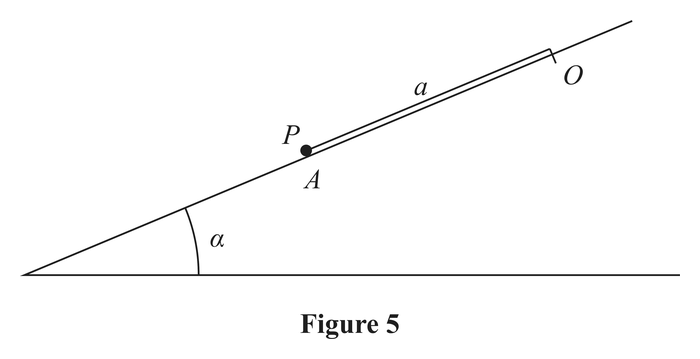
The particle PP is held at rest on the plane at the point AA, where OA=aOA=a, as shown in Figure 5.

The particle PP is released from AA and slides down the plane, coming to rest at the point BB. The coefficient of friction between PP and the plane is μ\mu, where μ<tan⁡α\mu<\tan\alpha

Air resistance is modelled as being negligible.

(a) Show that AB=a(sin⁡α−μcos⁡α)AB=a(\sin\alpha-\mu\cos\alpha).

(5)

Given that tan⁡α=34\tan\alpha=\dfrac34 and μ=12\mu=\dfrac12

(b) find, in terms of aa and gg, the maximum speed of PP as it moves from AA to BB

(7)

(c) Describe the motion of PP after it reaches BB, justifying your answer.

(3)
题目中文翻译

质量为 mm 的质点 PP 连接于一根原长为 aa、弹性模量为 2mg2mg 的弹性轻绳的一端,另一端连接于粗糙斜面上的固定点 OO。斜面与水平面成 α\alpha 角。

绳沿斜面的最大坡度线。

如图 5 所示,将质点 PP 静止保持在斜面上的 AA 点,其中 OA=aOA=a。

将质点 PP 从 AA 释放,它沿斜面下滑,并在 BB 点停下。PP 与斜面之间的摩擦系数为 μ\mu,其中 μ<tan⁡α\mu<\tan\alpha。

模型中忽略空气阻力。

(a) 证明 AB=a(sin⁡α−μcos⁡α)AB=a(\sin\alpha-\mu\cos\alpha)。

(5)

已知 tan⁡α=34\tan\alpha=\dfrac34 且 μ=12\mu=\dfrac12,

(b) 用 aa 和 gg 表示 PP 从 AA 到 BB 过程中的最大速率。

(7)

(c) 描述 PP 到达 BB 后的运动,并说明理由。

(3)

解答

(a)

解法一

思路

展开

开始时绳恰为原长,没有弹性能;到 B 时再次静止。重力势能减少用于储存弹性势能与克服摩擦,除去零位移的根后得到 AB。

答题过程

展开

Let AB=x>0AB=x>0. The string’s extension at BB is xx. The normal reaction is mgcos⁡αmg\cos\alpha, so the frictional force during the downward motion is μmgcos⁡α\mu mg\cos\alpha. The initial and final kinetic energies are zero. Work–energy therefore gives

mgxsin⁡α=2mgx22a+μmgcos⁡α x.mgx\sin\alpha=\frac{2mgx^2}{2a}+\mu mg\cos\alpha\,x.

Since x>0x>0, division by mgxmgx gives

sin⁡α=xa+μcos⁡α.\sin\alpha=\frac xa+\mu\cos\alpha.

Hence

AB=a(sin⁡α−μcos⁡α).\boxed{AB=a(\sin\alpha-\mu\cos\alpha)}.

The assumption μ<tan⁡α\mu<\tan\alpha ensures this distance is positive and the particle initially slides downwards.

(b)

解法一

思路

展开

对一般下滑距离写能量方程,得到速率平方的开口向下二次式。可配方直接求最大值,也可由合力为零找位置后代回能量式。

答题过程

展开

With tan⁡α=3/4\tan\alpha=3/4 and μ=1/2\mu=1/2,

sin⁡α=35,cos⁡α=45,sin⁡α−μcos⁡α=15.\sin\alpha=\frac35,\qquad \cos\alpha=\frac45,\qquad \sin\alpha-\mu\cos\alpha=\frac15.

At distance yy down the plane from AA, work–energy gives

mgysin⁡α=12mv2+2mgy22a+μmgcos⁡α y.mgy\sin\alpha=\frac12mv^2+\frac{2mgy^2}{2a}+\mu mg\cos\alpha\,y.

Therefore

v2=2g5y−2gay2.v^2=\frac{2g}{5}y-\frac{2g}{a}y^2.

Completing the square,

v2=ag50−2ga(y−a10)2.v^2=\frac{ag}{50}-\frac{2g}{a}\left(y-\frac a{10}\right)^2.

Since AB=a/5AB=a/5, the point y=a/10y=a/10 lies between AA and BB and gives the maximum. Hence

vmax⁡=ag50.\boxed{v_{\max}=\sqrt{\frac{ag}{50}}}.

解法二

思路

展开

张力随伸长增加,故沿坡合力从正变负。令其为零确定速率最大的位置,再用能量式求数值。

答题过程

展开

While the particle slides downwards, the tension at extension yy is 2mgy/a2mgy/a. The downward resultant is

mgsin⁡α−μmgcos⁡α−2mgya=mg(15−2ya).mg\sin\alpha-\mu mg\cos\alpha-\frac{2mgy}{a}=mg\left(\frac15-\frac{2y}{a}\right).

This decreases through zero at y=a/10y=a/10, so the speed increases before this point and decreases afterwards. Using work–energy at this point,

12mvmax⁡2=mg(a10)15−mga(a10)2=mga100.\frac12mv_{\max}^2=mg\left(\frac a{10}\right)\frac15-\frac{mg}{a}\left(\frac a{10}\right)^2=\frac{mga}{100}.

Therefore

vmax⁡=ag50.\boxed{v_{\max}=\sqrt{\frac{ag}{50}}}.

(c)

解法一

思路

展开

到 B 后不能继续假设摩擦力等于极限值。先算不含摩擦的沿坡合力,再与最大静摩擦力比较,确定能否保持静止。

答题过程

展开

From part (a), AB=a/5AB=a/5. Thus the tension at BB is

TB=2mg(a/5)a=25mg.T_B=\frac{2mg(a/5)}a=\frac25mg.

The component of weight down the plane is 3mg/53mg/5, so the resultant of weight and tension along the plane is

35mg−25mg=15mgdown the plane.\frac35mg-\frac25mg=\frac15mg\quad\text{down the plane}.

The greatest available static friction is

μR=12mg45=25mg.\mu R=\frac12mg\frac45=\frac25mg.

Since mg/5<2mg/5mg/5<2mg/5, friction of magnitude mg/5mg/5 can act up the plane and balance the other forces. Therefore P remains at rest at B\boxed{P\text{ remains at rest at }B}.