
题目
4.
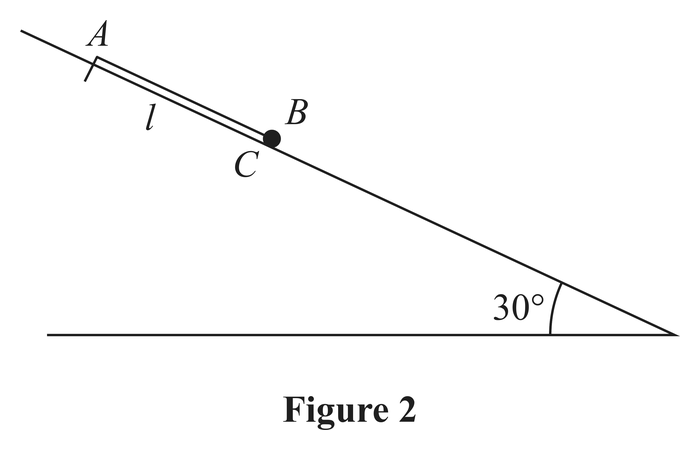
One end of a light elastic string, of natural length and modulus of elasticity , is fixed to a point on a smooth plane. The plane is inclined at to the horizontal.
A small ball of mass is attached to the other end of the elastic string. Initially, is held at rest at the point on the plane with the elastic string lying along a line of greatest slope of the plane.
The point is below and , as shown in Figure 2.
The ball is released and comes to instantaneous rest at a point on the plane.
The points , and all lie along a line of greatest slope of the plane and
The ball is modelled as a particle and air resistance is modelled as being negligible.
Using the model,
(a) show that
(b) find, in terms of and , the greatest speed of as it moves from to
题目中文翻译
一根原长为 、弹性模量为 的弹性轻绳的一端固定于光滑斜面上的 点,斜面与水平面成 角。
质量为 的小球 连接于弹性绳的另一端。最初将 静止保持在斜面上的 点,弹性绳沿斜面的最大坡度线。
如图 2 所示, 位于 下方,且 。
释放小球后,它在斜面上的 点瞬时静止。
、、 均位于斜面的同一条最大坡度线上,且 。
将小球视为质点,并忽略空气阻力。
利用此模型,
(a) 证明 ;
(b) 用 和 表示 从 到 过程中的最大速率。
解答
(a)
解法一
思路
展开
在 两点速率都为零。重力势能损失全部成为绳的弹性势能;下降高度是沿斜面路程乘 。
答题过程
展开
At the string has its natural length, so its elastic potential energy is zero. At its extension is
The vertical fall from to is
The plane is smooth and the ball is at rest at both ends. Conservation of energy gives
Cancelling and multiplying by ,
(b)
解法一
思路
展开
沿坡向下的重力分量不变,张力随伸长增加。先加速后减速,合力为零处取得最大速率;再从 写能量方程。
答题过程
展开
Let be the extension of the string. During the motion from to , . Resolving down the plane,
The acceleration is positive for and negative for . Since the ball moves down the plane between and , its speed is greatest when
At this position, conservation of energy from gives
Hence
Taking the positive root,
解法二
思路
展开
把位移改为从沿坡平衡位置量起,恢复力正比于反向位移,便可用简谐运动的中心最大速率。
答题过程
展开
At the equilibrium position ,
Let be displacement down the plane from . The extension is , so
Therefore
At the ball is released from rest at . Its amplitude is . Throughout the motion to , the extension is non-negative, so the SHM equation applies. The greatest speed occurs at and is