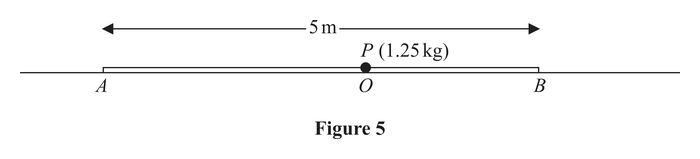
Figure 5 shows two fixed points, A and B, which are 5m apart on a smooth horizontal floor.
A particle P of mass 1.25kg is attached to one end of a light elastic string, of natural length 2m and modulus of elasticity 20N. The other end of the string is attached to A
A second light elastic string, of natural length 1.2m and modulus of elasticity λ newtons, has one end attached to P and the other end attached to B
Initially P rests in equilibrium at the point O, where AO=3m
(a) Show that λ=15
(3)
The particle is now projected along the floor towards B
At time t seconds, P is a displacement x metres from O in the direction OB
(b) Show that, while both strings are taut, P moves with simple harmonic motion where x¨=−18x
(4)
The initial speed of P is 10ms−1
(c) Find the speed of P at the instant when the string PB becomes slack.
(3)
Both strings are taut for T seconds during one complete oscillation.
(d) Find the value of T
(6)
题目中文翻译
图 5 所示的两个固定点 A、B 位于光滑水平地面上,相距 5m。
质量为 1.25kg 的质点 P 连接于一根原长为 2m、弹性模量为 20N 的弹性轻绳的一端,另一端连接于 A。
第二根弹性轻绳的原长为 1.2m,弹性模量为 λ 牛顿,一端连接于 P,另一端连接于 B。
最初,P 静止平衡于 O 点,其中 AO=3m。
(a) 证明 λ=15。
(3)
现在将质点沿地面向 B 发射。
在 t 秒时,P 相对于 O 沿 OB 方向的位移为 x 米。
(b) 证明两根绳均绷紧时,P 做简谐运动,且 x¨=−18x。
(4)
P 的初速率为 10ms−1。
(c) 求绳 PB 变松的瞬间 P 的速率。
一次完整振动中,两根绳均绷紧的时间为 T 秒。
(3)
(d) 求 T 的值。
(6)
解答
(a)
解法一
思路
展开
静止时两根绳的张力相等,但原长、伸长和模量均不同,应分别用胡克定律。
答题过程
展开
Initially AP=AO=3m and PB=5−3=2m. Hence the extensions of AP and PB are respectively
3−2=1m,2−1.2=0.8m.
By Hooke’s law the tensions are
TA=220(1)=10N,TB=1.2λ(0.8).
Horizontal equilibrium requires TA=TB, so
10=1.20.8λ,λ=15.
(b)
解法一
思路
展开
向 B 移动时,左绳伸长增加、右绳伸长减少。恢复方程只适用于两绳同时绷紧的区间,不能直接把它扩展到整次振动。
答题过程
展开
When P has displacement x towards B, the two lengths and extensions are
AP=3+x,eA=1+x;PB=2−x,eB=0.8−x.
While both strings are taut, −1<x<0.8. Resolving towards B,
The acceleration is proportional to the displacement from O and directed towards O. Hence the motion is SHM, with ω=18s−1, while both strings remain taut.
(c)
解法一
思路
展开
初速度在中心给出简谐运动的幅度参数。右绳伸长减至零时 x=0.8;这早于此段简谐运动的形式端点。
答题过程
展开
For the initial SHM segment, let its amplitude parameter be b. At O, x=0 and the speed is 10ms−1, so
10=ωb,b=1810.
The string PB becomes slack when PB=1.2m, that is,
2−x=1.2,x=0.8.
Using v2=ω2(b2−x2) gives
v2=18[(1810)2−0.82]=100−11.52=88.48.
Therefore
v=88.48≈9.41ms−1.
The parameter b describes the solution while both strings are taut; it is not the amplitude of the complete motion after either string becomes slack.
解法二
思路
展开
能量法要把两根绳的弹性势能都计入。右绳刚松时弹性势能为零,但左绳的伸长已由 1 增至 1.8。
答题过程
展开
Initially the total kinetic and elastic potential energy is
21(1.25)(10)2+2(2)20(1)2+2(1.2)15(0.8)2.
When PB becomes slack, x=0.8, so the extension of AP is 1.8m and that of PB is zero. Conservation of energy gives
The string PB reaches its natural length at x=0.8, and PA reaches its natural length when
3+x=2,x=−1.
Thus both strings are taut only for −1<x<0.8. Boundary instants do not change the total duration.
For the initial motion from O towards B,
x=1810sin(18t).
Let tR be the time from O to the right-hand boundary. The first, acute phase gives
tR=181sin−1(100.818)≈0.0816s.
The system has no dissipative forces. On returning to O, P therefore has speed 10ms−1, now towards A. For this passage, let s be time measured from that crossing. While both strings are taut,
x=−1810sin(18s).
The time tL from O to the left-hand boundary x=−1 is consequently
tL=181sin−1(1018)≈0.1033s.
During one complete oscillation, each of the intervals from O to these boundaries is traversed once in each direction. The times are equal on the outward and return passages by conservation of energy. Hence