Skip to content
CalcGospel 國際數學圖譜
返回

M3 2023 Jan Q7

A Level / Edexcel / M3

IAL 2023 Jan Paper · Question 7

题目

Problem

7.

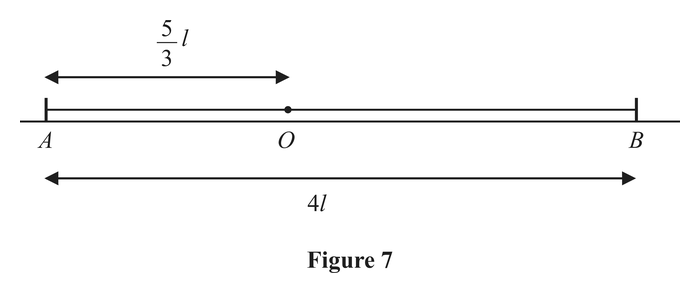
Two points AA and BB lie on a smooth horizontal table where AB=4lAB=4l.

A particle PP of mass mm is attached to one end of a light elastic spring of natural length ll and modulus of elasticity 2mg2mg. The other end of the spring is attached to AA. The particle PP is also attached to one end of another light elastic spring of natural length ll and modulus of elasticity mgmg. The other end of the spring is attached to BB.

The particle PP rests in equilibrium on the table at the point OO, where AO=53lAO=\dfrac53l, as shown in Figure 7.

The particle PP is moved a distance 12l\dfrac12l along the table, from OO towards AA, and released from rest.

(a) Show that PP moves with simple harmonic motion of period TT, where

T=2πl3gT=2\pi\sqrt{\frac l{3g}}
(6)

(b) Find, in terms of ll and gg, the speed of PP as it passes through OO.

(1)

(c) Find, in terms of gg, the maximum acceleration of PP.

(1)

(d) Find the exact time, in terms of ll and gg, from the instant when PP is released from rest to the instant when PP is first moving with speed 34gl\dfrac34\sqrt{gl}

(5)
题目中文翻译

光滑水平桌面上的两点 AA、BB 满足 AB=4lAB=4l。

质量为 mm 的质点 PP 连接于一根原长为 ll、弹性模量为 2mg2mg 的弹性轻弹簧的一端,另一端连接于 AA。质点 PP 也连接于另一根原长为 ll、弹性模量为 mgmg 的弹性轻弹簧的一端,另一端连接于 BB。

如图 7 所示,质点 PP 静止平衡于桌面上的 OO 点,其中 AO=53lAO=\dfrac53l。

将质点 PP 沿桌面从 OO 向 AA 移动距离 12l\dfrac12l 后由静止释放。

(a) 证明 PP 做周期为 TT 的简谐运动,其中

T=2πl3gT=2\pi\sqrt{\frac l{3g}}
(6)

(b) 用 ll 和 gg 表示 PP 经过 OO 时的速率。

(1)

(c) 用 gg 表示 PP 的最大加速度大小。

(1)

(d) 用 ll 和 gg 表示从释放 PP 的瞬间到 PP 首次以速率 34gl\dfrac34\sqrt{gl} 运动的瞬间所用的精确时间。

(5)

解答

(a)

解法一

思路

展开

取从平衡位置向 AA 的位移为正。左弹簧的伸长减少,右弹簧的伸长增加;两力相减后常数项抵消。写出恢复方程后再推出周期。

答题过程

展开

Let xx be displacement from OO towards AA. Since AO=5l/3AO=5l/3 and OB=7l/3OB=7l/3, the spring lengths and extensions are

AP=5l3−x,eA=2l3−x;PB=7l3+x,eB=4l3+x.AP=\frac{5l}{3}-x,\quad e_A=\frac{2l}{3}-x; \qquad PB=\frac{7l}{3}+x,\quad e_B=\frac{4l}{3}+x.

Resolving towards AA and applying Hooke’s law,

mx¨= 2mgl(2l3−x)−mgl(4l3+x)= (43mg−2mglx)−(43mg+mglx)= −3mglx.\begin{align*} m\ddot x=&\,\frac{2mg}{l}\left(\frac{2l}{3}-x\right) -\frac{mg}{l}\left(\frac{4l}{3}+x\right)\\ =&\,\left(\frac43mg-\frac{2mg}{l}x\right) -\left(\frac43mg+\frac{mg}{l}x\right)\\ =&\,-\frac{3mg}{l}x. \end{align*}

Therefore

x¨=−3glx.\ddot x=-\frac{3g}{l}x.

The acceleration is proportional to the displacement from OO and directed towards OO, so the motion is SHM with

ω=3gl.\omega=\sqrt{\frac{3g}{l}}.

The particle is released from rest at x=l/2x=l/2, so the amplitude is b=l/2b=l/2. Over −l/2≤x≤l/2-l/2\leq x\leq l/2, both extensions remain positive: their minimum values are l/6l/6 and 5l/65l/6. Thus the force equation applies throughout the oscillation. Its period is

T=2πω=2πl3g.\boxed{T=\frac{2\pi}{\omega}=2\pi\sqrt{\frac{l}{3g}}.}

(b)

解法一

思路

展开

经过平衡位置时,速率达到振幅乘角频率。题目要速率,因此结果取正。

答题过程

展开

At OO, the speed is the maximum SHM speed:

vO=bω=l23gl=123gl.\boxed{v_O=b\omega=\frac l2\sqrt{\frac{3g}{l}} =\frac12\sqrt{3gl}.}

(c)

解法一

思路

展开

加速度大小与离平衡位置的距离成正比,因此在两个端点最大。

答题过程

展开

The acceleration magnitude is ω2∣x∣\omega^2|x|, so its maximum occurs at ∣x∣=b=l/2|x|=b=l/2:

amax⁡=ω2b=3gll2=3g2.\boxed{a_{\max}=\omega^2b=\frac{3g}{l}\frac l2=\frac{3g}{2}.}

(d)

解法一

思路

展开

从正端点静止释放,用余弦位移;第一次向中心运动时速度为负。题给速率要转换为这个阶段的负速度,并选择第一次达到所需速率的锐角相位。

答题过程

展开

Take t=0t=0 at release. Since x(0)=l/2x(0)=l/2 and x˙(0)=0\dot x(0)=0,

x=l2cos⁡(ωt),x˙=−l2ωsin⁡(ωt),ω=3gl.x=\frac l2\cos(\omega t), \qquad \dot x=-\frac l2\omega\sin(\omega t), \qquad \omega=\sqrt{\frac{3g}{l}}.

On the first passage towards OO, x˙<0\dot x<0. Thus the required speed 3gl/43\sqrt{gl}/4 corresponds to

−123glsin⁡(ωt)=−34gl.-\frac12\sqrt{3gl}\sin(\omega t) =-\frac34\sqrt{gl}.

Dividing gives

sin⁡(ωt)=323=32.\sin(\omega t)=\frac{3}{2\sqrt3}=\frac{\sqrt3}{2}.

The speed increases from zero to its maximum on 0<ωt<π/20<\omega t<\pi/2, so the first solution is ωt=π/3\omega t=\pi/3. Hence

t=π3l3g.\boxed{t=\frac{\pi}{3}\sqrt{\frac{l}{3g}}.}

解法二

思路

展开

先由速率—位移关系找出第一次达到目标速率时的位置,再代入端点释放的余弦方程。平方后有两个位置,必须选择首次运动途中的正位移。

答题过程

展开

For SHM,

v2=ω2(b2−x2),b=l2,ω2=3gl.v^2=\omega^2(b^2-x^2), \qquad b=\frac l2,\quad \omega^2=\frac{3g}{l}.

At the required speed,

9gl16=3gl(l24−x2).\frac{9gl}{16}=\frac{3g}{l}\left(\frac{l^2}{4}-x^2\right).

Cancelling 3g/l3g/l and rearranging,

3l216=l24−x2,x2=l216.\frac{3l^2}{16}=\frac{l^2}{4}-x^2, \qquad x^2=\frac{l^2}{16}.

The particle starts at x=l/2x=l/2 and initially moves towards OO, so it first reaches the required speed at x=l/4x=l/4, rather than x=−l/4x=-l/4.

With time measured from release,

l4=l2cos⁡(ωt),cos⁡(ωt)=12.\frac l4=\frac l2\cos(\omega t), \qquad \cos(\omega t)=\frac12.

The first phase is ωt=π/3\omega t=\pi/3, giving

t=π3l3g.\boxed{t=\frac{\pi}{3}\sqrt{\frac{l}{3g}}.}