Skip to content
CalcGospel 國際數學圖譜
返回

M3 2025 Jan Q7

A Level / Edexcel / M3

IAL 2025 Jan Paper · Question 7

题目

Problem

7.

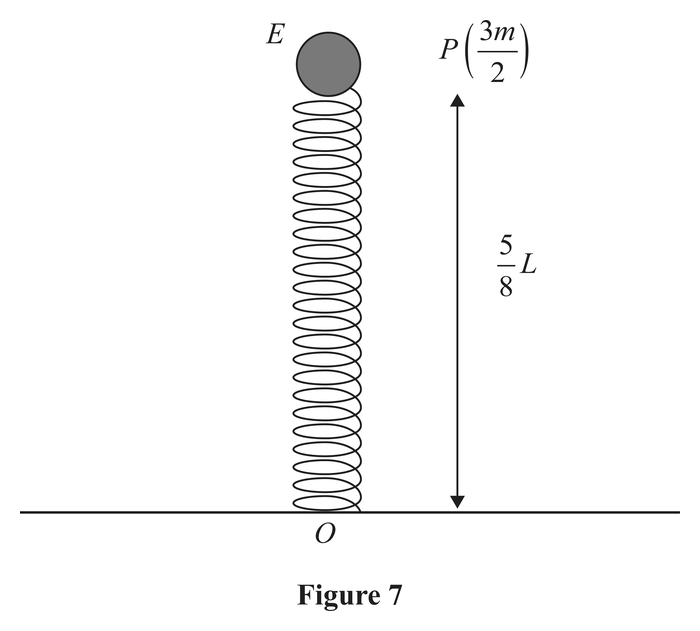
A light elastic spring has natural length LL and modulus of elasticity 4mg4mg. One end of the spring is attached to a point OO on a horizontal surface. The other end is attached to a particle PP of mass 3m2\dfrac{3m}2. The particle is at rest in equilibrium at the point EE, with the spring vertical and OE=58LOE=\dfrac58L, as shown in Figure 7.

The particle PP is then pushed vertically downwards through a distance 12L\dfrac12L and, at time t=0t=0, released from rest.

(a) Show that PP then moves with simple harmonic motion about EE, with period π3L2g\pi\sqrt{\dfrac{3L}{2g}}

(6)

(b) Find the exact value of tt at the instant when PP is first moving upwards and decelerating with magnitude 23g\dfrac23g

(5)
题目中文翻译

一根弹性轻弹簧的原长为 LL,弹性模量为 4mg4mg。弹簧的一端连接于水平面上的 OO 点,另一端连接于质量为 3m2\dfrac{3m}2 的质点 PP。如图 7 所示,质点静止平衡于 EE 点,弹簧竖直,且 OE=58LOE=\dfrac58L。

随后将质点 PP 竖直向下压低距离 12L\dfrac12L,并在 t=0t=0 时由静止释放。

(a) 证明 PP 随后绕 EE 做周期为 π3L2g\pi\sqrt{\dfrac{3L}{2g}} 的简谐运动。

(6)

(b) 求 PP 首次向上运动且以大小为 23g\dfrac23g 的加速度减速的瞬间的 tt 的精确值。

(5)

解答

(a)

解法一

思路

展开

弹簧原本受压,取从 EE 向上的位移。压缩量为 3L/8−x3L/8-x,可作为有符号压缩量使用;超过原长后弹簧会向下拉,仍满足同一恢复方程。

答题过程

展开

Take displacement xx upwards from EE. At equilibrium the spring’s compression is

L−OE=L−5L8=3L8.L-OE=L-\frac{5L}{8}=\frac{3L}{8}.

At displacement xx, its length is 5L/8+x5L/8+x and its signed compression is 3L/8−x3L/8-x. The upward spring force is therefore

Fs=4mgL(3L8−x).F_s=\frac{4mg}{L}\left(\frac{3L}{8}-x\right).

With particle mass 3m/23m/2, resolving upwards gives

3m2x¨= 4mgL(3L8−x)−3mg2= 3mg2−4mgLx−3mg2= −4mgLx.\begin{align*} \frac{3m}{2}\ddot x =&\,\frac{4mg}{L}\left(\frac{3L}{8}-x\right)-\frac{3mg}{2}\\ =&\,\frac{3mg}{2}-\frac{4mg}{L}x-\frac{3mg}{2}\\ =&\,-\frac{4mg}{L}x. \end{align*}

Hence

x¨=−8g3Lx.\ddot x=-\frac{8g}{3L}x.

The acceleration is proportional to the displacement from EE and directed towards EE, so the motion is SHM with

ω=8g3L.\omega=\sqrt{\frac{8g}{3L}}.

The amplitude is L/2L/2, because the particle is released from rest at x=−L/2x=-L/2. Its minimum height above the surface is 5L/8−L/2=L/8>05L/8-L/2=L/8>0. The spring can exert both a compressive and a tensile force, so the same force equation remains applicable throughout the oscillation.

Its period is

2πω=2π3L8g=π3L2g.\boxed{\frac{2\pi}{\omega} =2\pi\sqrt{\frac{3L}{8g}} =\pi\sqrt{\frac{3L}{2g}}.}

(b)

解法一

思路

展开

向上运动却在减速,说明加速度向下,即有符号加速度为 −2g/3-2g/3。由恢复方程先求位置,再从最初的下端点选择第一次到达该位置的相位。

答题过程

展开

The amplitude is L/2L/2. At release x=−L/2x=-L/2 and x˙=0\dot x=0, so

x=−L2cos⁡(ωt),x˙=Lω2sin⁡(ωt),ω=8g3L.x=-\frac L2\cos(\omega t), \qquad \dot x=\frac{L\omega}{2}\sin(\omega t), \qquad \omega=\sqrt{\frac{8g}{3L}}.

Moving upwards and decelerating means x˙>0\dot x>0 and x¨=−2g/3\ddot x=-2g/3. Using part (a),

−2g3=−8g3Lx,x=L4.-\frac{2g}{3}=-\frac{8g}{3L}x, \qquad x=\frac L4.

Substituting into the displacement equation,

L4=−L2cos⁡(ωt),cos⁡(ωt)=−12.\frac L4=-\frac L2\cos(\omega t), \qquad \cos(\omega t)=-\frac12.

During the first upward passage, 0<ωt<π0<\omega t<\pi, so x˙>0\dot x>0. The first relevant phase is ωt=2π/3\omega t=2\pi/3. Therefore

t=2π33L8g.\boxed{t=\frac{2\pi}{3}\sqrt{\frac{3L}{8g}}.}