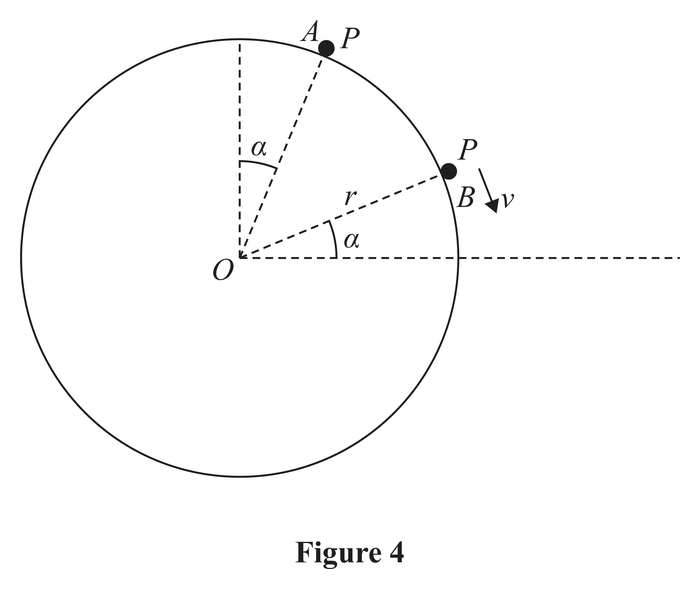
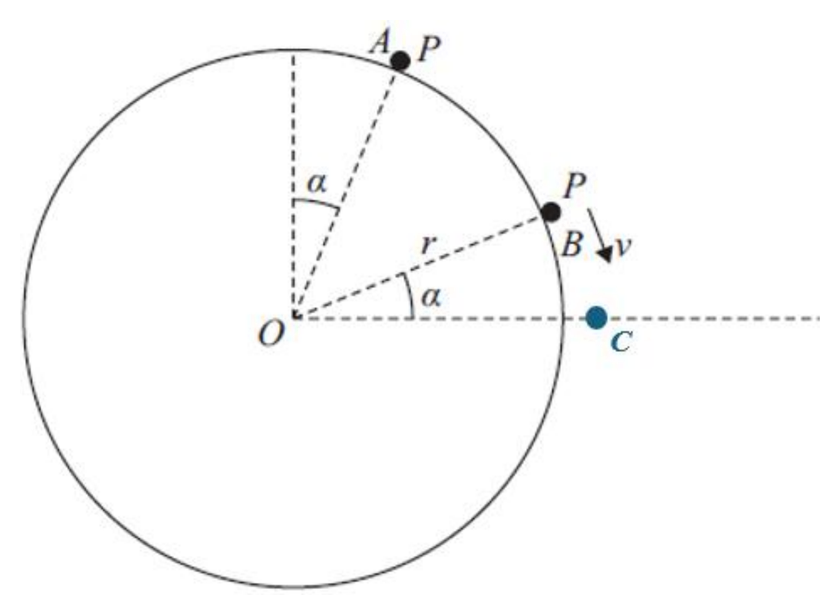
A particle P of mass m is held at the point A on the smooth outer surface of the sphere, where OA makes an angle α, where α<45∘, with the upward vertical.
The particle is released from rest and leaves the surface of the sphere at the point B, where OB makes an angle α with the horizontal, with speed v, as shown in Figure 4.
Air resistance is assumed to be negligible.
(a) Show that v2=2gr(cosα−sinα)
(3)
(b) Show that tanα=32
(4)
At the instant when P crosses the horizontal through O, P is moving at an angle θ to the horizontal.
(c) Show that cosθ=392
(7)
题目中文翻译
一个固定实心球的球心为 O,半径为 r。
质量为 m 的质点 P 被保持在球的光滑外表面上的 A 点,OA 与竖直向上方向成 α 角,其中 α<45∘。
如图 4 所示,将质点由静止释放后,它在 B 点以速率 v 离开球面,OB 与水平面成 α 角。
假设空气阻力可忽略。
(a) 证明 v2=2gr(cosα−sinα)。
(3)
(b) 证明 tanα=32。
(4)
P 经过过 O 的水平线的瞬间,其运动方向与水平面成 θ 角。
(c) 证明 cosθ=392。
(7)
解答
(a)
解法一
思路
展开
A 点的角度从竖直量起,B 点的角度从水平量起,因此两点高度分别为 rcosα 与 rsinα。支持力不做功,用下降的高度差求动能。
答题过程
展开
Relative to the horizontal through O, the heights of A and B are rcosα and rsinα respectively. The particle starts from rest and the normal reaction does no work, so
At B, the particle leaves the sphere, so the normal reaction is zero. Resolving towards O gives
mgsinα=rmv2.
Using part (a),
gsinα=2g(cosα−sinα),
so
3sinα=2cosα.
Dividing by 3cosα,
tanα=32.
(c)
解法一
思路
展开
离开球面后水平速度保持不变。用从 A 到过 O 水平面的总能量求末速率,再取水平分量与速率之比,避免先把角度换成小数。
答题过程
展开
Let C be the point where the projectile crosses the horizontal through O, and let its speed there be W. From part (b),
sinα=132,cosα=133.
At B, the velocity is tangent to the sphere, downwards and to the right. Its horizontal component is vsinα. This stays constant during the flight, so
Wcosθ=vsinα.(1)
By part (a),
v2=132gr.
Conservation of energy from rest at A to C gives
21mW2=mgrcosα,W2=136gr.
Squaring (1) and using these exact expressions,
cos2θ=W2v2sin2α=6gr/13(2gr/13)(4/13)=394.
Since θ is the acute angle below the horizontal,
cosθ=392.
解法二
思路
展开
另一条路线是分开计算落至 C 时的水平、竖直速度。竖直方向可用常加速度公式,因为离开球面后仅受重力。
答题过程
展开
From part (b), sinα=2/13 and cosα=3/13; part (a) gives v2=2gr/13.
The initial horizontal and downward vertical velocity components at B are vsinα and vcosα. The horizontal component remains constant, so its square at C is
wx2=v2sin2α=13138gr.
The fall from B to C is rsinα. Applying the vertical constant-acceleration equation,