Skip to content
CalcGospel 國際數學圖譜
返回

M3 2025 June Q7

A Level / Edexcel / M3

IAL 2025 June Paper · Question 7

题目

Problem

7.

A particle PP of mass mm lies at rest on a smooth horizontal table.

One end of a light elastic string, of natural length 3L3L and modulus of elasticity mgmg, is attached to PP. The other end is attached to a point AA on the table.

One end of a second light elastic string, of natural length 2L2L and modulus of elasticity 2mg2mg, is also attached to PP. The other end is attached to a point BB on the table where AB=7LAB=7L.

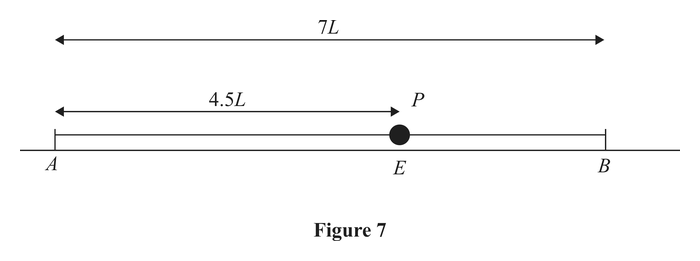
The particle PP rests in equilibrium on the table at the point EE, where AEBAEB is a straight line and AE=4.5LAE=4.5L, as shown in Figure 7.

The particle PP is now held at the point CC on ABAB, where AC=5LAC=5L, and released.

(a) Show that PP moves with simple harmonic motion with centre EE and period π3Lg\pi\sqrt{\dfrac{3L}g}

(7)

(b) Find, in terms of LL and gg, the maximum speed of PP.

(3)

(c) Find, in terms of LL and gg, the exact amount of time, in any one oscillation, for which the speed of PP is less than or equal to gL12\sqrt{\dfrac{gL}{12}}

(6)
题目中文翻译

质量为 mm 的质点 PP 静止于光滑水平桌面上。

一根原长为 3L3L、弹性模量为 mgmg 的弹性轻绳的一端连接于 PP,另一端连接于桌面上的 AA 点。

第二根弹性轻绳的原长为 2L2L,弹性模量为 2mg2mg,一端也连接于 PP,另一端连接于桌面上的 BB 点,其中 AB=7LAB=7L。

如图 7 所示,质点 PP 静止平衡于桌面上的 EE 点,AA、EE、BB 共线,且 AE=4.5LAE=4.5L。

现在将质点 PP 保持在 ABAB 上的 CC 点,其中 AC=5LAC=5L,然后释放。

(a) 证明 PP 做以 EE 为中心、周期为 π3Lg\pi\sqrt{\dfrac{3L}g} 的简谐运动。

(7)

(b) 用 LL 和 gg 表示 PP 的最大速率。

(3)

(c) 用 LL 和 gg 表示在任意一次完整振动中,PP 的速率小于或等于 gL12\sqrt{\dfrac{gL}{12}} 的精确持续时间。

(6)

解答

(a)

解法一

思路

展开

从平衡点 EE 向 BB 量位移。两个绳的模量及原长不同,应分别代入胡克定律。还需检查振幅范围内没有真正的松绳运动段。

答题过程

展开

Let xx be displacement from EE towards BB. Since AE=4.5LAE=4.5L and EB=2.5LEB=2.5L, the string extensions are

eA=1.5L+x,eB=0.5L−x.e_A=1.5L+x,\qquad e_B=0.5L-x.

Resolving towards BB and applying Hooke’s law,

mx¨= 2mg2L(0.5L−x)−mg3L(1.5L+x)= (mg2−mgLx)−(mg2+mg3Lx)= −4mg3Lx.\begin{align*} m\ddot x=&\,\frac{2mg}{2L}(0.5L-x) -\frac{mg}{3L}(1.5L+x)\\ =&\,\left(\frac{mg}{2}-\frac{mg}{L}x\right) -\left(\frac{mg}{2}+\frac{mg}{3L}x\right)\\ =&\,-\frac{4mg}{3L}x. \end{align*}

Thus

x¨=−4g3Lx.\ddot x=-\frac{4g}{3L}x.

The acceleration is proportional to displacement from EE and directed towards EE, so the motion is SHM with

ω=4g3L.\omega=\sqrt{\frac{4g}{3L}}.

The particle is released from rest at AC=5LAC=5L, so its amplitude is b=5L−4.5L=L/2b=5L-4.5L=L/2. For −L/2≤x≤L/2-L/2\leq x\leq L/2, eAe_A is always positive and eB≥0e_B\geq0. At the right-hand endpoint eB=0e_B=0, but the resultant force points back towards EE, so the particle immediately moves back into the region eB>0e_B>0. There is no interval of slack-string motion.

The period is therefore

T=2πω=2π3L4g=π3Lg.\boxed{T=\frac{2\pi}{\omega} =2\pi\sqrt{\frac{3L}{4g}} =\pi\sqrt{\frac{3L}{g}}.}

(b)

解法一

思路

展开

端点释放给出振幅 L/2L/2。经过 EE 时速率最大,等于振幅乘角频率。

答题过程

展开

The amplitude is b=L/2b=L/2. Hence the maximum speed, reached at EE, is

vmax⁡=bω=L24g3L=gL3.\boxed{v_{\max}=b\omega =\frac L2\sqrt{\frac{4g}{3L}} =\sqrt{\frac{gL}{3}}.}

(c)

解法一

思路

展开

目标速率是最大速率的一半。速率较小的时间位于两个端点附近,一次完整振动内共有四段相同的时间,不能只算第一次达到阈值的时间。

答题过程

展开

Take t=0t=0 at release from CC. Then

x=L2cos⁡(ωt),x˙=−gL3sin⁡(ωt).x=\frac L2\cos(\omega t), \qquad \dot x=-\sqrt{\frac{gL}{3}}\sin(\omega t).

The required speed condition is

∣x˙∣≤gL12⟺∣sin⁡(ωt)∣≤12.|\dot x|\leq\sqrt{\frac{gL}{12}} \quad\Longleftrightarrow\quad |\sin(\omega t)|\leq\frac12.

During one complete oscillation, put ϕ=ωt\phi=\omega t with 0≤ϕ≤2π0\leq\phi\leq2\pi. The allowed phase intervals are

0≤ϕ≤π6,5π6≤ϕ≤7π6,11π6≤ϕ≤2π.0\leq\phi\leq\frac\pi6, \qquad \frac{5\pi}{6}\leq\phi\leq\frac{7\pi}{6}, \qquad \frac{11\pi}{6}\leq\phi\leq2\pi.

Their total length is

π6+π3+π6=2π3.\frac\pi6+\frac\pi3+\frac\pi6=\frac{2\pi}{3}.

Consequently the required total time is

Δt=2π3ω=2π33L4g=πL3g.\boxed{\Delta t=\frac{2\pi}{3\omega} =\frac{2\pi}{3}\sqrt{\frac{3L}{4g}} =\pi\sqrt{\frac{L}{3g}}.}

解法二

思路

展开

也可先把低速条件转成位置范围。速率不超过阈值等价于离中心足够远,再用余弦位移求每段靠近端点的时间。

答题过程

展开

For SHM,

v2=ω2(b2−x2),b=L2,ω2=4g3L.v^2=\omega^2(b^2-x^2), \qquad b=\frac L2,\quad \omega^2=\frac{4g}{3L}.

Thus

4g3L(L24−x2)≤gL12⟹x2≥3L216.\frac{4g}{3L}\left(\frac{L^2}{4}-x^2\right) \leq\frac{gL}{12} \quad\Longrightarrow\quad x^2\geq\frac{3L^2}{16}.

The speed condition therefore holds where ∣x∣≥3L/4|x|\geq\sqrt3L/4, near either endpoint.

From the initial endpoint, x=(L/2)cos⁡(ωt)x=(L/2)\cos(\omega t). If t1t_1 is the time to reach the first boundary, then

3L4=L2cos⁡(ωt1),cos⁡(ωt1)=32,t1=π6ω.\frac{\sqrt3L}{4}=\frac L2\cos(\omega t_1), \qquad \cos(\omega t_1)=\frac{\sqrt3}{2}, \qquad t_1=\frac\pi{6\omega}.

Each endpoint contributes one such interval on approach and one on departure. The four intervals have equal duration by SHM symmetry. Hence

Δt=4t1=2π3ω=πL3g.\boxed{\Delta t=4t_1=\frac{2\pi}{3\omega} =\pi\sqrt{\frac{L}{3g}}.}