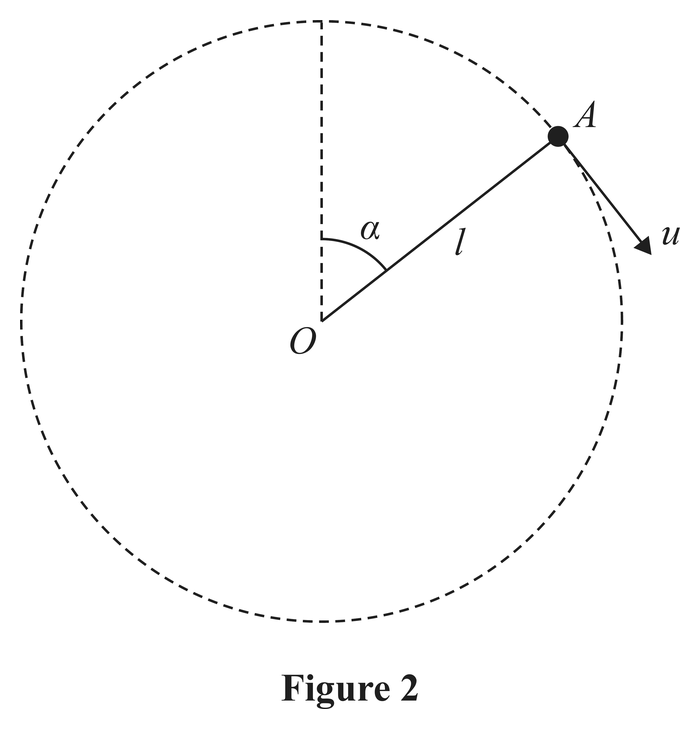
A particle of mass m is attached to one end of a light rod of length l. The other end of the rod is attached to a fixed point O. The rod can turn freely in a vertical plane about a horizontal axis through O.
The particle is projected with speed u from a point A, where OA makes an angle α with the upward vertical through O, as shown in Figure 2.
The particle moves in complete vertical circles.
Given that cosα=54
(a) show that u>52gl
(4)
As the rod rotates, the least tension in the rod is T and the greatest tension is 4T.
(b) Show that u=517gl
(11)
题目中文翻译
一个质量为 m 的质点连接于一根长为 l 的轻杆的一端,另一端连接于固定点 O。杆可绕过 O 的水平轴在竖直平面内自由转动。
Let vt be the speed at the highest point. From A to the highest point the increase in height is
l−lcosα=l(1−54)=5l.
Conservation of mechanical energy gives
21mvt2=21mu2−5mgl.
For complete circles, the particle must pass the highest point with positive speed. Therefore
21mu2−5mgl>0⟹u>52gl.
Equality would give zero speed at the highest point and would not give a completed revolution. The rod can exert compression as well as tension, so no additional positive-tension condition is needed.
Let θ be the angle of the rod from the downward vertical, and let N be the signed inward force exerted by the rod. Energy conservation and radial motion give
v2=u2+2gl(cosα+cosθ),N−mgcosθ=lmv2.
Hence
N=lmu2+2mgcosα+3mgcosθ.
This is greatest at the bottom (cosθ=1) and least at the top (cosθ=−1).
Let the corresponding speeds be vb and vt. At the bottom, energy conservation gives
21mvb2=21mu2+mgl(1+54),vb2=u2+518gl.
Resolving upwards towards O at the bottom,
Tmax−mg=lmvb2⟹Tmax=lmu2+523mg.
At the top, from (a),
vt2=u2−52gl.
Both gravity and tension act towards O there, so
Tmin+mg=lmvt2⟹Tmin=lmu2−57mg.
Now Tmax=4Tmin, giving
lmu2+523mg=4(lmu2−57mg).
Therefore
l3mu2=551mg,u2=517gl,u=517gl.
As a check, this gives vt2=3gl>0, Tmin=2mg and Tmax=8mg, satisfying both complete rotation and the required ratio.