
题目
7.
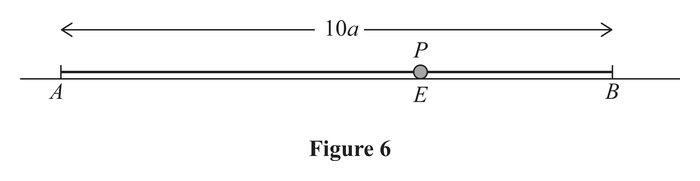
The fixed points and lie on a smooth horizontal surface with .
A particle has mass .
One end of a light elastic string, of natural length and modulus of elasticity , is attached to and the other end is attached to .
One end of another light elastic string, of natural length and modulus of elasticity , is attached to and the other end is attached to .
The particle is resting in equilibrium at the point on the surface, as shown in Figure 6.
(a) Show that
Particle is now held on the surface at the point , between and , where , and released from rest.
(b) Show that moves with simple harmonic motion about .
(c) Show that the simple harmonic motion has period
In any one complete oscillation of the simple harmonic motion, the particle is less than a distance from for a time .
(d) Find in terms of , and .
题目中文翻译
固定点 、 位于光滑水平面上,。
质点 的质量为 。
一根原长为 、弹性模量为 的弹性轻绳的一端连接于 ,另一端连接于 。
另一根原长为 、弹性模量为 的弹性轻绳的一端连接于 ,另一端连接于 。
如图 6 所示,质点 静止平衡于该平面上的 点。
(a) 证明 。
现在将质点 保持在平面上位于 、 之间的 点,其中 ,然后由静止释放。
(b) 证明 绕 做简谐运动。
(c) 证明该简谐运动的周期为 。
任意一次完整简谐振动中,质点距 小于 的持续时间为 。
(d) 用 、 和 表示 。
解答
(a)
解法一
思路
展开
两个张力相等,但因原长和弹性模量不同,伸长量不相等。设右绳伸长为 ,则左绳伸长为 ,分别使用各自的胡克定律。
答题过程
展开
Let the extension of the string attached to be . Then
so the extension of the string attached to is . In horizontal equilibrium the tensions are equal:
Multiplying by gives
Therefore
(b)
解法一
思路
展开
取从 向 的位移为正,分别写两根绳随位移变化的伸长,合力为右张力减左张力。还要检查释放后的振幅范围是否导致绳出现一段松弛运动。
答题过程
展开
Let be the displacement from towards . The extensions of the left and right strings are respectively
Taking towards as positive, Newton’s second law gives
The constant terms cancel:
Hence
The acceleration is proportional to the displacement from and directed towards , so the motion is SHM with .
The release point has , so
Thus the amplitude is . Throughout , the left extension is at least , and the right extension is nonnegative. The right string is at natural length only at the release endpoint; the resultant force there is towards , so it immediately stretches again. There is no interval of slack-string motion, and the SHM equation applies throughout the oscillation.
(c)
解法一
思路
展开
从恢复加速度的系数读取角频率,再用 求周期。
答题过程
展开
From (b),
Therefore the period is
(d)
解法一
思路
展开
半径为 的中心区间,其边界恰好是半振幅。重设过中心的时刻为零,求中心到边界的时间;一周期累计四段,而不是只算首次到达。
答题过程
展开
The amplitude is . Reset time to when the particle passes through towards . Then
The first arrival at satisfies
There are two passages through in a complete oscillation, each with equal times on either side of . Thus the total duration is four times the time just found:
The isolated instants at the two boundary positions do not affect this duration.