题目
Problem
6.
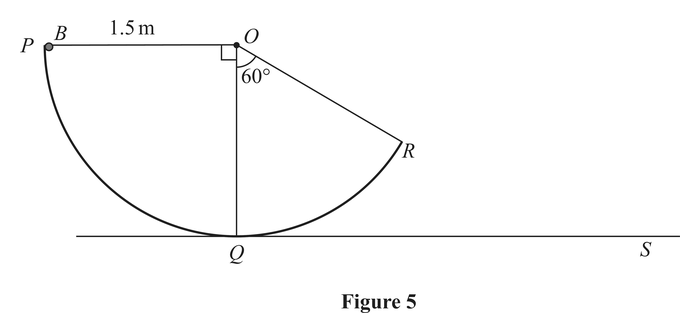
Figure 5 shows a smooth track PQR which is part of a circle.
The track is fixed in a vertical plane.
The circle has centre O and radius OP=1.5m.
The highest point of the track is P and PO is horizontal.
The lowest point of the track Q is on horizontal ground.
A small ball B, of mass 0.2kg, is released from rest at P and moves on the track until it leaves the track at R, where angle QOR=60∘
The ball is modelled as a particle.
(a) Find the magnitude of the normal reaction between the ball and the track when the ball is at Q.
(5)
After leaving the track, the ball moves freely under gravity and first lands on the ground at the point S.
(b) Find the distance QS.
(8)
题目中文翻译
图 5 所示的光滑轨道 PQR 是圆周的一部分。
轨道固定于竖直平面内。
圆心为 O,半径为 OP=1.5m。
轨道的最高点为 P,且 PO 水平。
轨道的最低点 Q 位于水平地面上。
将质量为 0.2kg 的小球 B 从 P 由静止释放,小球沿轨道运动至 R 后离开轨道,其中 ∠QOR=60∘。
将小球视为质点。
(a) 求小球位于 Q 时与轨道之间的法向反作用力大小。
(5)
离开轨道后,小球仅在重力作用下自由运动,首次落地于 S 点。
(b) 求距离 QS。
(8)
解答
(a)
解法一
思路
展开
从 P 到 Q 的下降高度等于半径,先用能量求速率。最低点的向心方向向上,支持力需要同时克服重力并提供向心力。
答题过程
展开
The drop from P to Q is 1.5 m. The normal reaction does no work, so
21mvQ2=mg(1.5)⟹vQ2=3g.
At Q, resolve upwards towards O. If the normal reaction is N,
N−mg=1.5mvQ2=1.5m(3g)=2mg.
Therefore
N=3mg=3(0.2)(9.8)=5.88 N.
(b)
解法一
思路
展开
离轨点 R 的速度沿圆的切线,与水平线成 60∘。先求离轨速率、离地高度及相对 Q 的水平偏移,再做抛体运动;所求 QS 还要加上这段初始偏移。
答题过程
展开
The point R is above the ground by
h=1.5−1.5cos60∘=0.75 m,
and its horizontal distance to the right of Q is
xR=1.5sin60∘.
The drop from P to R is 1.5cos60∘=0.75 m. Energy conservation gives the departure speed u:
21mu2=mg(0.75)⟹u=1.5g.
At R the velocity is tangential, directed upwards and to the right at 60∘ to the horizontal. Thus
ux=1.5gcos60∘,uy=1.5gsin60∘.
Let t be the flight time from R to the first ground contact. With upward positive,
−0.75=uyt−21gt2.
The positive root is
t=guy+uy2+2g(0.75)=0.85636… s.
The other root is negative and is outside the flight interval. Horizontal motion gives
QS=xR+uxt=1.5sin60∘+1.5gcos60∘(0.85636…).
Using g=9.8 without rounding intermediate values,
QS=2.94 m(3 s.f.).
