题目
Problem
Figure 3 shows a plot of the curve with equation y=sinθ, 0≤θ≤360∘.
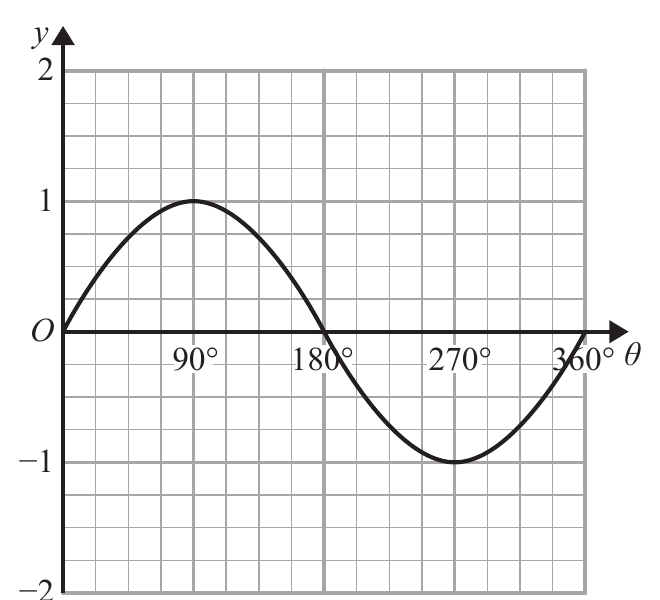
Figure 3
(a) State the coordinates of the minimum point on the curve with equation
y=4sinθ,0≤θ≤360∘.
(2)
A copy of Figure 3, called Diagram 1, is shown on the next page.
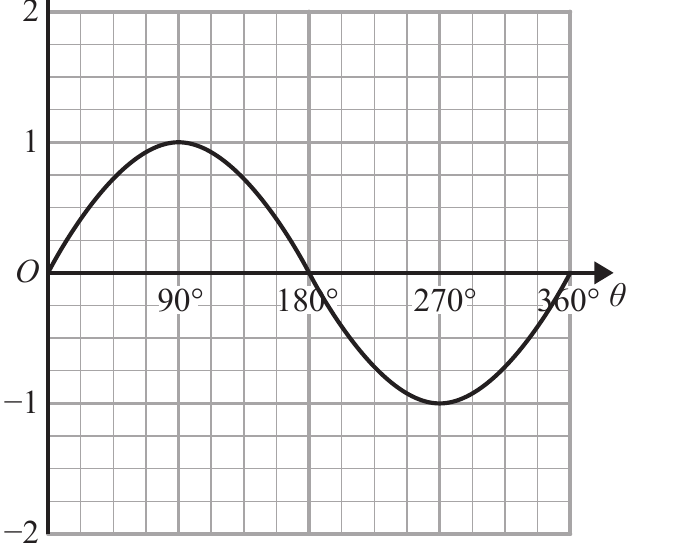
Diagram 1
(b) On Diagram 1, sketch and label the curves
(i) y=1+sinθ, 0≤θ≤360∘,
(ii) y=tanθ, 0≤θ≤360∘.
(2)
(c) Hence find the number of solutions of the equation
(i) tanθ=1+sinθ that lie in the region 0≤θ≤2160∘,
(ii) tanθ=1+sinθ that lie in the region 0≤θ≤1980∘.
(3)
解答
(a)
解法一
思路
展开
sinθ 在 270∘ 处取最小值 −1。乘以 4 后,最小值变成 −4。
答题过程
展开
The minimum point is
(270∘,−4).
(b)
解法一
思路
展开
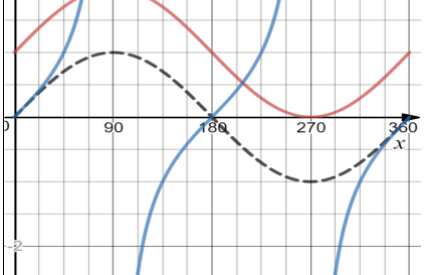
y=1+sinθ 是正弦图像上移 1。y=tanθ 在 90∘ 和 270∘ 有竖直渐近线,并经过 (0∘,0)、(180∘,0)、(360∘,0)。
答题过程
展开
For y=1+sinθ, the sketch should pass through
(0∘,1),(90∘,2),(180∘,1),(270∘,0),(360∘,1).
For y=tanθ, the sketch should have vertical asymptotes at
θ=90∘,θ=270∘,
and pass through
(0∘,0),(180∘,0),(360∘,0).
(c)
解法一
思路
展开
从 0∘ 到 360∘ 的图像中,两条曲线有 2 个交点。因为两个函数的周期都是 360∘,所以每 360∘ 重复一次。
答题过程
展开
In one interval of length 360∘, there are 2 intersections.
For 0≤θ≤2160∘,
2160∘=6(360∘),
so the number of solutions is
6⋅2=12.
For 0≤θ≤1980∘,
1980∘=5(360∘)+180∘.
The final half-cycle contributes one fewer solution than a full cycle here, so the number of solutions is
11.