题目
Problem
The curve C has equation
y=2−x1.
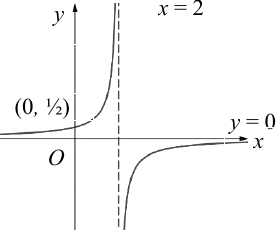
(a) Sketch C, showing the coordinates of any points of intersection with the coordinate axes and giving the equations of the asymptotes.
(3)
The line with equation y=4x+k, where k is a constant, meets C at two distinct points.
(b) Show that
k2+16k+48>0.
(4)
(c) Hence find the set of possible values of k.
(4)
解答
(a)
解法一
思路
展开
分母为零给出竖直渐近线。分母越来越大时,函数值趋近于 0,所以水平渐近线是 y=0。代入 x=0 可得 y 轴截距。
答题过程
展开
The vertical asymptote is
2−x=0⇒x=2.
The horizontal asymptote is
y=0.
At x=0,
y=21.
So the curve crosses the y-axis at (0,21) and has no x-intercept. The sketch should have one branch above the x-axis for x<2 and one branch below the x-axis for x>2.
(b)
解法一
思路
展开
交点满足直线方程和曲线方程同时成立。把它们联立后得到关于 x 的二次方程。若有两个不同交点,二次方程必须有两个不同实根,所以判别式要大于 0。
答题过程
展开
At the points of intersection,
4x+k=2−x1.
Multiplying by 2−x gives
(4x+k)(2−x)=8x+2k−4x2−kx=4x2+(k−8)x+1−2k=110.
For two distinct intersections, the discriminant must be positive:
(k−8)2−4(4)(1−2k)k2−16k+64−16+32kk2+16k+48>0>0>0.
(c)
解法一
思路
展开
把二次不等式因式分解。因为 k2 的系数是正数,抛物线开口向上,所以取两个根外侧的范围。
答题过程
展开
k2+16k+48(k+12)(k+4)>0>0.
The critical values are
k=−12,k=−4.
Since the quadratic is positive outside these two values,
k<−12ork>−4.