题目
Problem
The curve C1 has equation y=f(x).
Given that
- f(x) is a quadratic expression
- C1 has a maximum turning point at (2,20)
- C1 passes through the origin
(a) sketch a graph of C1 showing the coordinates of any points where C1 cuts the coordinate axes.
(2)
(b) find an expression for f(x).
(3)
The curve C2 has equation
y=x(x2−4).
Curve C1 and C2 meet at the origin, and at the points P and Q.
Given that the x coordinate of the point P is negative,
(c) using algebra and showing all stages of your working, find the coordinates of P.
(5)
解答
(a)
解法一
思路
展开
二次曲线有最大转折点,所以它开口向下。已知顶点是 (2,20),并且经过原点。由对称轴 x=2 可知另一个 x 轴截距在 x=4。
答题过程
展开
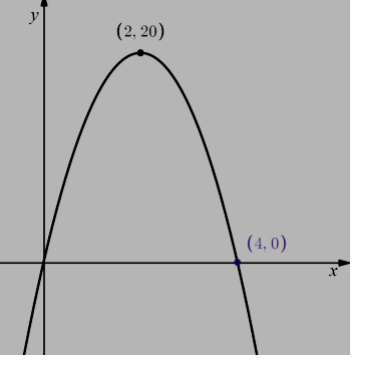
The graph is a downward-opening parabola with maximum turning point (2,20).
It passes through the origin, so one intercept is
(0,0).
Since the axis of symmetry is x=2, the other x-intercept is
(4,0).
The sketch should show a downward-opening parabola through (0,0) and (4,0), with maximum point (2,20).
(b)
解法一
思路
展开
因为两个根是 0 和 4,所以可设 f(x)=Ax(x−4)。再代入顶点 (2,20) 求 A。
答题过程
展开
Since the roots are 0 and 4, let
f(x)=Ax(x−4).
Using the point (2,20),
20=20=A=A(2)(2−4)−4A−5.
Therefore
f(x)==−5x(x−4)5x(4−x).
解法二
思路
展开
也可以直接用顶点式。最大点是 (2,20),所以写成 f(x)=a(x−2)2+20。因为开口向下,所以 a 会是负数。
答题过程
展开
Using vertex form,
f(x)=a(x−2)2+20.
Since the curve passes through (0,0),
0=0=a=a(0−2)2+204a+20−5.
So
f(x)====−5(x−2)2+20−5(x2−4x+4)+20−5x2+20x5x(4−x).
(c)
解法一
思路
展开
交点满足两个 y 值相等。把 C1 的表达式与 x(x2−4) 联立,因式分解后得到三个交点的 x 坐标。题目要 x 坐标为负的点,所以选 x=−8。
答题过程
展开
At intersections of C1 and C2,
x(x2−4)=5x(4−x).
Expand both sides:
x3−4x=x3+5x2−24x=x(x2+5x−24)=x(x+8)(x−3)=20x−5x2000.
So
x=0,x=−8,x=3.
Point P has negative x coordinate, so
x=−8.
Substitute into C2:
y===x(x2−4)(−8)(64−4)−480.
Therefore
P=(−8,−480).
解法二
思路
展开
直接除以 x 的二次降维法。
由于交点 P 的 x 坐标是负数(即 x=0),在联立方程 x(x2−4)=5x(4−x) 时,我们可以直接在等号两边同除以 x。
这使我们能够直接得到关于 x 的一元二次方程 x2−4=5(4−x),省去了展开和分解三次多项式的步骤,让求解过程更加直接、精炼。
答题过程
展开
At the intersection points of C1 and C2, we have:
x(x2−4)=5x(4−x)
Since point P is not the origin, its x-coordinate is non-zero (x=0). Thus, we can divide both sides by x directly:
x2−4=x2−4=x2+5x−24=5(4−x)20−5x0.
Factorise the quadratic equation:
(x+8)(x−3)=0.
So
x=−8orx=3.
\begin{align*}
Since the x-coordinate of P is negative:
\end{align*}
x=−8.
\begin{align*}
Substituting x=−8 into y=x(x2−4) gives:
\end{align*}
y===−8((−8)2−4)−8(64−4)−480.
Therefore, the coordinates of P are:
P=(−8,−480).