题目
Problem
A curve C with equation y=f(x) passes through the point R(4,13).
Given that
f′(x)=2(x−3)(3x+2)
(a) use integration to find f(x), giving your answer in simplest form.
(5)
(b) Given that f(x) can be written in the form
(x−3)2(px+q)
find the value of the constant p and the value of the constant q.
(2)
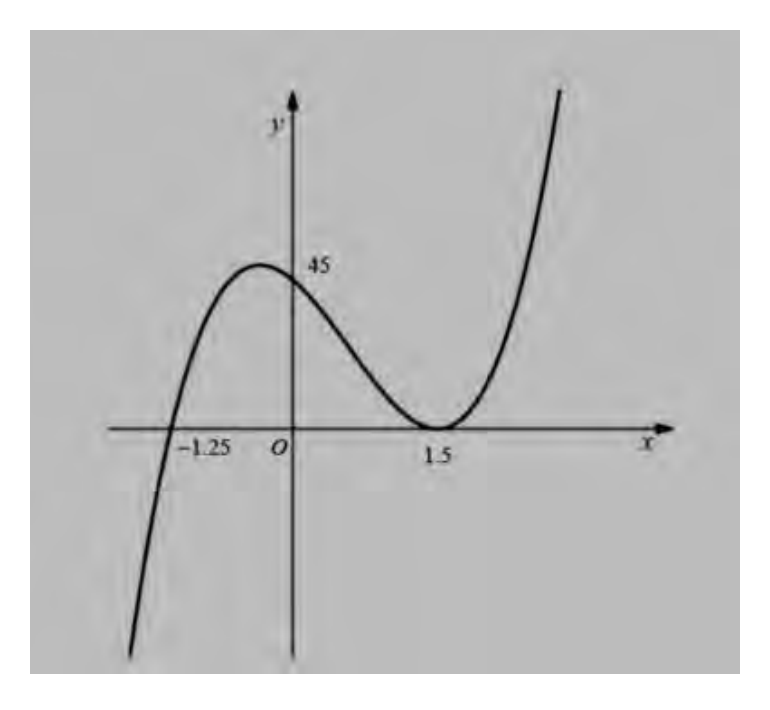
(c) Sketch the graph of y=f(2x), showing the coordinates of any points where the curve touches or crosses the coordinate axes.
(4)
题目中文翻译
曲线 C 的方程为 y=f(x),并经过点 R(4,13)。
已知
f′(x)=2(x−3)(3x+2).
(a) 使用积分求 f(x),并将答案写成最简形式。
(5)
(b) 已知 f(x) 可写成
(x−3)2(px+q)
的形式,求常数 p 和常数 q 的值。
(2)
(c) 画出 y=f(2x) 的草图,并标出曲线与坐标轴相切或相交的所有点的坐标。
(4)
解答
(a)
解法一
思路
展开
先展开 f′(x),再积分得到 f(x)。积分常数用点 R(4,13) 求出。
答题过程
展开
Expand the derivative:
f′(x)===2(x−3)(3x+2)2(3x2−7x−6)6x2−14x−12.
Integrate:
f(x)==∫(6x2−14x−12)dx2x3−7x2−12x+c.
Use R(4,13):
13=13=13=c=2(4)3−7(4)2−12(4)+c128−112−48+c−32+c45.
Therefore
f(x)=2x3−7x2−12x+45.
(b)
解法一
思路
展开
把 (x−3)2(px+q) 展开,并与 (a) 中的三次式比较系数。也可以直接因式分解得到 (x−3)2(2x+5)。
答题过程
展开
From part (a),
f(x)=2x3−7x2−12x+45.
Factorise:
2x3−7x2−12x+45=(x−3)2(2x+5).
Therefore
p=2,q=5.
(c)
解法一
思路
展开
由 (b) 得
f(x)=(x−3)2(2x+5).
所以
f(2x)=(2x−3)2(4x+5).
平方因子表示曲线在对应的 x 截距处“触碰” x 轴;一次因子表示曲线“穿过” x 轴。
答题过程
展开
Using
f(x)=(x−3)2(2x+5),
we have
f(2x)==(2x−3)2(2(2x)+5)(2x−3)2(4x+5).
The x-intercepts are found from
(2x−3)2(4x+5)=0.
So
2x−3=0or4x+5=0.
Hence
x=23orx=−45.
At x=23, the repeated factor means the curve touches the x-axis:
(23,0).
At x=−45, the curve crosses the x-axis:
(−45,0).
The y-intercept is
f(0)=45,
so for y=f(2x) the y-intercept is still
(0,45).
The sketch is a positive cubic curve, crossing the x-axis at (−45,0), touching the x-axis at (23,0), and crossing the y-axis at (0,45).