题目
Problem
In this question you must show all stages of your working.
Solutions relying on calculator technology are not acceptable.
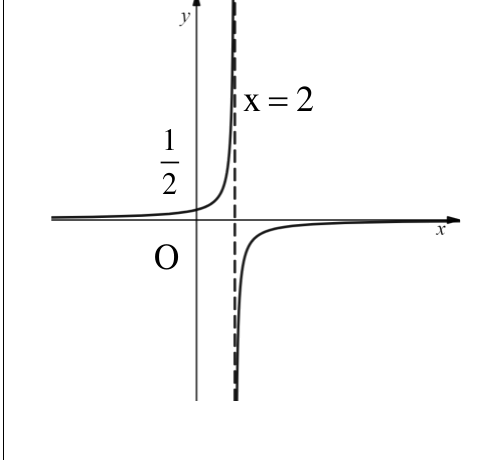
(a) Sketch the curve C with equation
y=2−x1,x=2.
State on your sketch
- the equation of the vertical asymptote
- the coordinates of the intersection of C with the y-axis
(3)
The straight line l has equation y=kx−4, where k is a constant.
Given that l cuts C at least once,
(b) (i) show that
k2−5k+4≥0
(ii) find the range of possible values for k.
(6)
题目中文翻译
本题必须写出所有解题步骤。
不得使用依赖计算器技术的方法。
(a) 作出曲线 C 的草图,其方程为
y=2−x1,x=2.
在草图上标出
- 竖直渐近线的方程;
- C 与 y 轴交点的坐标。
直线 l 的方程为 y=kx−4,其中 k 为常数。
已知 l 与 C 至少相交一次。
(b)
(i) 证明
k2−5k+4≥0.
(ii) 求 k 的可能取值范围。
解答
(a)
解法一
思路
展开
y=2−x1 是倒数型图像。分母为 0 的地方是竖直渐近线,所以 x=2。令 x=0 可以求出 y 轴截距。
答题过程
展开
The vertical asymptote is where the denominator is zero:
2−x=x=02.
The intersection with the y-axis occurs when x=0:
y=2−01=21.
So the sketch should show a reciprocal-type curve with
x=2
as the vertical asymptote and
(0,21)
as the y-intercept.
(b)(i)
解法一
思路
展开
直线和曲线相交时,它们的 y 值相等。整理后会得到关于 x 的二次方程。题目说至少相交一次,所以这个二次方程至少有一个实根,即判别式 Δ≥0。
答题过程
展开
At intersections,
kx−4=2−x1.
Multiply by 2−x:
(kx−4)(2−x)=2kx−kx2−8+4x=11.
Rearrange:
−kx2+(2k+4)x−9=kx2+(−2k−4)x+9=00.
For the line to cut the curve at least once, this quadratic must have at least one real root. Hence
b2−4ac(−2k−4)2−4(k)(9)≥0≥0.
Expand and simplify:
4k2+16k+16−36k4k2−20k+164(k2−5k+4)≥0≥0≥0.
Therefore
k2−5k+4≥0.
This is the required result.
(b)(ii)
解法一
思路
展开
解二次不等式。先因式分解找到临界值 1 和 4,再根据开口向上判断外侧区间满足 ≥0。
答题过程
展开
From part (b)(i),
k2−5k+4(k−1)(k−4)≥0≥0.
The critical values are
k=1,k=4.
Since the quadratic opens upwards,
(k−1)(k−4)≥0
outside the interval between the roots.
Therefore
k≤1ork≥4.