题目
Problem
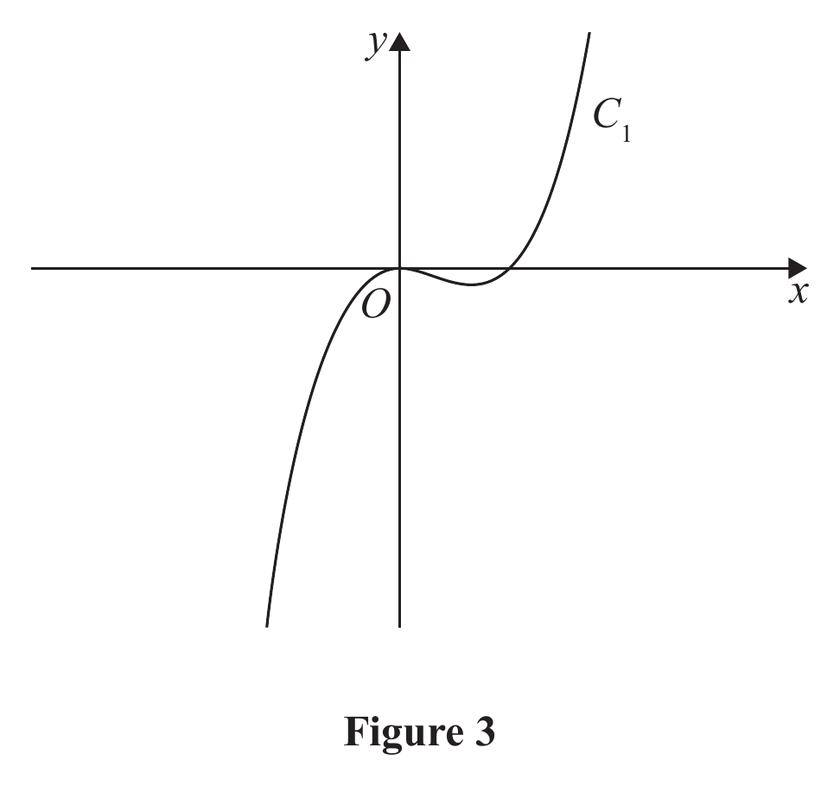
Figure 3 shows a sketch of part of the curve C1.
Given that C1
- has equation y=f(x) where f(x) is a cubic function
- touches the x-axis at the origin and cuts the x-axis at x=4
- passes through the point (10,120)
(a) find f(x).
(3)
The curve C2 has equation y=1.2x(8−x).
On the following page there is a copy of Figure 3 called Diagram 1.
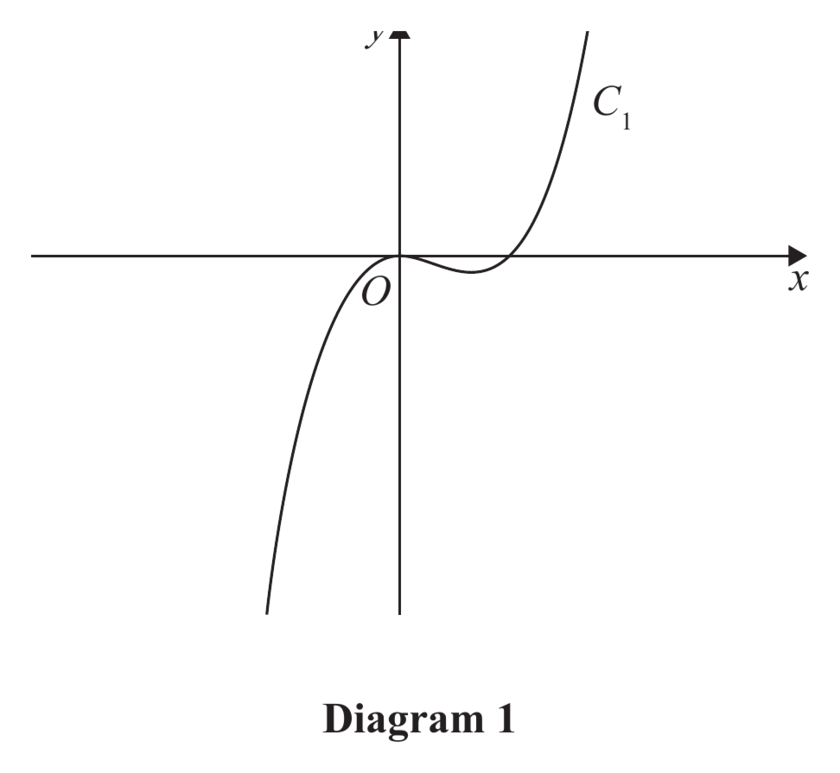
(b) On Diagram 1 sketch a graph of the curve C2.
(2)
(c) Use algebra to find the coordinates of the points where C1 and C2 intersect.
Show each stage of your working.
(5)
题目中文翻译
图 3 给出了曲线 C1 的一部分草图。
已知 C1
- 的方程为 y=f(x),其中 f(x) 是三次函数
- 在原点与 x 轴相切,并在 x=4 处与 x 轴相交
- 经过点 (10,120)
(a) 求 f(x)。
曲线 C2 的方程为 y=1.2x(8−x)。
下一页有一份图 3 的副本,称为图表 1。
(b) 在图表 1 上画出曲线 C2 的草图。
(c) 用代数方法求 C1 与 C2 各交点的坐标,并写出每一步计算过程。
解答
(a)
解法一
思路
展开
曲线在原点与 x 轴相切,说明 x=0 是重根;又在 x=4 处穿过 x 轴,所以另一个因子是 (x−4)。因此设 f(x)=λx2(x−4),再代入点 (10,120) 求 λ。
答题过程
展开
Since the curve touches the x-axis at the origin and cuts the x-axis at x=4,
f(x)=λx2(x−4).
Use the point (10,120):
120=120=λ=λ(10)2(10−4)600λ0.2.
Therefore
f(x)=0.2x2(x−4).
解法二
思路
展开
也可以从一般三次式出发。原点在曲线上给出常数项;在原点相切说明导数在 0 处为 0;再用 x=4 和 (10,120) 求剩下常数。
答题过程
展开
Let
f(x)=ax3+bx2+cx+d.
Since the curve passes through the origin,
d=0.
Since it touches the x-axis at the origin, the gradient there is 0:
f′(x)=f′(0)=3ax2+2bx+c,c=0.
So
f(x)=ax3+bx2.
Using f(4)=0,
64a+16b=b=0−4a.
Using f(10)=120,
1000a+100b=1000a−400a=600a=a=1201201200.2.
So b=−0.8, and
f(x)=0.2x3−0.8x2=0.2x2(x−4).
(b)
解法一
思路
展开
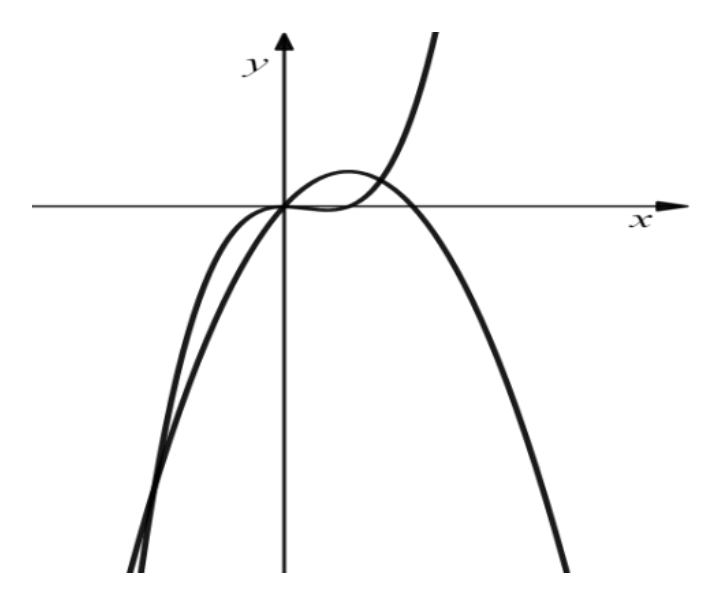
y=1.2x(8−x) 是开口向下的二次曲线,根为 x=0 和 x=8。所以图像经过原点,并在 x=4 右侧再次穿过 x 轴。
答题过程
展开
The curve
y=1.2x(8−x)
is a downward-opening parabola.
Its x-intercepts are found from
1.2x(8−x)=0,
so it passes through
(0,0)and(8,0).
The sketch should show a downward-opening parabola through the origin and through a positive x-intercept to the right of x=4.
A completed sketch is:
(c)
解法一
思路
展开
交点处两条曲线的 y 值相等。建立方程后提取公因式 x,再解二次方程。最后要把每个 x 代回任一曲线求 y。
答题过程
展开
At intersections,
1.2x(8−x)=0.2x2(x−4).
Multiply by 5:
6x(8−x)=x2(x−4).
Expand and collect terms:
48x−6x2=x3+2x2−48x=x(x2+2x−48)=x(x+8)(x−6)=x3−4x2000.
Thus
x=0,x=−8,x=6.
Using y=1.2x(8−x):
x=0x=−8x=6⇒y=0,⇒y=1.2(−8)(16)=−153.6,⇒y=1.2(6)(2)=14.4.
Therefore the points of intersection are
(0,0),(−8,−153.6),(6,14.4).
