题目
Problem
Figure 2 shows the points P, Q and R.
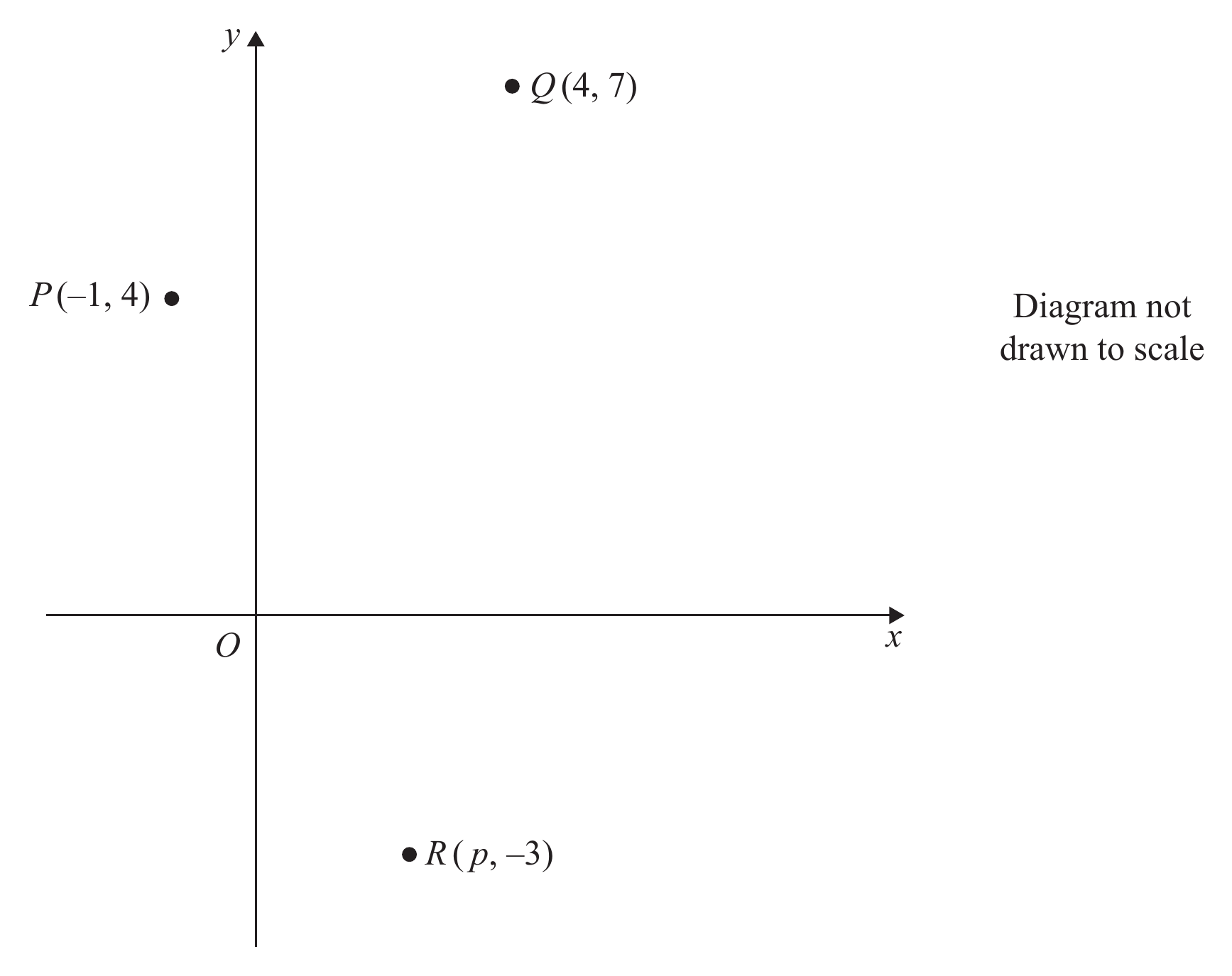
Points P and Q have coordinates (−1,4) and (4,7) respectively.
(a) Find an equation for the straight line passing through points P and Q.
Give your answer in the form ax+by+c=0 where a, b and c are integers.
(3)
The point R has coordinates (p,−3), where p is a positive constant.
Given that angle QPR=90∘,
(b) find the value of p.
(Solutions relying on calculator technology are not acceptable.)
(3)
题目中文翻译
图 2 显示了点 P、Q 和 R。
点 P 和 Q 的坐标分别为 (−1,4) 和 (4,7)。
(a) 求经过点 P 和 Q 的直线方程。将答案写成 ax+by+c=0 的形式,其中 a、b 和 c 为整数。(3 分)
点 R 的坐标为 (p,−3),其中 p 为正常数。
已知角 QPR=90∘,
(b) 求 p 的值。
(依赖计算器技术的解答不予接受。)(3 分)
解答
(a)
解法一
思路
展开
先用两点求斜率,再代入点斜式,最后整理到 ax+by+c=0。
答题过程
展开
The gradient of PQ is
4−(−1)7−4=53.
Using point P(−1,4),
y−4=5y−20=3x−5y+23=53(x+1)3x+30.
(b)
解法一
思路
展开
因为 ∠QPR=90∘,所以 PR 垂直于 PQ。先求出 PR 的斜率应为 −35,再用 P(−1,4) 和 R(p,−3) 写斜率方程。
答题过程
展开
The gradient of PQ is 53, so the gradient of PR is
−35.
Using P(−1,4) and R(p,−3),
p−(−1)−3−4=p+1−7=−35−35.
Hence
21=21=5p=p=5(p+1)5p+516516.
解法二
思路
展开
也可以使用勾股定理路线。因为 ∠QPR=90∘,所以 QR 是直角三角形 PQR 的斜边;分别用坐标差写出三边的平方,再使用 PQ2+PR2=QR2。
答题过程
展开
The squared lengths are
PQ2==PR2==QR2==(4−(−1))2+(7−4)252+32,(p−(−1))2+(−3−4)2(p+1)2+72,(p−4)2+(−3−7)2(p−4)2+102.
Since ∠QPR=90∘, Pythagoras’ theorem gives
PQ2+PR2=52+32+(p+1)2+72=34+p2+2p+1+49=2p+84=10p=p=QR2(p−4)2+102p2−8p+16+100−8p+11632516.
