题目
Problem
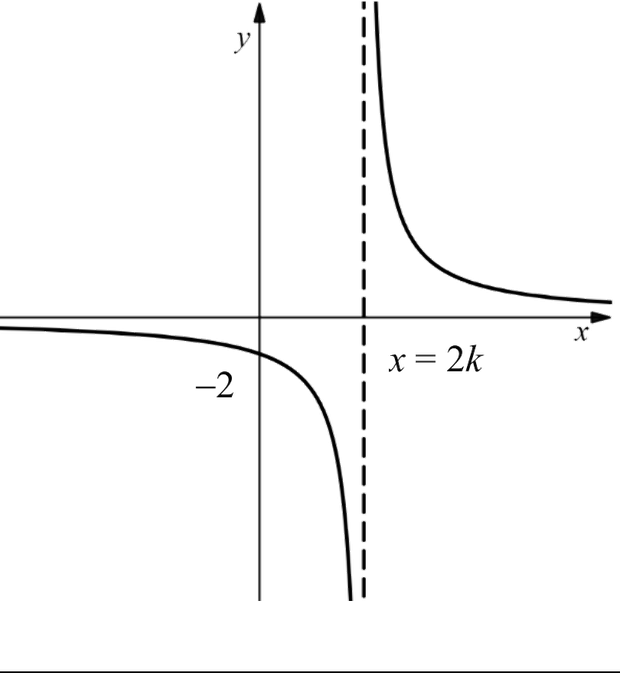
(a) Sketch the graph of the curve C with equation
y=x−2k4k
where k is a positive constant.
On your sketch show
- the coordinates of any points where C cuts the coordinate axes
- the equation of the vertical asymptote to C
(4)
The straight line l has equation
y=6−2x
Given that there is at least one point of intersection between l and C,
(b) find the range of possible values of k.
(5)
解答
(a)
解法一
思路
展开
这是 reciprocal graph 的平移和伸缩。分母为 0 时给出竖直渐近线;当 x=0 时求 y 轴截距。由于分子 4k>0,所以没有 x 轴截距。
答题过程
展开
The vertical asymptote occurs when the denominator is zero:
x−2k=x=02k.
At the y-axis, x=0, so
y==0−2k4k−2.
Thus the curve cuts the y-axis at
(0,−2).
There is no x-axis intercept, because
x−2k4k=0
is impossible when k>0.
The sketch should have vertical asymptote x=2k and horizontal asymptote y=0.
A completed sketch is:
(b)
解法一
思路
展开
交点满足两条曲线的 y 值相等。整理成关于 x 的二次方程后,“至少一个交点”表示这个二次方程有实根,所以判别式大于等于 0。最后别忘了题目给定 k>0。
答题过程
展开
At intersections,
x−2k4k=6−2x.
Cross multiply:
4k==(6−2x)(x−2k)6x−12k−2x2+4kx.
Rearrange:
2x2−(4k+6)x+16k=0.
For at least one real intersection,
b2−4ac⩾0.
So
(−(4k+6))2−4(2)(16k)(4k+6)2−128k16k2+48k+36−128k16k2−80k+364k2−20k+9⩾0⩾0⩾0⩾0⩾0.
Factorise:
4k2−20k+9=(2k−1)(2k−9).
Hence
(2k−1)(2k−9)⩾0.
Since this is positive or zero outside the critical values,
k⩽21ork⩾29.
Also k>0, so
0<k⩽21ork⩾29.