题目
Problem
Figure 4 shows a sketch of the curve C1 with equation y=f(x) where f(x) is a
cubic function in x.
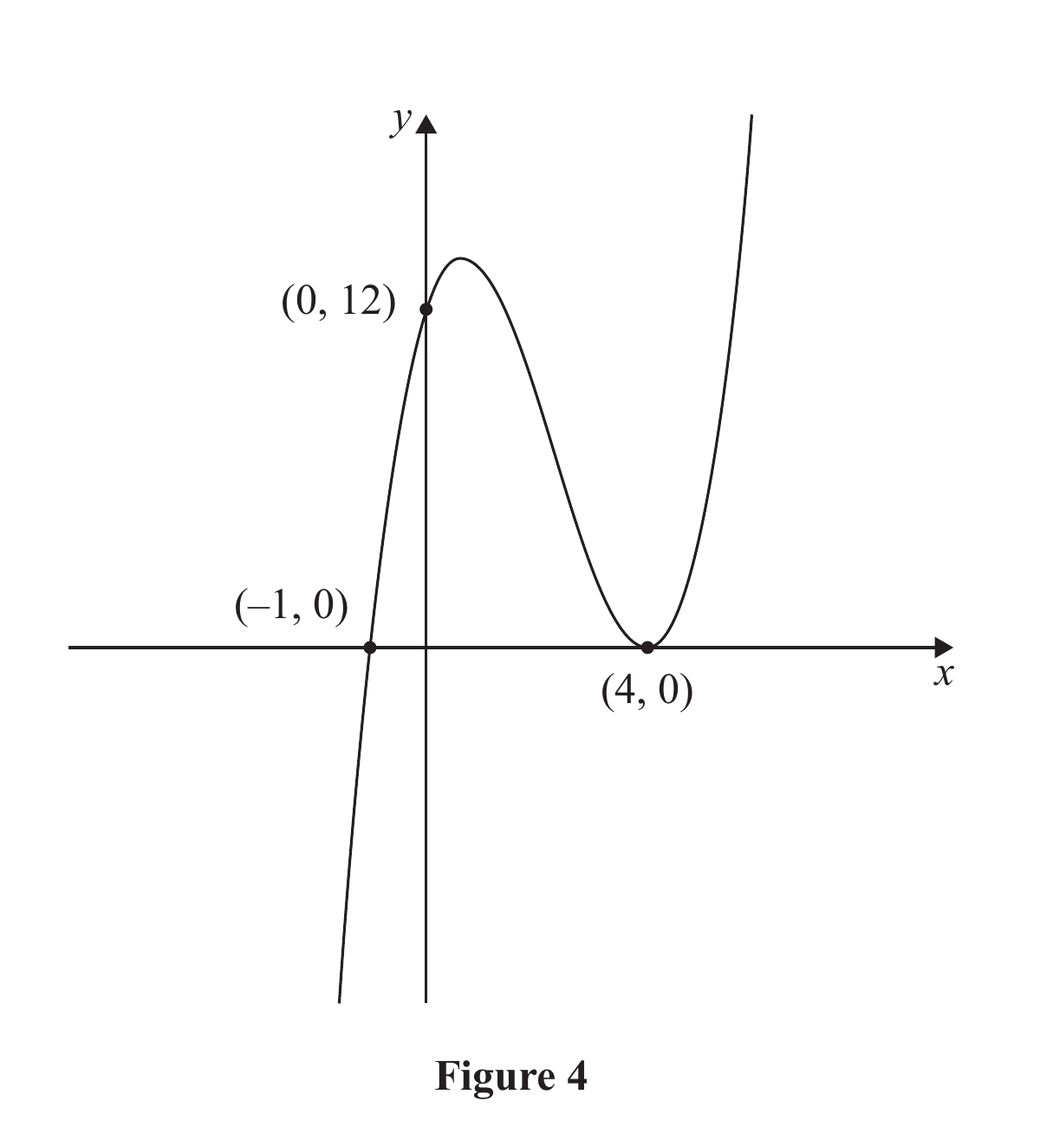
The curve
- cuts the x and y axes at (−1,0) and (0,12) respectively
- has a minimum turning point at (4,0)
as shown in Figure 4.
(a) Find f(x)
(4)
The curve C2 has equation y=g(x) where g(x)=6(x+1)(x−2)
(b) Find the exact x coordinates of the points of intersection of curves C1 and C2.
(Solutions relying on calculator technology are not acceptable.)
(4)
题目中文翻译
图 4 给出了曲线 C1 的草图,其方程为 y=f(x),其中 f(x) 是关于 x 的三次函数。
如图 4 所示,该曲线:
- 分别在 (−1,0) 和 (0,12) 处与 x 轴和 y 轴相交;
- 在 (4,0) 处有一个最低转折点。
(a) 求 f(x)。
曲线 C2 的方程为 y=g(x),其中 g(x)=6(x+1)(x−2)。
(b) 求曲线 C1 与 C2 各交点横坐标的精确值。
(不接受依赖计算器技术的解答。)
解答
(a)
解法一
思路
展开
三次函数在 x=−1 截 x 轴,所以有因式 (x+1)。又因为 (4,0) 是最低转折点且在 x 轴上,所以 x=4 是重根,对应因式 (x−4)2。最后用 y 轴截距 (0,12) 求常数倍。
答题过程
展开
Since the curve crosses the x-axis at (−1,0) and has a turning point at (4,0),
f(x)=a(x+1)(x−4)2.
Using the point (0,12),
12=12=a=a(0+1)(0−4)216a43.
Therefore
f(x)=43(x+1)(x−4)2.
解法二
思路
展开
也可以从一般三次函数 ax3+bx2+cx+d 出发。四个条件分别来自 y 轴截距、两个经过点,以及 x=4 处斜率为 0。
答题过程
展开
Let
f(x)=ax3+bx2+cx+d.
Since (0,12) lies on the curve,
d=12.
Since (−1,0) lies on the curve,
−a+b−c+12=0.
Since (4,0) lies on the curve,
64a+16b+4c+12=0.
Also,
f′(x)=3ax2+2bx+c.
The curve has a turning point at x=4, so
48a+8b+c=0.
Solving these simultaneous equations gives
a=43,b=−421,c=6,d=12.
Therefore
f(x)=43x3−421x2+6x+12.
This is equivalent to
f(x)=43(x+1)(x−4)2.
解法三
思路
展开
把图上的三个根按重数列为 −1,4,4,再利用三次多项式“根的乘积 =−d/a”与常数项 d=12 求首项系数。
答题过程
展开
The roots of f(x), including multiplicity, are
−1,4,4.
Write
f(x)=ax3+bx2+cx+d.
Since the curve crosses the y-axis at (0,12),
d=12.
By the relation between roots and coefficients,
(−1)(4)(4)=−16=a=−ad−a1243.
Therefore
f(x)=43(x+1)(x−4)2.
(b)
解法一
思路
展开
交点满足 f(x)=g(x)。因为两个式子都有因式 (x+1),所以 x=−1 直接给出一个交点;其余交点可以约去共同因式后解二次方程。
答题过程
展开
At intersections,
43(x+1)(x−4)2=6(x+1)(x−2).
One solution is
x=−1.
For x=−1, divide by (x+1):
43(x−4)2=3(x−4)2=(x−4)2=6(x−2)24(x−2)8(x−2).
Expand and rearrange:
x2−8x+16=x2−16x+32=8x−160.
Complete the square:
x2−16x+32=(x−8)2−64+32=(x−8)2=x−8=0032±42.
Therefore the exact x coordinates are
x=−1,x=8−42,x=8+42.
解法二
思路
展开
先把两个函数都展开,再把交点条件整理为一个三次方程。由图中共同交点 x=−1 找到一次因式,余下的二次因式即可精确求根。
答题过程
展开
From part (a),
f(x)=43x3−421x2+6x+12.
Also,
g(x)=6(x+1)(x−2)=6x2−6x−12.
At intersections, f(x)=g(x), so
3x3−21x2+24x+48=x3−15x2+16x+32=24x2−24x−480.
Since x=−1 is a root,
x3−15x2+16x+32=(x+1)(x2−16x+32).
Therefore
x+1=0orx2−16x+32=0.
The quadratic gives
(x−8)2=x=328±42.
Hence the exact x coordinates are
x=−1,x=8−42,x=8+42.
