题目
Problem
A scientist is using carbon-14 dating to determine the age of some wooden items.
The equation for carbon-14 dating an item is given by
N=kλt
where
- N grams is the amount of carbon-14 currently present in the item
- k grams was the initial amount of carbon-14 present in the item
- t is the number of years since the item was made
- λ is a constant, with 0<λ<1
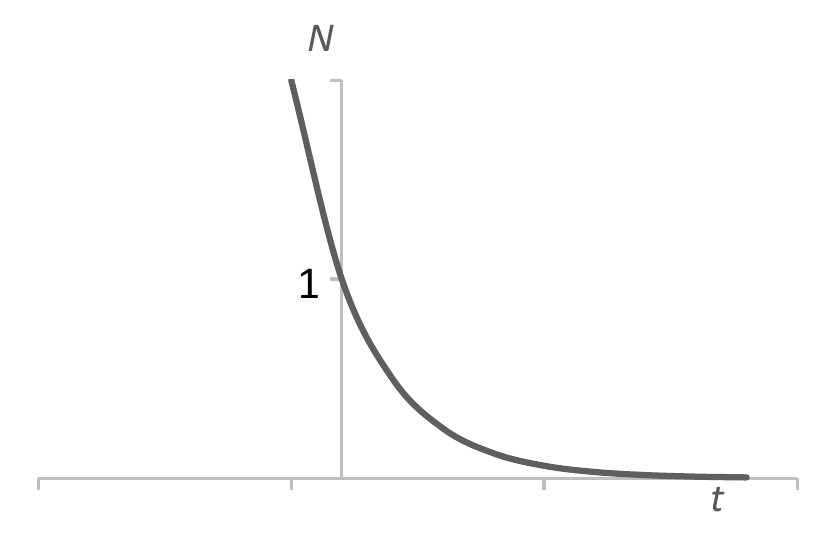
(a) Sketch the graph of N against t for k=1
(2)
Given that it takes 5700 years for the amount of carbon-14 to reduce to half its initial value,
(b) show that the value of the constant λ is 0.999878 to 6 decimal places.
(2)
Given that Item A
- is known to have had 15 grams of carbon-14 present initially
- is thought to be 3250 years old
(c) calculate, to 3 significant figures, how much carbon-14 the equation predicts is currently in Item A.
(2)
Item B is known to have initially had 25 grams of carbon-14 present, but only 18 grams now remain.
(d) Use algebra to calculate the age of Item B to the nearest 100 years.
(3)
题目中文翻译
科学家正在使用碳-14 测年法来确定一些木制物品的年龄。
碳-14 测年的方程为:
N=kλt
其中:
- 目前木制品中含有的碳-14 质量为 N 克
- 初始时木制品中含有的碳-14 质量为 k 克
- t 是物品制成至今的年数(年龄)
- λ 是常数,且 0<λ<1
(a) 当 k=1 时,画出 N 随时间 t 变化的函数图象草图。 (2)
(b) 已知碳-14 的质量减少到其初始值的一半需要 5700 年(即半衰期),证明常数 λ 的值保留 6 位小数为 0.999878。 (2)
(c) 已知物品 A 初始含有 15 克碳-14,且估计其年龄为 3250 年。计算方程预测当前物品 A 中剩余的碳-14 质量,结果保留 3 位有效数字。 (2)
(d) 已知物品 B 初始含有 25 克碳-14,当前仅剩 18 克。利用代数方法计算物品 B 的年龄,结果精确到最近的 100 年。 (3)
解答
(a)
解法一
思路
展开
我们需要画出当 k=1 时 N=λt 对自变量 t 的函数图象(其中 t⩾0):
- 分析图形特征:
因为常数满足 0<λ<1,这是一个典型的指数衰减函数(Exponential decay function)。
- 确定关键点和极限行为:
- 纵截距(Vertical Intercept):当 t=0 时,N=λ0=1。因此图象与纵轴交于点 (0,1)。
- 单调性:由于底数 λ∈(0,1),随着 t 增大,N 呈递减趋势,曲线平滑向下弯曲。
- 渐近线(Asymptote):当 t→∞ 时,N→0。因此 t 轴(即 N=0)是其水平渐近线。
- 绘图说明:
- 纵轴为 N,横轴为 t。
- 曲线从第一象限向下平滑倾斜,经过纵轴上的点 1(或点 (0,1)),并以 t 轴为渐近线无限趋近,但不穿过 t 轴。
答题过程
展开
Since k=1, the equation is N=λt. Given 0<λ<1, this represents an exponential decay graph.
The key features of the sketch are:
- Shape: A smooth, continuously decreasing curve in the first quadrant that curves downwards towards the horizontal axis.
- Vertical intercept: The curve starts or passes through (0,1) on the positive vertical axis (labeled 1 on the N-axis).
- Asymptotic behaviour: The horizontal axis (the t-axis where N=0) is a horizontal asymptote. The curve approaches N=0 as t increases.
(b)
解法一:开方求底数
思路
展开
根据半衰期(Half-life)的定义:当 t=5700 时,剩余的碳-14 质量 N 减少为初始质量 k 的一半,即:
N=21k
代入方程 N=kλt:
21k=kλ5700
因为初始质量 k>0,两边同时约去 k:
λ5700=0.5
求 λ 的值,两边同时求 5700 次方根(或者在两边取对数后计算):
λ=(0.5)57001
计算其值并保留 6 位小数,验证是否符合 0.999878。
答题过程
展开
Since it takes 5700 years for the amount of carbon-14 to reduce to half its initial value:
N=21kwhent=5700
Substitute these into the formula N=kλt:
21k=kλ5700
Divide both sides by k (since k>0):
λ5700=0.5
Take the 5700-th root of both sides:
λ=(0.5)57001
Calculate using the calculator:
λ≈0.9998784026…
Rounding to 6 decimal places:
λ≈0.999878
解法二:取对数
思路
展开
由半衰期条件得到 λ5700=1/2,取对数将指数移到前面,再还原 λ。
答题过程
展开
Using λ5700=1/2,
5700log10λ=log10λ=λ==≈log10(1/2),−5700log102,10−5700log1020.9998784026…0.999878(6 d.p.).
解法三:代入夹逼
思路
展开
六位小数舍入为 0.999878 的区间是 [0.9998775,0.9998785)。比较区间两端的 5700 次方与 1/2;由于 λ5700 随正数 λ 递增,可以确定满足半衰期条件的底数落在该区间内。
答题过程
展开
At the two rounding boundaries,
0.99987755700=0.99987855700=0.4974338125…<0.5,0.5002776294…>0.5.
Since λ5700 is increasing for λ>0, the solution of λ5700=0.5 lies strictly between 0.9998775 and 0.9998785.
Therefore λ=0.999878 to 6 decimal places.
(c)
解法一
思路
展开
对于物品 A,已知条件为:
- 初始量 k=15 克
- 时间 t=3250 年
- 常数 λ=0.999878(或使用计算器中更精确的值)
代入公式 N=kλt:
N=15×(0.999878)3250
利用计算器计算结果并保留 3 位有效数字。
答题过程
展开
For Item A, we are given:
- k=15
- t=3250
- λ=0.999878
Substitute these values into N=kλt:
N=≈≈15×(0.999878)325015×0.672654006…10.089810090…
Rounding to 3 significant figures:
N≈10.1 grams
(Note: Using the more accurate value λ=0.51/5700 yields 15×0.673534878…≈10.1 grams.)
(d)
解法一
思路
展开
对于物品 B,已知条件为:
- 初始量 k=25 克
- 剩余量 N=18 克
- 常数 λ=0.999878(使用题目给出的值)
我们需要求解时间 t。代入公式列出方程:
18=25×(0.999878)t
- 分离指数项:
两边同除以 25:
(0.999878)t=2518=0.72
- 利用对数求解未知指数:
两边取常用对数或自然对数:
ln(0.999878t)=ln(0.72)⟹tln(0.999878)=ln(0.72)
或者直接写为:
t=log0.999878(0.72)
- 计算结果:
t=ln(0.999878)ln(0.72)
算出 t 的具体数值,并将其四舍五入到最接近的 100 年(nearest 100 years)。
答题过程
展开
For Item B, we are given:
- k=25
- N=18
- λ=0.999878
Substitute these into N=kλt:
18=25×(0.999878)t
Divide both sides by 25:
(0.999878)t=2518=0.72
Take natural logarithms on both sides:
ln((0.999878)t)=ln(0.72)
Apply the power law of logarithms:
tln(0.999878)=ln(0.72)
Solve for t:
t=≈≈ln(0.999878)ln(0.72)−0.000122…−0.328504…2692.49… years
Rounding to the nearest 100 years:
t≈2700 years
(Note: Using the more accurate value λ=0.51/5700 yields t=ln(0.51/5700)ln(0.72)≈2701.4 years, which also rounds to 2700 years.)
