题目
Problem
In this question you must show all stages of your working.
Solutions based entirely on calculator technology are not acceptable.
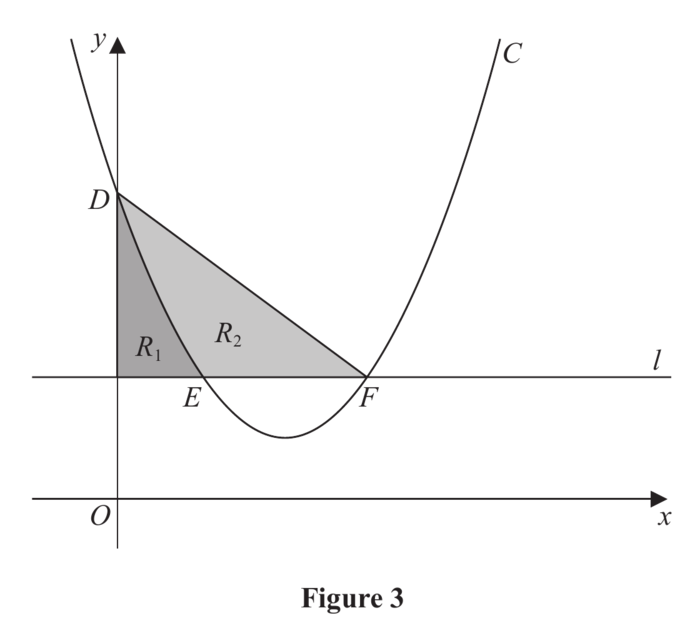
Figure 3 shows
- the curve C with equation y=x2−4x+5
- the line l with equation y=2
The curve C intersects the y-axis at the point D.
(a) Write down the coordinates of D.
(1)
The curve C intersects the line l at the points E and F, as shown in Figure 3.
(b) Find the x coordinate of E and the x coordinate of F.
(2)
Shown shaded in Figure 3 is
- the region R1 which is bounded by C, l and the y-axis
- the region R2 which is bounded by C and the line segments EF and DF
Given that area of R2area of R1=k, where k is a constant,
(c) use algebraic integration to find the exact value of k, giving your answer as a simplified fraction.
(5)
题目中文翻译
本题必须展示全部计算步骤。完全依赖计算器技术的解答不予接受。
图 3 显示曲线 C:y=x2−4x+5 和直线 l:y=2。曲线 C 与 y 轴交于点 D。
(a) 写出 D 的坐标。(1 分)
曲线与直线相交于图 3 中的 E,F。
(b) 求 E,F 各自的 x 坐标。(2 分)
图 3 的阴影包括区域 R1 和 R2。R1 由 C,l,y 轴围成;R2 由 C 及线段 EF,DF 围成。
已知 R1 的面积除以 R2 的面积为常数 k,
(c) 使用代数积分求 k 的精确值,答案写成最简分数。(5 分)
解答
(a)
解法一
思路
展开
曲线 C 与 y 轴相交于点 D,即该点的 x 坐标为 0。
将 x=0 代入曲线方程 y=x2−4x+5,即可求出 D 的 y 坐标,写出坐标形式即可。
答题过程
展开
The curve C intersects the y-axis at point D. Substituting x=0 into the equation of C:
y=02−4(0)+5=5.
Therefore, the coordinates of D are:
(0,5).
(b)
解法一
思路
展开
点 E 和 F 是曲线 C 与直线 l:y=2 的交点。
联立方程,令 x2−4x+5=2,得到一个一元二次方程,因式分解解出两个根。
根据图中位置,较小的根为 E 的 x 坐标,较大的根为 F 的 x 坐标。
答题过程
展开
Set the equation of curve C equal to the equation of line l:
x2−4x+5=x2−4x+3=(x−1)(x−3)=200.
Solving for x gives x=1 or x=3.
Since E lies to the left of F:
(c)
解法一
思路
展开
本题需要分别求出区域 R1 和 R2 的面积:
1. 计算 Area(R1):
区域 R1 在 x∈[0,1] 区间内,由曲线 C(上方)和直线 y=2(下方)围成。
Area(R1)===∫01(yC−yl)dx∫01(x2−4x+5−2)dx∫01(x2−4x+3)dx
2. 计算 Area(R2):
-
方法一:割补法。区域 R2 可以看作是直线段 DF 下方的梯形面积,减去其分段下边界以下的面积。
-
直线段 DF 连接 D(0,5) 和 F(3,2)。其下方的投影是一个直角梯形,上底为 5,下底为 2,高为 3。
Area(Trapezium)==25+2×3221
-
分段下边界以下的面积(从 x=0 到 x=3)可以分为两部分:
-
在 x∈[0,1] 上,是曲线 C 下方的面积:∫01(x2−4x+5)dx。
-
在 x∈[1,3] 上,是直线 y=2 下方的矩形面积:2×2=4。
-
故分段下边界以下的总面积为:
∫01(x2−4x+5)dx+4==310+4322
Area(R2)==221−322619
3. 计算比值 k:
k===Area(R2)Area(R1)19/64/3198
答题过程
展开
Step 1: Find the Area of R1
The region R1 is bounded above by the curve C and below by the line y=2 from x=0 to x=1.
Area(R1)======∫01((x2−4x+5)−2)dx∫01(x2−4x+3)dx[31x3−2x2+3x]01(31(1)3−2(1)2+3(1))−031−2+334.
Step 2: Find the Area of R2
First, find the equation of the line segment DF connecting D(0,5) and F(3,2).
The gradient of DF is:
mDF=3−02−5=−1.
Since the y-intercept is 5, the equation of the line DF is:
y=−x+5.
The region R2 is bounded above by the line segment DF and below by:
We can calculate the area of R2 by subtracting the area under the bottom boundary from the area of the trapezium under the line segment DF (from x=0 to x=3).
- Area of the trapezium under DF:
Areatrap=25+2×3=221.
- Area under the bottom boundary:
For x∈[0,1], the area under the curve C is:
AreaC====∫01(x2−4x+5)dx[31x3−2x2+5x]0131−2+5310.
For x∈[1,3], the area under the line y=2 is a rectangle of width 2 and height 2:
Arearect=2×2=4.
也可由曲线积分减矩形求 R1:A1=10/3−2×1=4/3。但 R2 的下边界在 x=1 后是直线,不是曲线。
So, the total area under the bottom boundary is:
Areabottom=310+4=322.
Area(R2)====Areatrap−Areabottom221−322663−44619.
Step 3: Calculate the value of k
k====Area(R2)Area(R1)6193434×196198.
Therefore, the exact value of k is 198.
解法二:三角形面积减去 R1
思路
展开
由前两小题,D=(0,5)、F=(3,2)。水平线 y=2 与 y 轴交于 G=(0,2)。三角形 DGF 恰好由 R1 与 R2 组成,所以求出 R1 后作差即可。
答题过程
展开
As in method 1, algebraic integration gives
A1===∫01(x2−4x+3)dx[3x3−2x2+3x]0134.
Let G=(0,2). Then DG=3 and GF=3, and DGF consists of R1 and R2. Hence
A2==k=21(3)(3)−A129−34=61919/64/3=198.
解法三:分段直接积分
思路
展开
直线 DF 为 y=5−x。R2 的上边界始终是 DF,但下边界在 x=1 处变化:0⩽x⩽1 为曲线,1⩽x⩽3 为水平线 y=2。分段求面积,后一段也可直接看成面积为 2 的三角形。
答题过程
展开
The gradient of DF is (2−5)/(3−0)=−1, so DF has equation y=5−x.
As in method 1,
A1=[3x3−2x2+3x]01=34.
The area of R2 is
A2===∫01[(5−x)−(x2−4x+5)]dx+∫13[(5−x)−2]dx[23x2−3x3]01+[3x−2x2]1367+2=619.
Therefore k=(4/3)/(19/6)=8/19.
解法四:整段积分后扣除多算面积
思路
展开
先求 DF 与曲线之间从 0 到 3 的整块面积;其中 1<x<3、曲线低于 y=2 的一块不属于 R2,必须扣除。注意这一块虽然也等于 4/3,却不是左侧的 R1,不能混淆边界。
答题过程
展开
The line DF has equation y=5−x. Its area above the curve for 0⩽x⩽3 is
B===∫03(3x−x2)dx[23x2−3x3]0329.
The extra area below y=2 for 1⩽x⩽3 is
E===∫13[2−(x2−4x+5)]dx[−3x3+2x2−3x]130−(−34)=34.
Using A1=4/3 from method 1,
A2=k=B−E=29−34=619A2A1=198.
