
题目
In this question you must show all stages of your working. Solutions relying entirely on calculator technology are not acceptable.
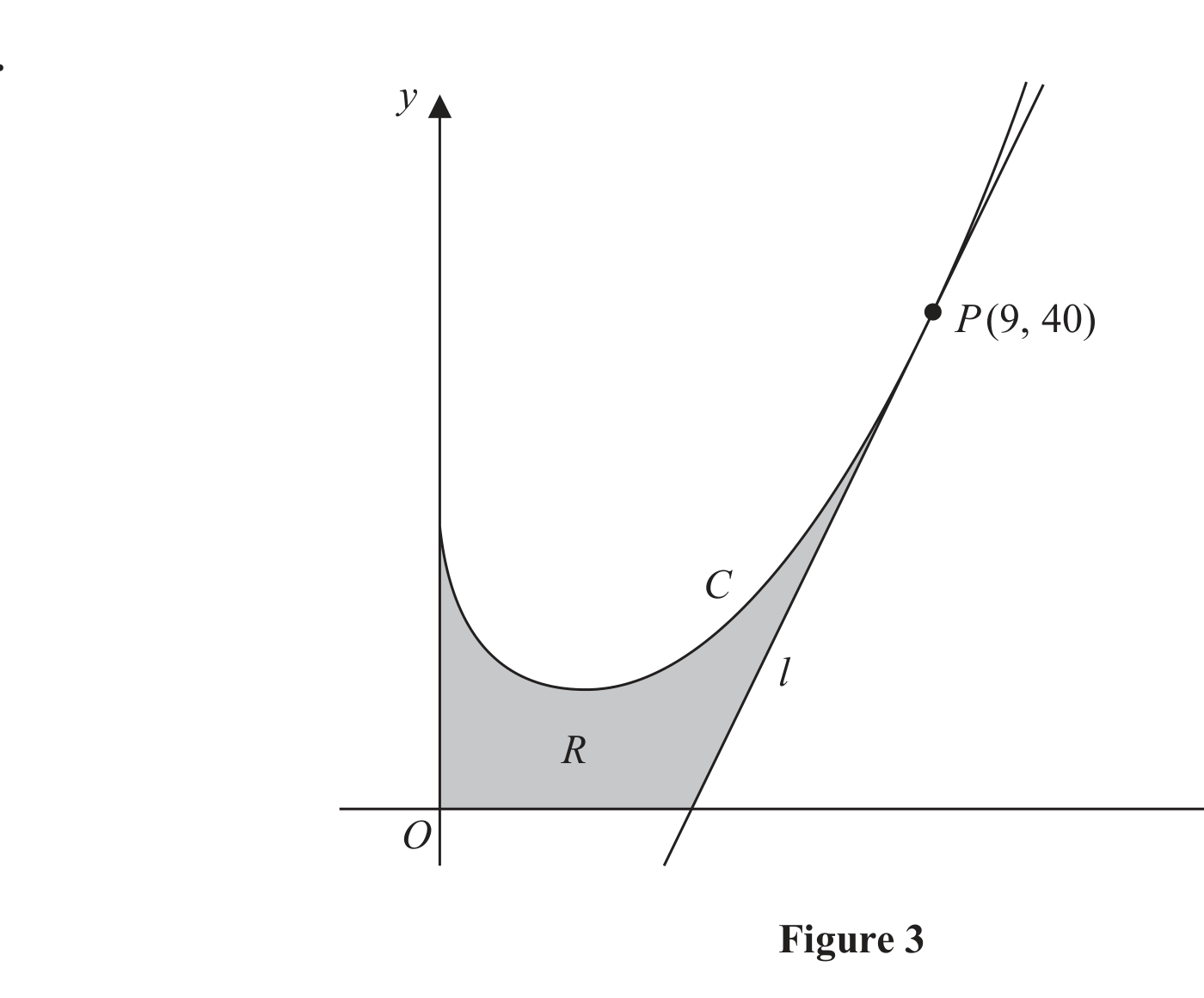
Figure 3 shows a sketch of part of the curve with equation
(a) Find, using calculus, the range of values of for which is increasing.
The point lies on and has coordinates .
The line is the tangent to at the point .
The finite region , shown shaded in Figure 3, is bounded by the curve , the line , the -axis and the -axis.
(b) Find, using calculus, the exact area of .
题目中文翻译
本题必须展示所有解题步骤,不能完全依赖计算器技术。
图3显示了曲线 的一部分的草图,曲线方程为:
(a) 用微积分求 递增时 的取值范围。
点 在 上,坐标为 。
直线 是 在点 处的切线。
图3中阴影所示的有限区域 由曲线 、直线 、 轴和 轴围成。
(b) 用微积分求 的精确面积。
(12分)
解答
解法一
思路
(a) 求导后令 ,解不等式。注意 ,求导时用幂法则。 (b) 区域 的面积 = 曲线下方面积 切线下方面积。先求切线方程,再求切线与 轴的交点,用定积分或三角形面积计算。
答题过程
(a)
\frac{\mathrm{d}y}{\mathrm{d}x} =&\, \frac{4}{3}x - \frac{9}{2}x^{-1/2} \\[2mm] =&\, \frac{4}{3}x - \frac{9}{2\sqrt{x}} \end{align*}$$ Setting $\dfrac{\mathrm{d}y}{\mathrm{d}x} > 0$: $$\frac{4}{3}x - \frac{9}{2\sqrt{x}} > 0$$ Multiply through by $6\sqrt{x}$ (positive for $x > 0$): $$8x\sqrt{x} - 27 > 0 \implies 8x^{3/2} > 27 \implies x^{3/2} > \frac{27}{8}$$ $$x > \left(\frac{27}{8}\right)^{2/3} = \frac{9}{4}$$ $$\boxed{\frac{\mathrm{d}y}{\mathrm{d}x} > 0 \text{ for } x > \frac{9}{4}}$$ **(b)** The area under the curve from $x = 0$ to $x = 9$: $$\begin{align*} A_{\text{curve}} =&\, \int_0^9 \left(\frac{2}{3}x^2 - 9x^{1/2} + 13\right) \mathrm{d}x \\[2mm] =&\, \left[\frac{2}{9}x^3 - 6x^{3/2} + 13x\right]_0^9 \\[2mm] =&\, \left(\frac{2}{9}(729) - 6(27) + 13(9)\right) - 0 \\[2mm] =&\, 162 - 162 + 117 \\[2mm] =&\, 117 \end{align*}$$ The gradient of the tangent at $P(9, 40)$: $$\begin{align*} \frac{\mathrm{d}y}{\mathrm{d}x}\bigg|_{x=9} =&\, \frac{4}{3}(9) - \frac{9}{2\sqrt{9}} = 12 - \frac{3}{2} = \frac{21}{2} \end{align*}$$ The equation of the tangent line $l$: $$\begin{align*} y - 40 =&\, \frac{21}{2}(x - 9) \\ y =&\, \frac{21}{2}x - \frac{189}{2} + 40 \\ y =&\, \frac{21}{2}x - \frac{109}{2} \end{align*}$$ Where the tangent meets the $x$-axis ($y = 0$): $$\begin{align*} 0 =&\, \frac{21}{2}x - \frac{109}{2} \\ x =&\, \frac{109}{21} \end{align*}$$ The area under the tangent line from $x = \dfrac{109}{21}$ to $x = 9$: $$\begin{align*} A_{\text{tangent}} =&\, \int_{109/21}^{9} \left(\frac{21}{2}x - \frac{109}{2}\right) \mathrm{d}x \\[2mm] =&\, \left[\frac{21}{4}x^2 - \frac{109}{2}x\right]_{109/21}^{9} \\[2mm] =&\, \left(\frac{21}{4}(81) - \frac{109}{2}(9)\right) - \left(\frac{21}{4}\cdot\frac{109^2}{21^2} - \frac{109}{2}\cdot\frac{109}{21}\right) \\[2mm] =&\, \left(\frac{1701}{4} - \frac{981}{2}\right) - \left(\frac{11881}{84} - \frac{11881}{42}\right) \\[2mm] =&\, \frac{1701 - 1962}{4} - \frac{11881 - 23762}{84} \\[2mm] =&\, -\frac{261}{4} + \frac{11881}{84} \\[2mm] =&\, \frac{-5481 + 11881}{84} = \frac{6400}{84} = \frac{1600}{21} \end{align*}$$ Alternatively, the tangent forms a triangle with the $x$-axis and $y$-axis. The $x$-intercept is $\dfrac{109}{21}$ and the $y$-intercept is $-\dfrac{109}{2}$, but since we need the area from the $x$-intercept to $P(9,40)$, we can compute: $$A_{\text{tangent}} = \frac{1}{2} \times \left(9 - \frac{109}{21}\right) \times 40 = \frac{1}{2} \times \frac{189 - 109}{21} \times 40 = \frac{1}{2} \times \frac{80}{21} \times 40 = \frac{1600}{21}$$ Therefore the area of $R$: $$\begin{align*} A_R =&\, 117 - \frac{1600}{21} \\[2mm] =&\, \frac{2457 - 1600}{21} \\[2mm] =&\, \frac{857}{21} \end{align*}$$ $$\boxed{A_R = \frac{857}{21}}$$