Skip to content
CalcGospel 國際數學圖譜
返回

IAL 2024 May Q9

A Level / Edexcel / P2

IAL 2024 May Paper · Question 9

题目

Problem

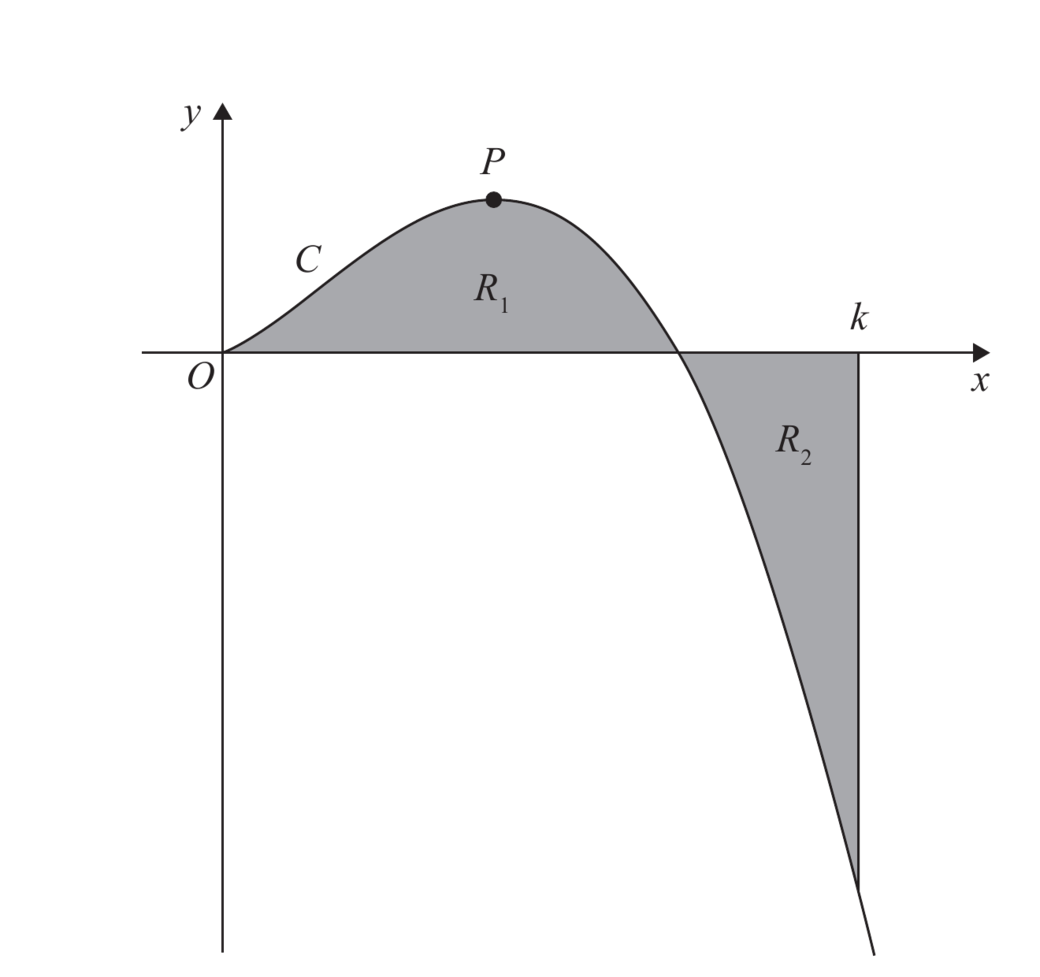
Figure 1

Figure 1 is a sketch of the curve CC with equation

y=2x32(4x)x0y=2x^{\frac32}(4-x) \qquad x\geq0

The point PP is the stationary point of CC.

(a) Find, using calculus, the xx coordinate of PP.

(4)

The region R1R_1, shown shaded in Figure 1, is bounded by CC and the xx-axis.

The region R2R_2, also shown shaded in Figure 1, is bounded by CC, the xx-axis and the line with equation x=kx=k, where kk is a constant.

Given that the area of R1R_1 is equal to the area of R2R_2

(b) find, using calculus, the exact value of kk.

(4)

解答

(a)

解法一

思路

展开

先把函数展开成幂函数之和,再求导。驻点满足 dydx=0\frac{\mathrm{d}y}{\mathrm{d}x}=0

答题过程

展开

Rewrite the curve:

y=2x32(4x)=8x322x52.\begin{align*} y=&\,2x^{\frac32}(4-x)\\ =&\,8x^{\frac32}-2x^{\frac52}. \end{align*}

Differentiate:

dydx=8(32)x122(52)x32=12x125x32.\begin{align*} \frac{\mathrm{d}y}{\mathrm{d}x} =&\,8\left(\frac32\right)x^{\frac12} -2\left(\frac52\right)x^{\frac32}\\ =&\,12x^{\frac12}-5x^{\frac32}. \end{align*}

At a stationary point,

dydx=0.\begin{align*} \frac{\mathrm{d}y}{\mathrm{d}x}=0. \end{align*}

So

12x125x32=0x12(125x)=0.\begin{align*} 12x^{\frac12}-5x^{\frac32}=&\,0\\ x^{\frac12}(12-5x)=&\,0. \end{align*}

The stationary point PP is not at x=0x=0, so

125x=0x=125.\begin{align*} 12-5x=&\,0\\ x=&\,\frac{12}{5}. \end{align*}

(b)

解法一

思路

展开

R1R_1xx-axis 上方,R2R_2xx-axis 下方。两块面积相等,表示从 00kk 的有向面积为 00

答题过程

展开

Integrate the curve:

(8x322x52)dx=165x5247x72.\begin{align*} \int \left(8x^{\frac32}-2x^{\frac52}\right)\,\mathrm{d}x =&\,\frac{16}{5}x^{\frac52} -\frac47x^{\frac72}. \end{align*}

Since the area above the xx-axis equals the area below the xx-axis,

0kydx=0.\begin{align*} \int_0^k y\,\mathrm{d}x=0. \end{align*}

So

[165x5247x72]0k=0165k5247k72=0.\begin{align*} \left[ \frac{16}{5}x^{\frac52} -\frac47x^{\frac72} \right]_0^k=&\,0\\ \frac{16}{5}k^{\frac52} -\frac47k^{\frac72}=&\,0. \end{align*}

Factorise:

k52(16547k)=0.\begin{align*} k^{\frac52}\left(\frac{16}{5}-\frac47k\right)=&\,0. \end{align*}

Since k0k\neq0,

16547k=047k=165k=16574=285.\begin{align*} \frac{16}{5}-\frac47k=&\,0\\ \frac47k=&\,\frac{16}{5}\\ k=&\,\frac{16}{5}\cdot\frac74\\ =&\,\frac{28}{5}. \end{align*}