题目
Problem
In this question you must show all stages of your working.
Solutions relying entirely on calculator technology are not acceptable.
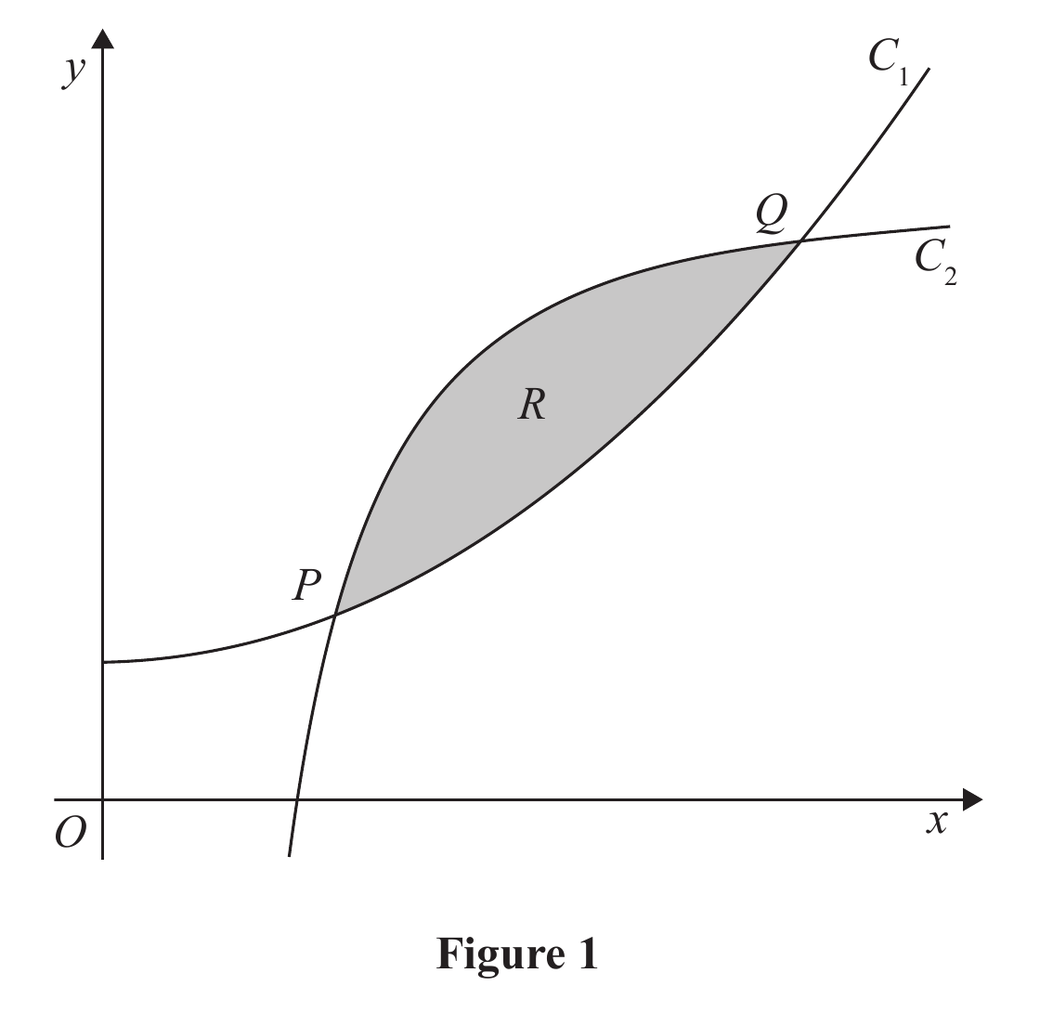
Figure 1 shows a sketch of part of the curve C1 with equation
y=x2+3,x>0
and part of the curve C2 with equation
y=13−x29,x>0
The curves C1 and C2 intersect at the points P and Q as shown in Figure 1.
(a) Use algebra to find the x coordinate of P and the x coordinate of Q.
(4)
The finite region R, shown shaded in Figure 1, is bounded by C1 and C2
(b) Use algebraic integration to find the exact area of R.
(4)
题目中文翻译
本题必须展示计算过程的所有步骤。
完全依赖计算器技术的解答不予接受。
图1给出曲线 C1 和 C2 的一部分的草图。C1 的方程为
y=x2+3,x>0
C2 的方程为
y=13−x29,x>0
两曲线相交于图1所示的点 P 和 Q。
(a) 使用代数方法求 P 和 Q 的 x 坐标。(4)
图1中阴影所示的有限区域 R 由 C1 和 C2 围成。
(b) 使用代数积分求 R 的精确面积。(4)
解答
(a)
解法一
思路
展开
交点处两个 y 相等。因为有 x29,先乘以 x2,把它化成关于 x2 的二次方程。
答题过程
展开
At the intersections,
x2+3=13−x29.
Multiply by x2:
x4+3x2=x4−10x2+9=13x2−90.
Factorise as a quadratic in x2:
(x2−1)(x2−9)=0.
So
x2=1orx2=9.
Since x>0,
x=1orx=3.
Therefore, the x coordinates of P and Q are 1 and 3.
解法二
思路
展开
不必先乘出四次式,可以把两个含 x 的倒数项直接配成两个因式,再用 x>0 求根。
答题过程
展开
At an intersection,
x2+3=x2−10+x29=13−x290.
Factorising directly,
(x−x9)(x−x1)=0.
Thus either
x−x9=x2=x=093,
or
x−x1=x2=x=011.
The negative square roots are excluded since x>0. Hence xP=1 and xQ=3.
解法三
思路
展开
先消去 x2 得到关于 y 的二次方程,求两个交点的高度,再代回 x2=y−3。
答题过程
展开
From C1, x2=y−3. Substitute this into C2:
y=13−y−39.
Since x>0, y−3=x2>0, so multiplying through is valid:
y(y−3)=y2−16y+48=(y−4)(y−12)=13(y−3)−900.
For y=4, x2=1, hence x=1.
For y=12, x2=9, hence x=3.
Therefore xP=1 and xQ=3.
(b)
解法一
思路
展开
在 1<x<3 上,上方曲线是 C2,下方曲线是 C1。面积是上减下的积分。
答题过程
展开
Between the intersections, C2 is above C1 (for example, at x=2 their heights are 43/4 and 7). Thus the area is
∫13(13−x29−(x2+3))dx.
Simplify:
13−x29−(x2+3)=10−9x−2−x2.
So
Area=====∫13(10−9x−2−x2)dx[10x+9x−1−3x3]1324−(19−31)24−356316.
Therefore, the exact area of R is
316.
也可以分别积分两条曲线后相减:
A2==A1==A=[13x+x9]13(39+3)−(13+9)=20[3x3+3x]1318−310=344A2−A1=316. 